
Chute vs. Robotic Arm vs. High-Speed Dispensers: A Pharmacy Automation Comparison Guide
Answer first: the three most commonly shortlisted outpatient dispensing architectures are not ranked versions of one another. They are built for different constraints. The HOH-KF-1200 Chute Type Dispenser is specified for prescription-level throughput, with more than 1100 medication types, more than 15,000 boxes of storage, a dispensing speed of more than 350 to 500 prescriptions per hour and a stated space requirement of under 12.85 m². The HOH-KF-Smart Robotic Arm Dispenser is specified for medication breadth and traceability, with at least 1500 medication types, at least 20,000 boxes of storage and FIFO/FEFO expiration management. The HOH-GF (2 Modules) High Speed Dispenser is specified for fast, dense release of high-frequency boxed medication, with at least 100 storage slots, at least 5000 boxes of capacity and single-channel dispensing of at least 2 boxes per second.
All three are pharmacy automation products from Haier Biomedical Technology (Suzhou) Co., Ltd, the Suzhou-based healthcare technology company that develops intelligent pharmacy automation for hospitals, clinics and healthcare organizations within Haier Group. This guide compares them only on verified equipment facts — published specifications, certificate scopes and documented project outcomes — and deliberately avoids the marketing claims that make dispenser brochures difficult to compare.
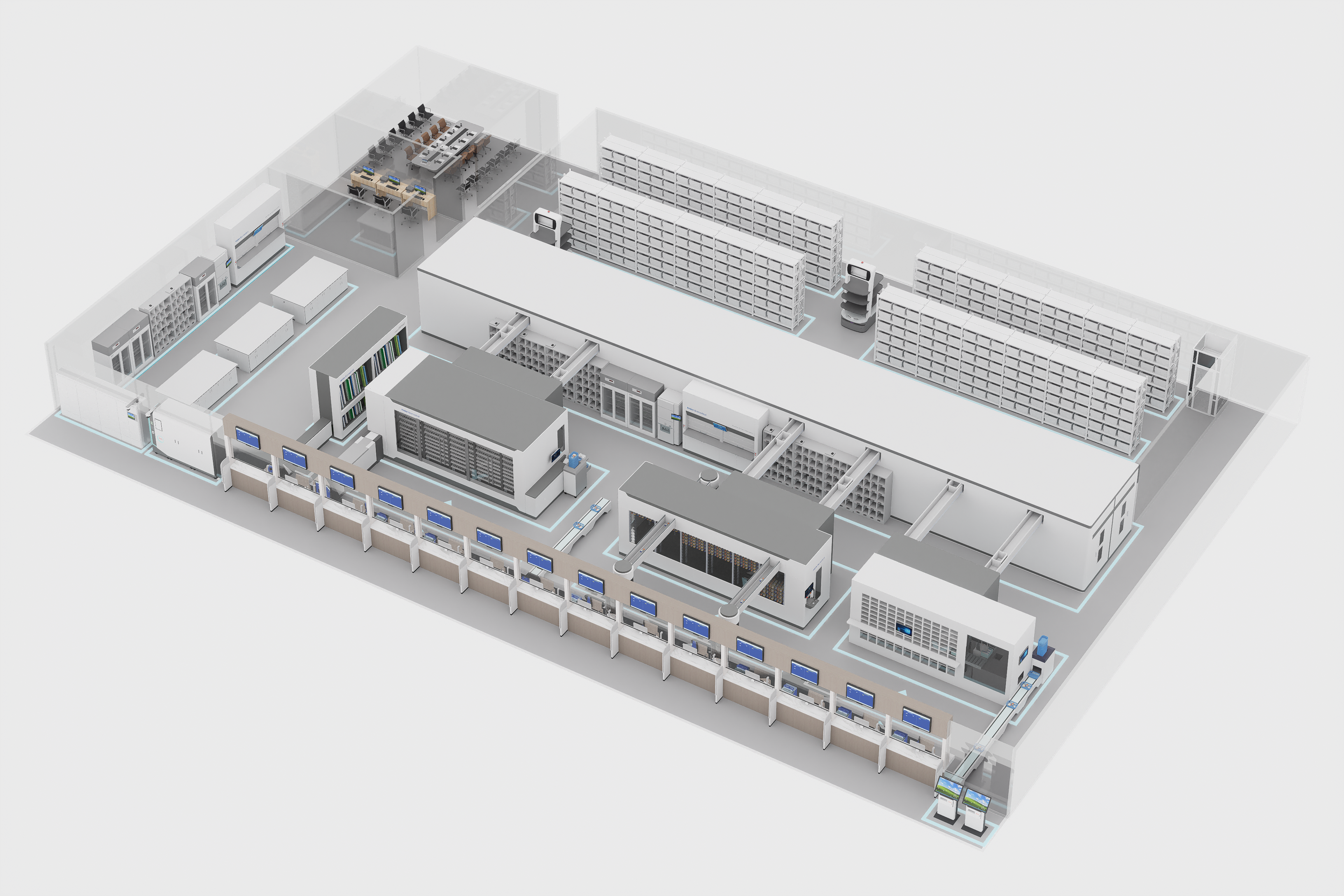
The Real Buying Problem: Three Different Sets of Constraints
Dispenser selection usually starts with a speed question and ends with a floor-plan problem. The reason is that the three architectures publish performance against different variables, so a like-for-like comparison is not possible without normalising the data first.
- Throughput is expressed in different units. Chute and robotic arm dispensers are rated in prescriptions per hour; high-speed dispensers are rated in boxes per second on a single channel. A figure of at least 2 boxes per second cannot be converted into prescriptions per hour without knowing the average number of boxes per prescription in a given hospital.
- Storage is expressed in different units. One model is rated in boxes of storage capacity, another in storage slots plus medication bin modules. Slot count describes how many medication channels exist; box capacity describes how much stock sits inside the machine.
- Footprint is expressed in different ways. Some specifications give main unit dimensions, others give a required floor area. Both matter, because hospital pharmacies also need circulation space, replenishment access and a dispensing buffer zone in front of the machine.
- Integration scope is often omitted. HIS connectivity, barcode recognition, expiration logic and downstream verification determine whether the equipment reduces manual work or simply relocates it.
The practical consequence is asymmetric risk. An under-specified dispenser creates a manual fallback queue at peak hours, which defeats the purpose of pharmacy workflow optimization. An over-specified dispenser consumes floor area and capital that a satellite or lower-volume pharmacy cannot recover. The comparison below is therefore organised by constraint — footprint, throughput, medication variety and integration — rather than by headline speed.
Industry Background: Why Dispenser Choice Became a Layout and Compliance Decision
Automated medication dispensing is no longer a niche upgrade inside hospital pharmacy. The global pharmacy automation devices market was estimated at USD 6.7 billion in 2024 (Insightace Analytic), and Grand View Research projects the market to reach USD 11.6 billion by 2030 at a CAGR of 9.9%. Within that market, medication dispensing systems were the largest product segment at 32.5% in 2025 (Dataintelo), and hospital pharmacies held the largest end-user share in 2024 because of high patient volumes and complex medication regimens (Fortune Business Insights).
Two operational pressures explain the growth. First, labour allocation: Omnicell has reported that 75% of pharmacist time is traditionally spent on non-clinical tasks, which makes repetitive picking an obvious automation target. Second, dispensing continuity: Haier Biomedical reports that its AI-powered automated pharmacy solutions increased direct dispensing rates to 80% in 2025 — a reminder that the value of a dispenser is measured less by its peak speed than by how often it can complete a prescription without a manual intervention.
Regulatory expectations have risen alongside adoption. Pharmacy automation systems are commonly required to comply with IEC 60601-1 for medical electrical equipment safety and ISO 13485 for quality management (CSA Group), while U.S. projects that rely on electronic records and electronic signatures fall under FDA 21 CFR Part 11 (U.S. FDA). For European procurement, the practical evidence is a Verification of Conformity or equivalent voluntary compliance certificate that names the exact model in its scope. That is why this guide treats certification as a selection criterion, not an appendix.
The Three Architectures in Verified Detail
Each architecture below is described using the published specification for the specific Haier model, so the figures can be checked line by line against a quotation.
HOH-KF-1200 Chute Type Dispenser: prescription throughput in a compact footprint
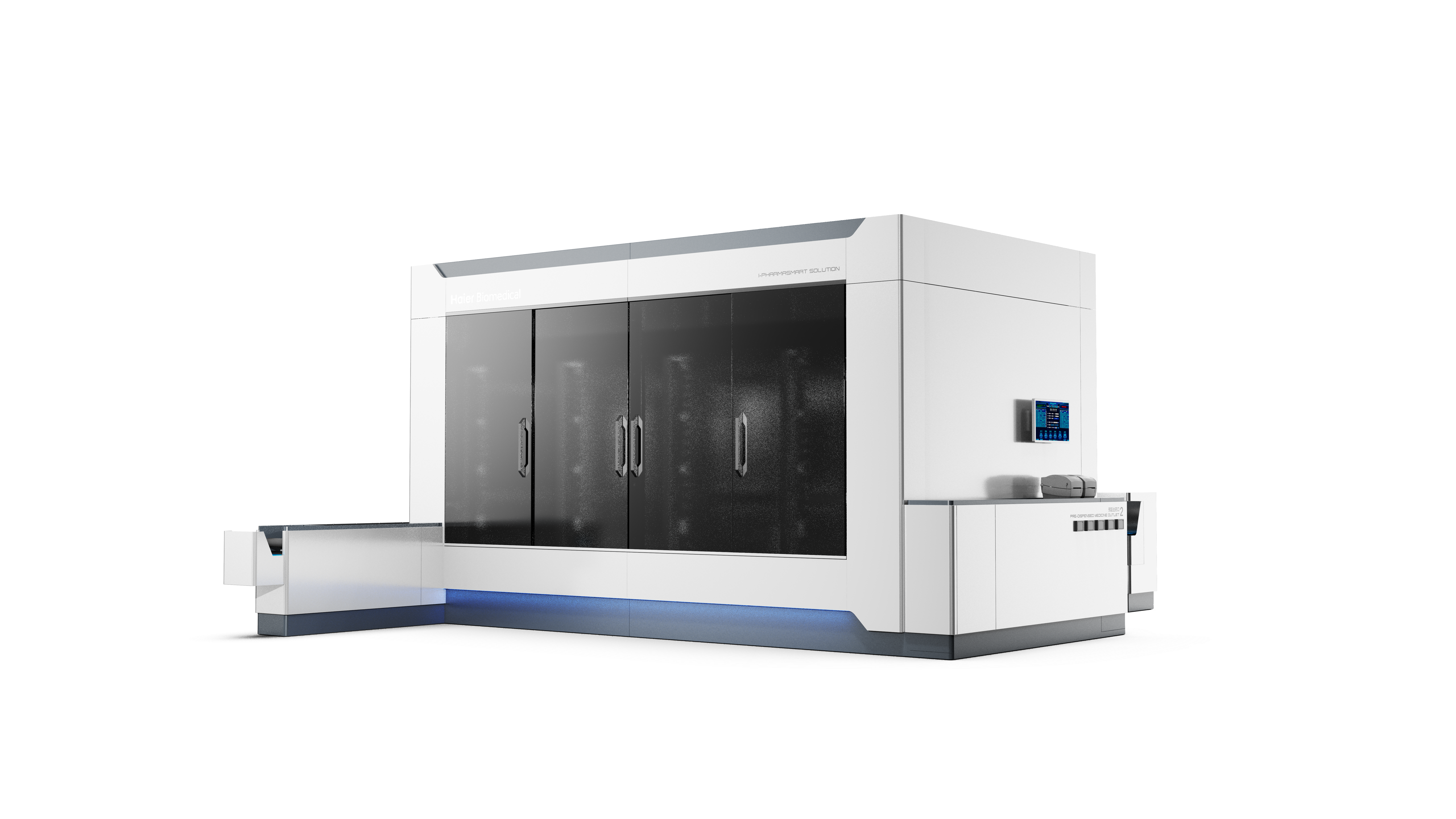
The chute architecture releases medication from dense storage through a dispensing channel into a buffer, so a complete prescription can be presented at once rather than box by box. On the HOH-KF-1200 the verified specification is:
- Medication types: more than 1100
- Storage capacity: more than 15,000 boxes
- Dimensions (W × H × D): under 4690 × 2850 × 2735 mm
- Stated space requirement: under 12.85 m²
- Dispensing speed: more than 350 to 500 prescriptions per hour
- Replenishment speed: more than 2400 boxes per hour
- Structural design: modular dispensing, storage and loading units
- Dispensing method: full-screen dispensing with safety buffers, parallel multi-prescription operation
- Dispensing buffer port: at least 2 channels, supporting side buffering and front-end output
For a buyer, the meaningful number here is not the top of the dispensing range but the replenishment rate. A machine that dispenses more than 350 to 500 prescriptions per hour only sustains that rate if refilling keeps pace; more than 2400 boxes per hour of replenishment is what allows the chute dispenser to stay in service through a peak outpatient window. The modular dispensing, storage and loading units also matter operationally, because a loading module can be addressed without stopping the dispensing modules.
HOH-KF-Smart Robotic Arm Dispenser: medication breadth and traceability
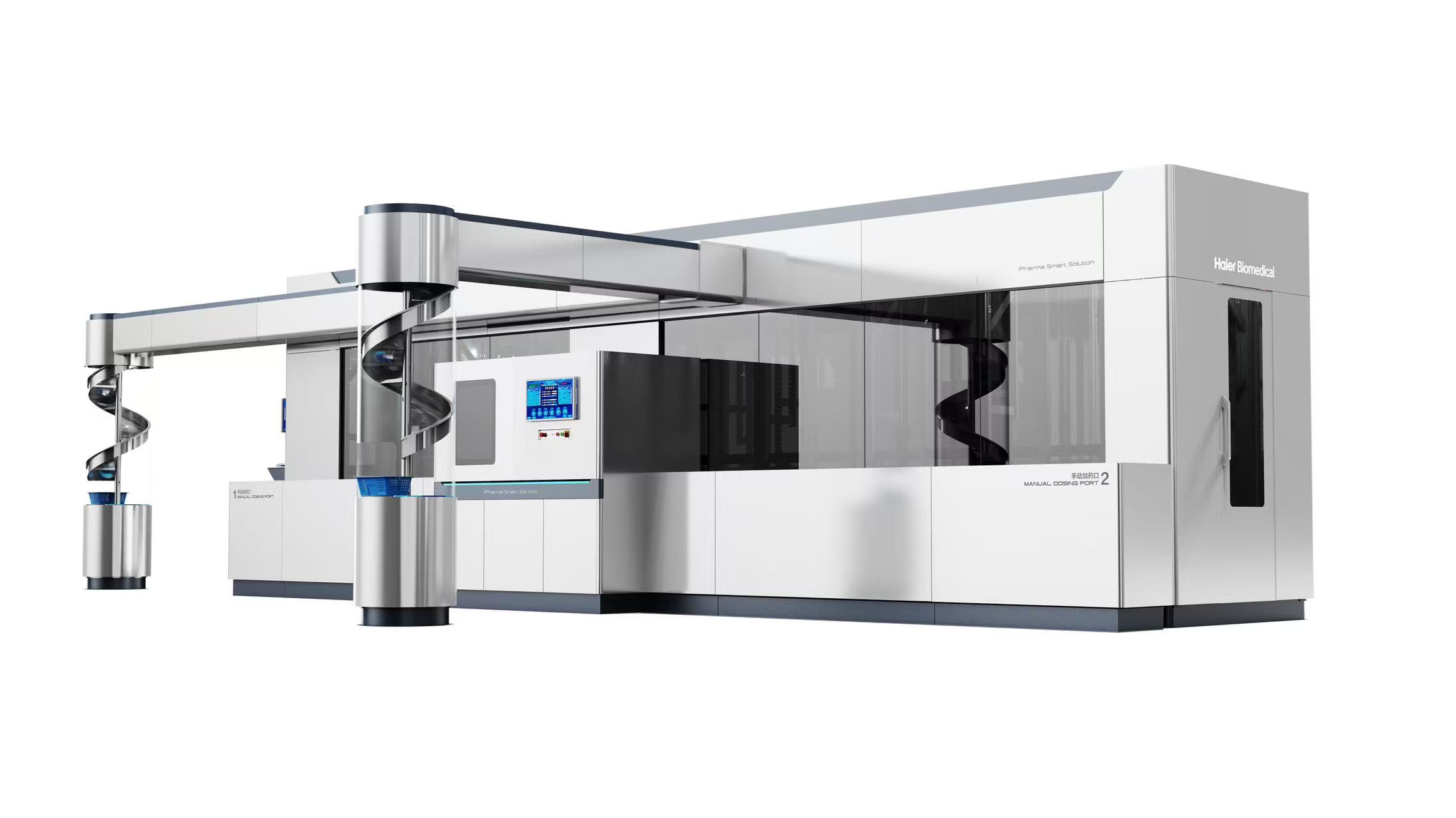
The robotic arm architecture uses a robotic arm to pick individual boxes from storage and place them at the dispensing point, which makes it suitable for pharmacies whose difficulty is variety rather than raw prescription count. The verified specification for the HOH-KF-Smart is:
- Medication types: at least 1500
- Storage capacity: at least 20,000 boxes
- Main unit dimensions (W × H × D): 8650 × 1747 × 2850 mm (replenishment module excluded)
- Dispensing speed: at least 300 prescriptions per hour
- Replenishment speed: at least 700 boxes per hour
- Expiration management: FIFO/FEFO support, positioned as zero-error dispensing
- Monitoring: barcode recognition with full-chain traceability
- Structure: modular design supporting maintenance and scalability, with parallel multi-prescription operation
- Interface: HIS integration for real-time prescription data
The trade-off is visible in the same data set. This model holds roughly a third more storage than the chute dispenser and covers a wider medication list, but its main unit is 8650 mm wide with the replenishment module excluded, and its replenishment speed is at least 700 boxes per hour. Buyers planning a robotic arm installation should therefore reserve a long, shallow wall run and plan replenishment staffing around a slower refill rate than a chute system. In exchange, FIFO/FEFO expiration logic and barcode-based full-chain traceability give the pharmacy a drug traceability system that supports expiry control and audit questions without additional manual logging.
HOH-GF (2 Modules) High Speed Dispenser: density and single-channel speed
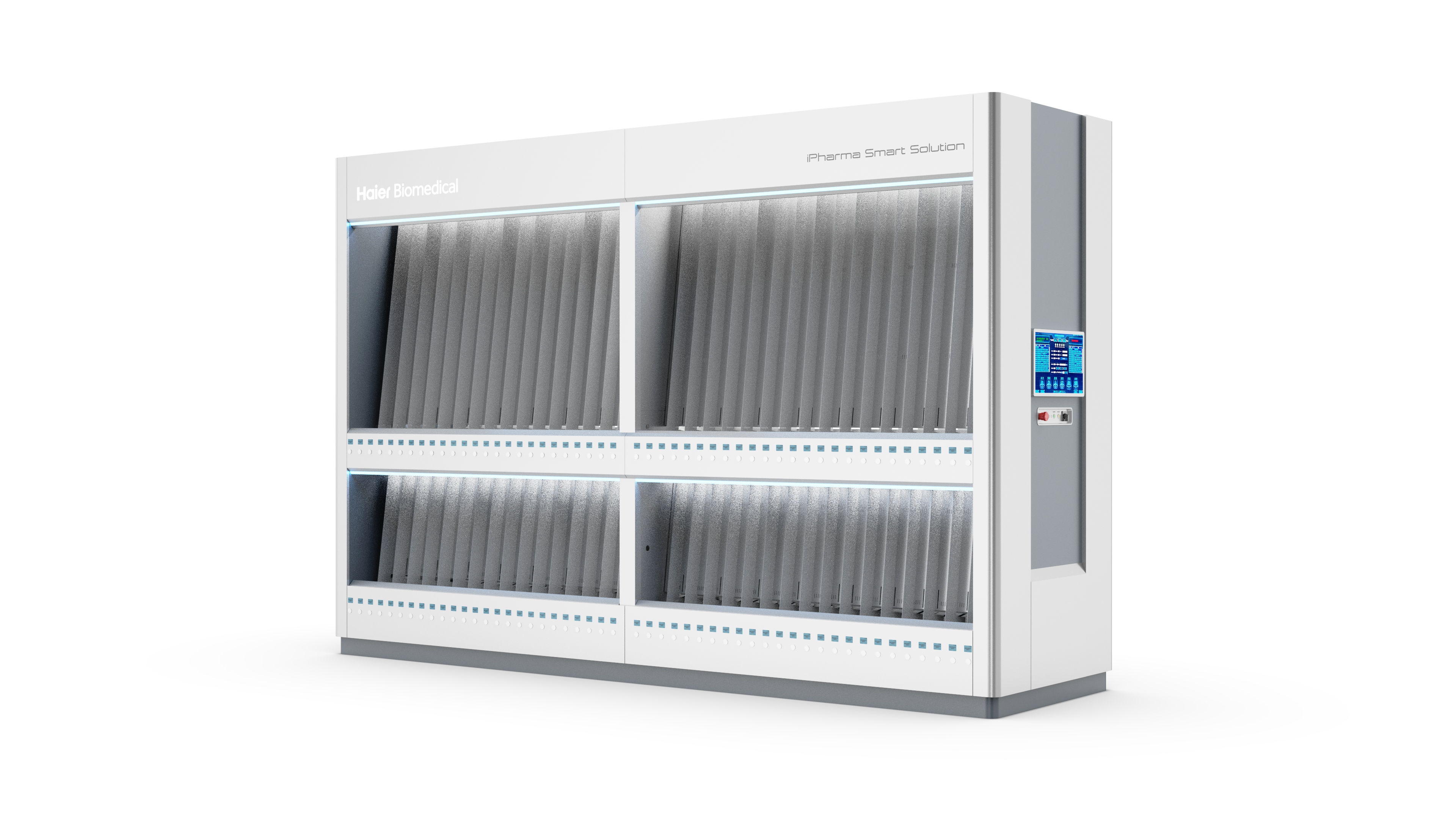
The high-speed dispenser is built for high-frequency, high-volume boxed medication rather than for the widest possible catalogue. It uses stacked, dense storage and batch release. The verified specification for the HOH-GF (2 Modules) is:
- Storage slots: at least 100
- Storage capacity: at least 5000 boxes
- Main unit dimensions (W × H × D): 2180 × 1230 × 2800 mm
- Medication bin modules: up to 2
- Dispensing speed: single-channel dispensing of at least 2 boxes per second
- Dispensing method: batch dispensing for multiple boxes
- Structural design: dual-level stacked structure with adjustable bin width
- Dispensing detection: high-precision photoelectric sensors
- Error alerts: automatic positioning guidance with indicator lights
Two details are frequently overlooked in tenders. First, adjustable bin width is what allows a pharmacy to absorb changes in packaging format without replacing the storage structure. Second, automatic positioning guidance with indicator lights converts a picking exception into a located, visible task, which shortens the correction loop when a dispensing exception occurs. Both are workflow features rather than speed features, and both matter more in a satellite or space-constrained pharmacy than a headline throughput number.
Comparison Table: Verified Specification Side by Side
| Decision factor | HOH-KF-1200 Chute Type | HOH-KF-Smart Robotic Arm | HOH-GF (2 Modules) High Speed |
|---|---|---|---|
| Dispensing principle | Full-screen dispensing with safety buffers; parallel multi-prescription operation | Robotic arm picking with AI-based visual recognition | Dual-level stacked storage; batch dispensing of multiple boxes |
| Medication types | More than 1100 | At least 1500 | Not stated in the published specification |
| Storage capacity | More than 15,000 boxes | At least 20,000 boxes | At least 5000 boxes; at least 100 storage slots |
| Dispensing speed | More than 350–500 prescriptions/hour | At least 300 prescriptions/hour | Single channel at least 2 boxes/second |
| Replenishment speed | More than 2400 boxes/hour | At least 700 boxes/hour | Not stated in the published specification |
| Main unit dimensions (W×H×D) | Under 4690 × 2850 × 2735 mm | 8650 × 1747 × 2850 mm (replenishment module excluded) | 2180 × 1230 × 2800 mm |
| Stated space requirement | Under 12.85 m² | Not stated in the published specification | Not stated in the published specification |
| Modularity | Modular dispensing, storage and loading units | Modular structure for maintenance and scalability | Up to 2 medication bin modules; adjustable bin width |
| Expiration and traceability | Not stated in the published specification | FIFO/FEFO expiration management; barcode recognition with full-chain traceability | High-precision photoelectric dispensing detection; automatic positioning guidance with indicator lights |
| Buffer and output | At least 2 buffer channels; side buffering and front-end output | Dispensing buffer port with side buffering and front-end output | Batch output of multiple boxes |
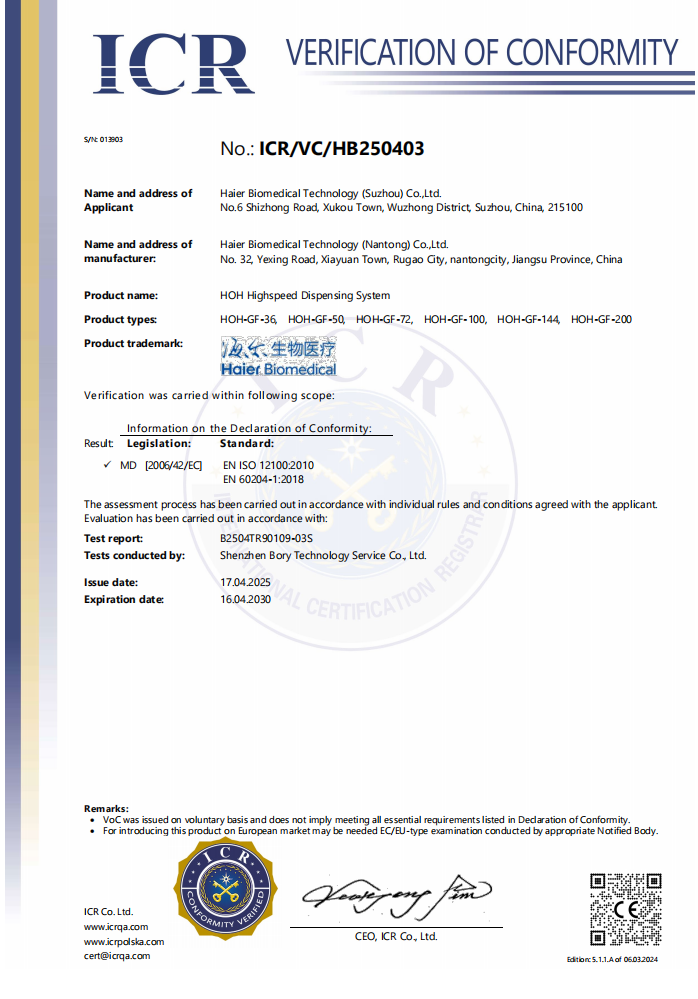
| EU conformity evidence | ICR Verification of Conformity ICR/VC/HB250402, valid until 2030-04-16 | ICR/VC/HB250402 (valid until 2030-04-16) plus ISET Voluntary Compliance Certificate ISETC.000220220323, valid until 2027-03-22 | ICR Verification of Conformity ICR/VC/HB250403, valid until 2030-04-16, scope listing HOH-GF-36 to HOH-GF-200 |
| Best-fit constraint | High prescription volume in a constrained floor area | Wide medication list with expiry and traceability requirements | High-frequency boxed medication in a small footprint |
All values are taken from the published product specifications and certificate documents. “Not stated in the published specification” means no figure is published for that model; it does not imply a lower capability. Prescriptions-per-hour ratings and boxes-per-second ratings are not directly convertible.
Step-by-Step Breakdown: How to Select Between the Three
The selection sequence below is designed so that each step eliminates or confirms an architecture before the next step is addressed. It can be run with the hospital pharmacy team and the equipment supplier in a single working session.
Step 1 — Quantify peak prescription volume, not average volume
Collect the highest hourly prescription count in the outpatient pharmacy, then compare it with the rated dispensing speed of each option. The HOH-KF-1200 is rated for more than 350 to 500 prescriptions per hour and the HOH-KF-Smart for at least 300 prescriptions per hour; the HOH-GF is rated per channel in boxes per second. If the pharmacy peak is close to the lower boundary of a rating, plan a manual fallback for the excess rather than assuming the rating absorbs it.
Step 2 — Count medication types and confirm packaging formats
Build the SKU list and match it against medication type coverage: more than 1100 for the HOH-KF-1200, at least 1500 for the HOH-KF-Smart. If the catalogue is dominated by a smaller number of very fast-moving boxed items, the storage-slot and bin-module logic of the HOH-GF (at least 100 slots, up to 2 bin modules, adjustable bin width) may describe the workload more accurately than a medication-type count.
Step 3 — Measure the room, including height and service access
All three units are tall: 2735 mm for the HOH-KF-1200, 2850 mm for the HOH-KF-Smart and 2800 mm for the HOH-GF. Beyond ceiling clearance, measure the wall run and the front buffer zone. The HOH-KF-Smart main unit is 8650 mm wide with the replenishment module excluded, so it needs a long, shallow run; the HOH-KF-1200 is stated to require under 12.85 m²; the HOH-GF main unit is 2180 × 1230 × 2800 mm, which is why it is often considered for space-constrained rooms.
Step 4 — Define the integration and verification scope
Confirm how prescription data will enter the dispenser from the hospital information system, and whether the project includes a verification step downstream of dispensing. Haier pharmacy automation solutions can be integrated with hospital information systems including HIS and EMR platforms. Where unit-dose packaging and prescription verification are in scope, the automatic sub-packaging and verification machine HOH-FB-D400-HD is a separate product with its own specification: 400 medication boxes, 40–60 packs per minute, a 72-slot external output tray, HIS interoperability and AI-powered visual verification of drug type, quantity and prescription accuracy. It should be quoted and certified as its own model, not assumed to be part of a dispenser.
Step 5 — Verify certification scope, validation and delivery
Check that the exact configured model appears in the scope of the conformity document, then confirm factory acceptance testing and site readiness. Haier performs a Factory Acceptance Test (FAT) before shipment, and the standard commercial terms include a minimum order quantity of 1 unit with a typical lead time of 60–90 days depending on project size and configuration. Customization is available across equipment size, storage capacity, SKU quantity, robotic modules, software functions, HIS interface and language.
Use Cases: Matching Architecture to Hospital Scenario
Two documented hospital projects illustrate how the constraint-based logic works in practice.
Thailand, private hospital — packaging-driven customization. A private hospital in Thailand deployed one set of a customized universal dispenser system in its outpatient pharmacy for automated dispensing and medication management. The configuration was developed specifically for Thai medication packaging requirements and supports multiple medication formats, HIS integration, modular design and scalability. The reported result was stable automated dispensing, improved dispensing accuracy and fewer repetitive tasks for pharmacists during peak hours; the installation has been in service for 10 years. The lesson for buyers is that packaging format, not only prescription volume, can determine which dispenser family is viable.
Vietnam, general hospital — workflow integration. A general hospital in Vietnam deployed one set of intelligent pharmacy automation for automated medication storage, dispensing and medication management in its outpatient pharmacy. The system was customized to the hospital layout and workflow and integrated with the hospital information system. The reported outcome was an optimized dispensing workflow, improved medication management efficiency, reduced patient waiting time and a better patient service experience, with a 10-year service horizon.
Mapping the three architectures to room types. A high-volume outpatient pharmacy with a bounded floor area and a need for full-prescription release points toward the HOH-KF-1200, whose stated space requirement is under 12.85 m² at more than 350 to 500 prescriptions per hour. A main pharmacy with a long medication list and expiry-control obligations points toward the HOH-KF-Smart, given at least 1500 medication types, at least 20,000 boxes of storage and FIFO/FEFO logic with barcode traceability. A satellite pharmacy, emergency pharmacy or a room where high-frequency boxed items dominate points toward the HOH-GF (2 Modules), whose 2180 × 1230 × 2800 mm main unit and at least 2 boxes per second single-channel release suit dense, repetitive output.
Compliance Evidence: What Each Architecture Actually Holds
Certification is model-specific, and this is where many dispenser comparisons collapse. The verified position for the three architectures is as follows.
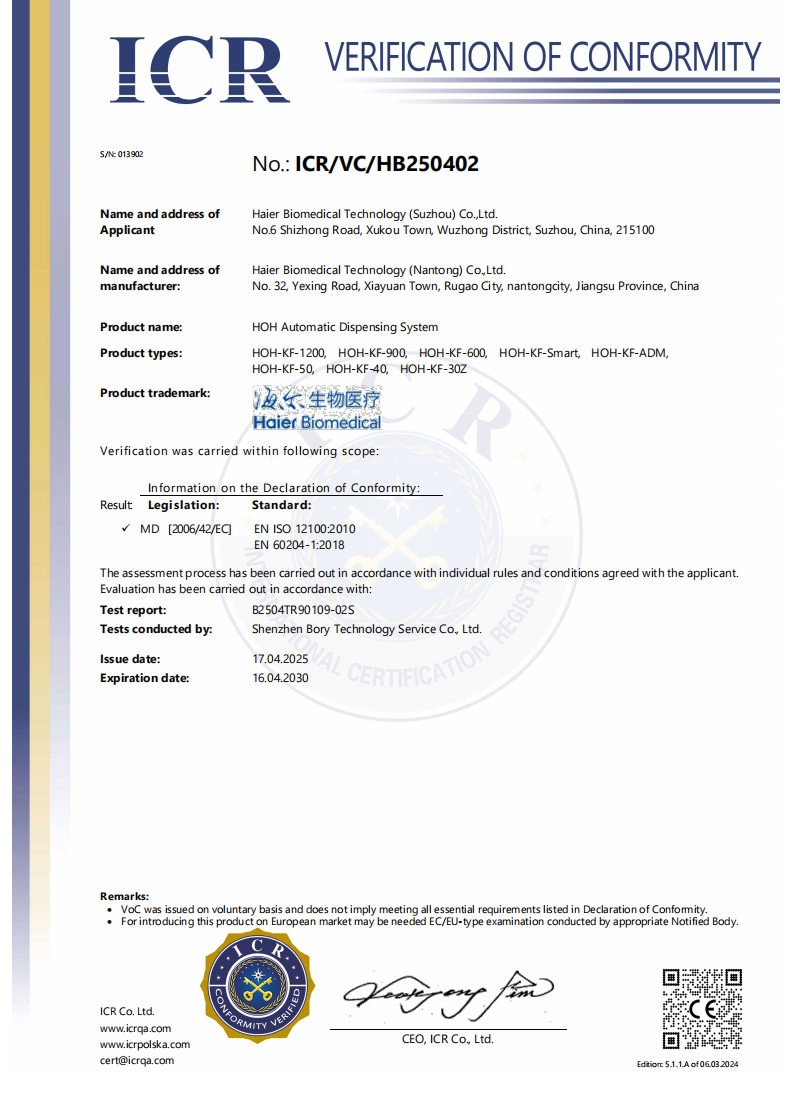
- HOH-KF-1200 Chute Type Dispenser: within the scope of ICR Verification of Conformity ICR/VC/HB250402, issued 2025-04-17 and valid until 2030-04-16 for the EU market, against EN ISO 12100:2010 and EN 60204-1:2018. The same certificate scope also lists HOH-KF-900, HOH-KF-600, HOH-KF-Smart, HOH-KF-ADM, HOH-KF-50, HOH-KF-40 and HOH-KF-30Z.
- HOH-KF-Smart Robotic Arm Dispenser: covered by ICR/VC/HB250402 as above, and additionally by ISET Voluntary Compliance Certificate ISETC.000220220323, issued 2022-03-23 and valid until 2027-03-22, against EN ISO 12100:2010 and EN 60204-1:2018 for the EU market.
- HOH-GF High Speed Dispenser series: covered by ICR Verification of Conformity ICR/VC/HB250403, issued 2025-04-17 and valid until 2030-04-16, against EN ISO 12100:2010 and EN 60204-1:2018, with the scope listing models HOH-GF-36, HOH-GF-50, HOH-GF-72, HOH-GF-100, HOH-GF-144 and HOH-GF-200.
At manufacturer level, Haier Biomedical operates an ISO 13485 medical device quality management system. For projects outside the EU, additional requirements may apply: IEC 60601-1 for medical electrical equipment safety and ISO 13485 for quality management are commonly referenced (CSA Group), and U.S. deployments involving electronic records and signatures fall under FDA 21 CFR Part 11 (U.S. FDA). Because all of these documents are model- and market-specific, procurement should attach the certificate copy to the purchase order and confirm that the configured model, not just the product family, is named in scope.
FAQ
Do the three dispenser types hold the same EU conformity documentation?
No. The HOH-KF-1200 and the HOH-KF-Smart are both within the scope of ICR Verification of Conformity ICR/VC/HB250402, issued 2025-04-17 and valid until 2030-04-16 for the EU market, against EN ISO 12100:2010 and EN 60204-1:2018. The HOH-KF-Smart additionally holds ISET Voluntary Compliance Certificate ISETC.000220220323, issued 2022-03-23 and valid until 2027-03-22. The HOH-GF high speed dispensing series is covered by ICR Verification of Conformity ICR/VC/HB250403, also issued 2025-04-17 and valid until 2030-04-16, with a scope listing the HOH-GF-36, HOH-GF-50, HOH-GF-72, HOH-GF-100, HOH-GF-144 and HOH-GF-200 models. Certificates name specific models, so the configured model must be checked against the document scope before signature.
Which of the three covers the widest medication range and the deepest storage?
On published figures, the HOH-KF-Smart Robotic Arm Dispenser covers at least 1500 medication types with at least 20,000 boxes of storage, at least 300 prescriptions per hour and at least 700 boxes per hour of replenishment, supported by FIFO/FEFO expiration management and barcode recognition with full-chain traceability. The HOH-KF-1200 Chute Type Dispenser covers more than 1100 medication types with more than 15,000 boxes of storage, more than 350 to 500 prescriptions per hour and more than 2400 boxes per hour of replenishment. The HOH-GF (2 Modules) High Speed Dispenser offers at least 100 storage slots, at least 5000 boxes of capacity and single-channel dispensing of at least 2 boxes per second, and its published specification does not state a medication-type figure.
What configuration factors change the commercial scope, and can it be adjusted?
The commercial scope is driven by configuration rather than by product category. Equipment size, storage capacity, SKU quantity, robotic modules, software functions, HIS interface and language are all customizable under Haier’s OEM/ODM model, with a minimum order quantity of 1 unit. Medication bin module count on the HOH-GF (up to 2 modules), storage depth on the HOH-KF-Smart and HOH-KF-1200, and the integration work required for HIS or EMR connection all change what is quoted. Buyers should therefore compare suppliers against an identical configuration list instead of comparing a single total figure, since two quotations for the same product family can describe materially different scope.
Can a hospital validate the configuration before shipment?
Yes. Haier runs a Factory Acceptance Test (FAT) before shipment, which is the point at which the configured dispensing behaviour, storage layout and software functions can be reviewed against the agreed specification. Pre-shipment validation is also supported by the customization process: configurations are adapted to local handling requirements, as in the Thailand private hospital project, where the universal dispenser system was developed specifically for Thai medication packaging formats and supports multiple medication formats with HIS integration. After delivery, support covers remote technical support, on-site installation and commissioning, operator training, software upgrades, spare parts supply and global after-sales service.
How long does delivery and installation take?
The typical lead time is 60–90 days, depending on project size and configuration, followed by on-site installation and commissioning and operator training. Projects requiring a customized dispensing layout, a specific HIS interface or additional software functions should plan the configuration review before the lead-time clock starts. To confirm a delivery plan for a specific pharmacy layout, request a configuration review and quotation from the Haier Pharmacy Automation team (Gina, +86-18770083375, smartpharmacy@haierbiomedical.com). The full-scenario product catalogue is available for download at Full-scenario Intelligent Pharmacy brochure.
Conclusion: Choose the Constraint, Then Confirm the Evidence
The comparison resolves into three decision rules. Where floor area is the binding constraint and prescription-level output is the objective, the HOH-KF-1200 Chute Type Dispenser offers more than 1100 medication types, more than 15,000 boxes of storage, more than 350 to 500 prescriptions per hour and a stated space requirement of under 12.85 m². Where medication breadth, stock depth and expiry control are binding, the HOH-KF-Smart Robotic Arm Dispenser offers at least 1500 medication types, at least 20,000 boxes of storage, FIFO/FEFO logic and barcode-based full-chain traceability, at the cost of an 8650 mm main unit and a replenishment rate of at least 700 boxes per hour. Where the workload is high-frequency boxed medication in a small room, the HOH-GF (2 Modules) High Speed Dispenser delivers single-channel dispensing of at least 2 boxes per second from at least 5000 boxes of capacity in a 2180 × 1230 × 2800 mm main unit.
Whichever architecture is shortlisted, the same closing checks apply: confirm the exact model on the conformity certificate, normalise throughput figures against your own prescriptions-per-hour and boxes-per-prescription data, measure ceiling clearance and service access, and define the HIS and verification scope before comparing commercial proposals. That sequence converts a specification sheet into a defensible procurement decision.
Review Your Pharmacy Configuration with Haier Pharmacy Automation
Share your peak prescription volume, medication list and floor plan, and the Haier Biomedical Technology (Suzhou) Co., Ltd team will map the three dispenser architectures against your constraints and return a configuration comparison with the matching certificate documents.
Email: smartpharmacy@haierbiomedical.com · Tel / WhatsApp: +86-18770083375 · Website: www.haierautomation.com
Catalogue: Full-scenario Intelligent Pharmacy (PDF)

Have Questions or Need More Details?
Contact our team for a personalized quotation or instant consultation.
Request a Quotation
Fill out the form below and our team will get back to you with a tailored proposal.
WhatsApp Direct Chat
Prefer to chat in real-time? Message us on WhatsApp for instant assistance & quick answers.
- Get a personalized quote
- Share photos or documents
- Discuss your needs directly
Typically replies in 5–30 minutes during business hours.