
What Is a Robotic Arm Dispenser? Role in Hospital Pharmacy
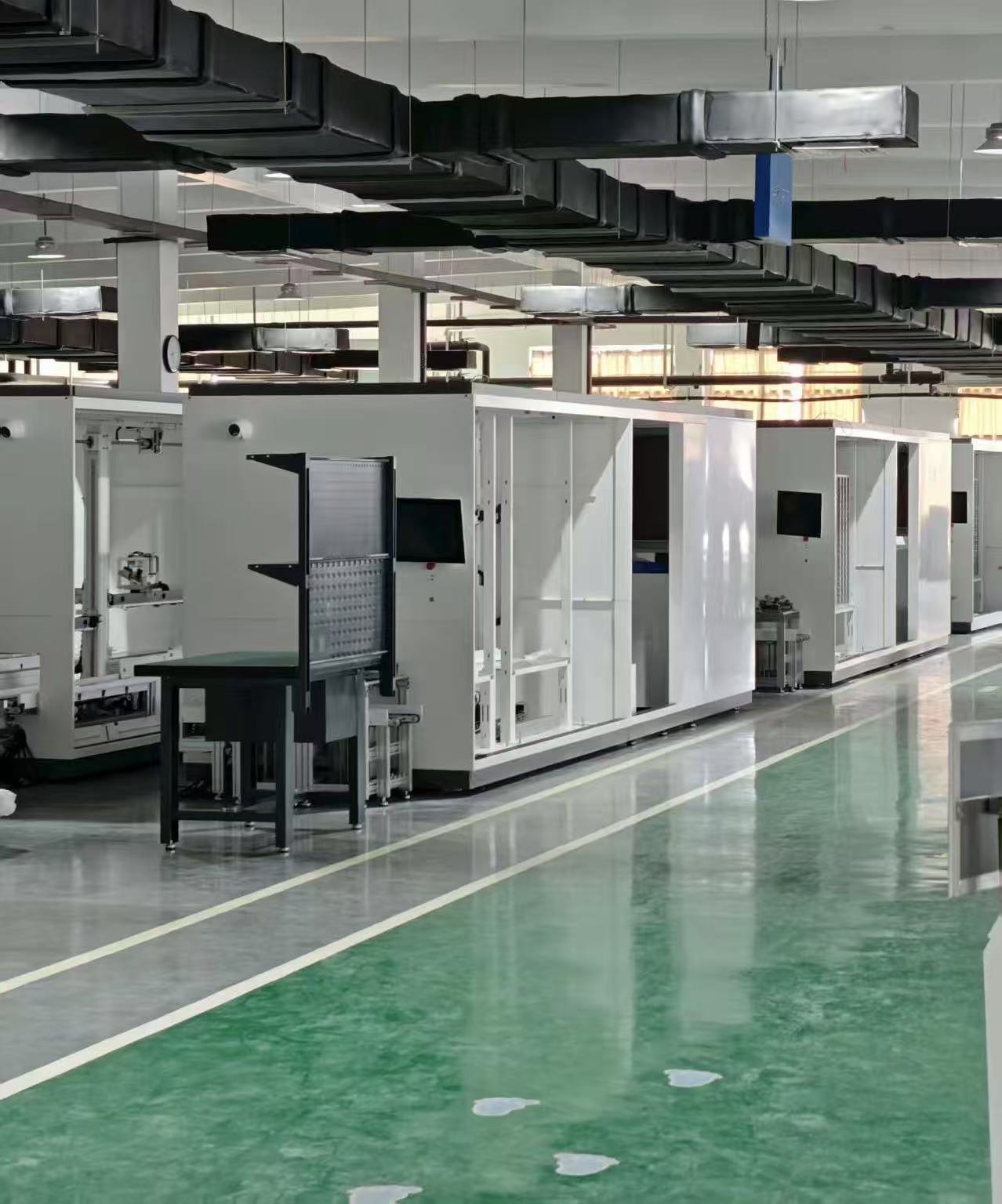
A robotic arm dispenser is a pharmacy automation system in which a robotic arm performs the physical picking and placing of boxed medications, carrying each pack between its configured storage position and the dispensing point on instruction from the pharmacy software. It is a distinct category from chute-type dispensers and carousel systems, because the arm, rather than gravity or a rotating shelf, does the handling. Haier Biomedical Technology (Suzhou) Co., Ltd supplies this category through the Robotic Arm Dispenser HOH-KF-Smart, a robotic arm medication dispensing system specified for at least 1,500 medication types, at least 20,000 boxes of storage and at least 300 prescriptions per hour.
Haier Biomedical Technology (Suzhou) Co., Ltd is a Suzhou-based healthcare technology company under Haier Group that develops intelligent pharmacy automation solutions for hospitals, clinics and healthcare organizations, covering medication storage, automated dispensing, medication verification, inventory management, IV compounding automation and digital pharmacy workflow optimization. Its pharmacy portfolio includes outpatient automated dispensing systems, inpatient pharmacy automation systems and automated PIVAS systems, and the company operates under an ISO 13485 medical device quality management system.
Problem Definition: The Handling Problem Robotic Dispensing Addresses
The operational problem a robotic arm dispenser targets is not prescribing and it is not clinical judgement. It is handling. A hospital pharmacy that dispenses a large volume of boxed medication repeats the same physical routine hundreds of times per shift: read the prescription line, locate the shelf position, confirm the pack, pick it, place it in a basket or bin, and pass it forward for a final check. Every repetition consumes staff time and introduces a small opportunity for a picking mistake.
The scale of that time cost is widely discussed in industry literature. Omnicell has reported that 75% of pharmacist time is traditionally spent on non-clinical tasks, and pharmacy automation is commonly positioned as a way to shift that balance. Haier's own explanation follows the same logic: automated dispensing equipment receives dispensing instructions, identifies the corresponding medication storage location or dispensing unit, and performs the configured dispensing operation, so that repetitive medication picking and dispensing move from manual operation to automated equipment.
Accuracy is the second half of the problem. Pharmacy automation can reduce the amount of repetitive manual picking and standardise the dispensing workflow. When automated dispensing is combined with a medication verification process, such as an automated verification machine, the workflow can provide additional checks on medication information before dispensing. That is an important framing for buyers: automation changes who performs the handling step and how consistently it is performed, while verification adds a separate checking layer on top of it.
Decision rule. Robotics addresses the volume of physical handling. It does not replace prescription review, clinical judgement or the verification step. Hospitals that expect one system to deliver all three usually end up with a poorly scoped project.
Industry Background: Where Robotic Dispensing Sits in Pharmacy Automation
Robotic arm dispensing is a segment inside a market that has been growing steadily. Insightace Analytic estimated the global pharmacy automation devices market at USD 6.7 billion in 2024, while Grand View Research projected the global pharmacy automation market to reach USD 11.6 billion by 2030, growing at a CAGR of 9.9%.
Published estimates are not identical. Openly available 2024 market size figures range from roughly USD 6.65 billion to USD 7.52 billion depending on whether secondary services and software components are included, so procurement teams should treat any single headline number as an order-of-magnitude reference rather than a precise figure.
The structure of the market matters more than its total size for anyone evaluating a robotic arm dispenser. Fortune Business Insights reported that the hospital pharmacy segment held the largest market share in 2024, driven by high patient volumes and complex medication regimens. Dataintelo reported that medication dispensing systems accounted for the largest product segment share at 32.5% in 2025. In other words, the dominant buying centre is the hospital pharmacy, and the dominant product category is dispensing equipment, which is exactly where robotic arm systems compete.
The practical consequence is that most hospital buyers are comparing systems inside the same product segment but across different mechanical architectures. That is why category clarity, rather than marketing positioning, is the first thing to establish in an evaluation.
Definition and Category Boundaries: What a Robotic Arm Dispenser Is, and What It Is Not
A robotic arm dispenser is best defined by its handling mechanism. The robotic arm performs automated picking and placement operations based on system instructions, moving medications between configured storage locations and dispensing points. Storage is organised as positions that the system can address individually, and the arm is the transport mechanism between those positions and the output.
A chute-type dispenser works differently. Medication is released from a storage position and travels to the output through a chute structure, which is why chute platforms are described in terms of drop patterns, buffers and parallel prescription streams rather than robotic picking. A carousel dispenser is different again: it combines structured medication storage with automated access, identifying the required medication position and rotating or moving the storage structure to bring that position to the dispensing point. An automated dispensing cabinet is a decentralised storage and access device rather than a centralised prescription dispensing line.
Three misconceptions that distort hospital comparisons
- Misconception 1: any automated dispenser is a robotic arm dispenser. It is not. A chute dispenser and a carousel dispenser are both automated, and neither is driven by robotic pick-and-place handling.
- Misconception 2: performance figures transfer between architectures. They do not. In Haier's published specifications, the modular dispensing, storage and loading unit structure, full-screen dispensing with safety buffers, parallel multi-prescription operation and a dispensing buffer port of at least 2 channels are attributes of the Chute Type Dispenser HOH-KF-1200. The Robotic Arm Dispenser HOH-KF-Smart is specified separately, and its specification should be read on its own terms.
- Misconception 3: robotics removes the need for verification. Haier's position is that automation reduces manual picking steps while the verification process provides an additional layer of medication checking.
Getting these boundaries right matters commercially, because it determines which throughput figure, which footprint and which output design a hospital is actually buying.
How the HOH-KF-Smart Works: Modules, Capacity and Control
The HOH-KF-Smart is Haier's robotic arm medication dispensing system. It is intended for hospitals that handle a relatively large number of boxed medications and require automated storage and dispensing, and it can be configured with multiple modules and integrated into the overall pharmacy workflow according to medication volume, available space and dispensing requirements.
Published specification at a glance
| Parameter | Specified value |
|---|---|
| System type | Robotic arm medication dispensing system |
| Medication types | ≥1,500 |
| Storage capacity | ≥20,000 boxes |
| Main unit dimensions (W×H×D) | 8,650 × 1,747 × 2,850 mm (replenishment module excluded) |
| Dispensing speed | ≥300 prescriptions per hour |
| Replenishment speed | ≥700 boxes per hour |
| Expiration management | FIFO/FEFO support |
| Full-chain monitoring | Barcode recognition with full traceability |
Two numbers deserve particular attention in an evaluation. The 8,650 mm main unit width, stated with the replenishment module excluded, means the footprint decision has to be made early and against a real room drawing rather than against a generic floor plan. The ≥700 boxes per hour replenishment speed is the figure that governs how long the system is offline during restocking and how much of the refill cycle can run alongside dispensing.
From HIS prescription to dispensed box
Haier pharmacy automation solutions can be integrated with hospital information systems to support automated prescription processing and dispensing workflows. Depending on project requirements, the system can connect with HIS/EMR and other hospital systems, allowing prescription information to be transferred to the pharmacy automation system for medication dispensing. The hospital system sends prescription information through the defined interface, and the pharmacy automation system processes the prescription according to configured dispensing rules and equipment workflows.
The mechanism is straightforward but worth stating precisely, because it explains where most integration risk sits. The equipment receives a dispensing instruction, identifies the corresponding medication storage location or dispensing unit, and performs the configured dispensing operation. Everything downstream of that instruction depends on the accuracy of the interface definition, and HIS interface plus interface language are, in Haier's OEM and ODM scope, explicitly customisable items.
Medication identification, traceability and expiry control
Barcode recognition with full traceability is specified across the dispensing chain, which is what makes medication identification auditable rather than assumed. Combined with FIFO/FEFO expiration management support, the system gives the pharmacy two controls that are difficult to maintain manually at high volume: each pack can be traced through the process, and stock rotation can follow first-expired-first-out logic rather than shelf proximity.
Haier's selection guidance states that for pharmacies handling a large volume of boxed medications where dispensing accuracy is a key priority, the robotic arm dispenser can be considered, offering dispensing accuracy of up to 99%.
Parallel prescription handling and the output design question
Throughput in a hospital pharmacy is rarely limited by the speed of a single pick. It is limited by whether the system can work on the next prescription before the previous one has been collected. Systems that handle this well decouple the picking sequence from the handover point, so that consecutive prescriptions do not collide at the output.
In Haier's published specifications, this decoupling is described in detail for the chute platform: the HOH-KF-1200 uses a dispensing buffer port of at least 2 channels, supporting side buffering and front-end output, within a parallel multi-prescription operation design. That specification is a useful benchmark for the question a buyer should ask of any robotic arm dispenser: how many output or buffer positions are configured in this project, and what happens at the output when two prescriptions finish within seconds of each other. On the HOH-KF-Smart, output and buffer configuration is a project-level design item and should be confirmed against the proposed layout, alongside the ≥300 prescriptions per hour dispensing speed and ≥700 boxes per hour replenishment speed that the specification does state.
Step-by-Step Breakdown: From Prescription to Handover
- Prescription capture. The hospital information system sends prescription information through the defined interface to the pharmacy automation system.
- Rule-based processing. The automation system processes the prescription according to configured dispensing rules and equipment workflows.
- Position identification. The system identifies the corresponding medication storage location or dispensing unit for each line.
- Robotic picking. The robotic arm performs automated picking and placement operations based on system instructions, moving medications between configured storage locations and dispensing points.
- Identification and traceability. Barcode recognition supports full traceability as the item moves through the chain.
- Expiry logic. FIFO/FEFO expiration management support governs which pack is selected where rotation applies.
- Output and handover. Dispensed items are released at the configured output, where the buffer and channel design determines how smoothly consecutive prescriptions are separated.
- Replenishment loop. Restocking runs at the specified ≥700 boxes per hour on the HOH-KF-Smart, and the replenishment module sits outside the 8,650 mm main unit dimension.
- Verification. Where the workflow includes an automated verification machine, the dispensed medication is checked against the relevant information according to the configured workflow before handover.
Use Cases: Where Robotic Arm Dispensing Fits Best
Outpatient pharmacies with a large boxed-medication profile
The clearest fit is an outpatient pharmacy where the majority of prescriptions are boxed medication and the daily prescription count is high enough that manual picking consumes a meaningful share of staff time. Haier frames the category for exactly this condition: a relatively large number of boxed medications requiring automated storage and dispensing, with the configuration set by medication volume, available space and dispensing requirements.
Hospitals that need model-level customisation
Packaging formats differ by market, and a system that cannot accommodate local formats will underperform regardless of its nominal capacity. Haier's Thailand project illustrates the pattern: a private hospital received one set of a customised universal dispenser system for its outpatient pharmacy, developed specifically for Thai medication packaging requirements and compatible with various medication formats, with modular design and HIS integration supporting dispensing efficiency during peak hours. The project has been running for 10 years.
Hospitals where HIS integration is the gating requirement
A general hospital in Vietnam received one set of an intelligent pharmacy automation system for automated medication storage, dispensing and intelligent medication management, customised according to the hospital's pharmacy layout and workflow requirements with seamless HIS integration. That project also has a 10-year duration and is described in terms of reduced patient waiting time and an optimised dispensing workflow.
When a robotic arm dispenser is the wrong answer
Haier's own selection guidance makes the boundary explicit. Hospital pharmacy automation should be selected according to prescription volume, medication types, pharmacy layout, workflow, available space and investment requirements, and Haier positions different architectures for different scenarios. Where a pharmacy requires higher dispensing efficiency and handles a high daily prescription volume, the Chute Type Dispenser is the recommended consideration: it supports simultaneous dispensing and replenishment and full-screen medication drop, with a published dispensing speed of >350–500 prescriptions per hour and a space requirement under 12.85 m². A site whose real constraint is floor area or peak-hour velocity should evaluate that option honestly rather than defaulting to robotics.
Comparison Table: Robotic Arm Dispenser vs Chute Type Dispenser
The table below uses only published Haier specifications and certification scopes. Items marked as not stated are not published in the available specification and should be confirmed with the manufacturer for the specific project.
| Attribute | Robotic Arm Dispenser HOH-KF-Smart | Chute Type Dispenser HOH-KF-1200 |
|---|---|---|
| Handling principle | Robotic arm performs automated picking and placement between storage locations and dispensing points | Modular dispensing, storage and loading units; full-screen dispensing with safety buffers |
| Medication types | ≥1,500 | >1,100 |
| Storage capacity | ≥20,000 boxes | >15,000 boxes |
| Dispensing speed | ≥300 prescriptions/hour | >350–500 prescriptions/hour |
| Replenishment speed | ≥700 boxes/hour | >2,400 boxes/hour |
| Main unit dimensions (W×H×D) | 8,650 × 1,747 × 2,850 mm (replenishment module excluded) | <4,690 × 2,850 × 2,735 mm |
| Space requirement | Confirm against project layout | <12.85 m² |
| Prescription handling | Robotic picking and placement per system instruction | Parallel multi-prescription operation |
| Dispensing buffer port | Confirm configured output and buffer positions per project | ≥2 channels, supports side buffering and front-end output |
| Dispensing accuracy | Up to 99% (per Haier selection guidance) | Not stated in available specification |
| Expiry and traceability | FIFO/FEFO support; barcode recognition with full traceability | Not stated in available specification |
| EU compliance evidence | ISET VoC ISETC.000220220323 (valid to 2027-03-22); ICR/VC/HB250402 (valid to 2030-04-16) | ICR/VC/HB250402 (valid to 2030-04-16) |
Reading the table: the two architectures trade capacity and footprint differently rather than one dominating the other. The robotic platform publishes higher medication-type coverage and storage capacity; the chute platform publishes higher prescription throughput, higher replenishment speed and a smaller stated space requirement. The right comparison is against your own prescription mix and room drawing.
Compliance and Verification: What to Request in the Document Pack
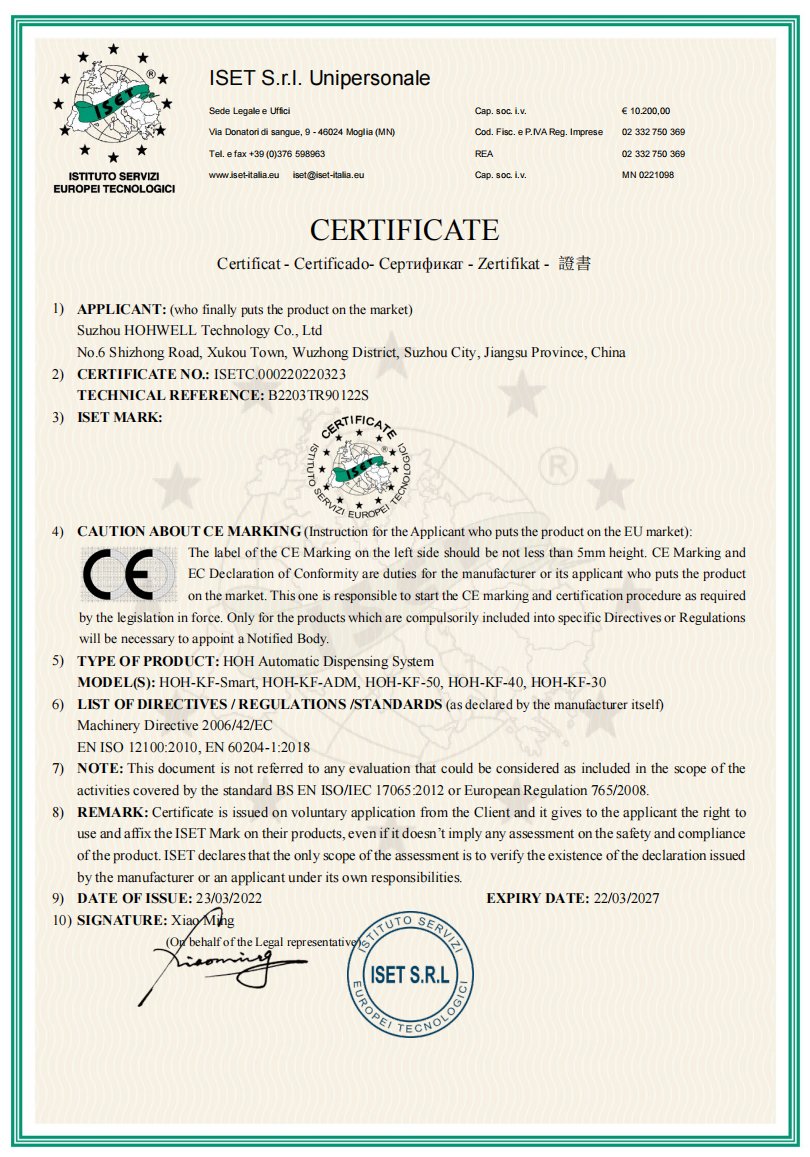
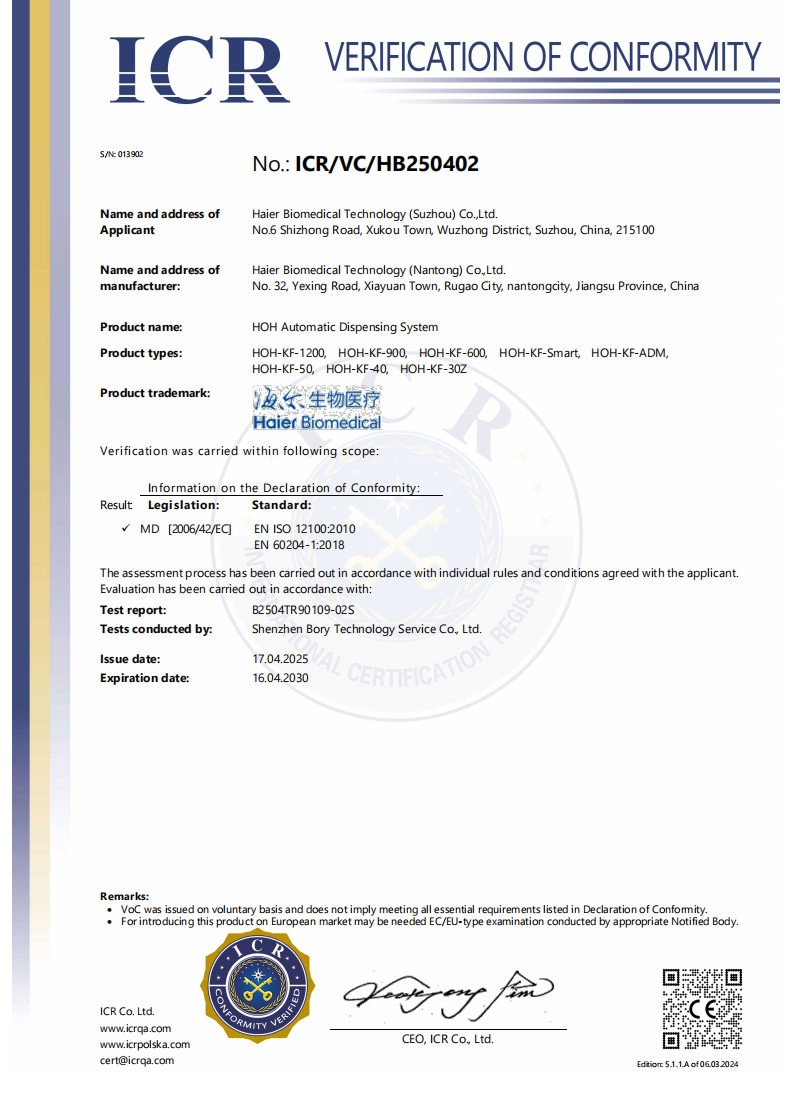
Buyers in the evaluation and execution stages should treat compliance evidence as a document check, not a claim. Two certification documents in Haier's published scope cover the robotic arm dispenser.
- ISET Voluntary Compliance Certificate ISETC.000220220323. MD Machinery Directive voluntary compliance certificate issued by ISET for the EU market on 2022-03-23 and valid until 2027-03-22, against EN ISO 12100:2010 and EN 60204-1:2018. Scope includes the Automatic Dispensing System models HOH-KF-Smart, HOH-KF-ADM, HOH-KF-50, HOH-KF-40 and HOH-KF-30.
- ICR Verification of Conformity ICR/VC/HB250402. MD Directive Verification of Conformity issued by ICR for the EU market on 2025-04-17 and valid until 2030-04-16, against EN ISO 12100:2010 and EN 60204-1:2018. Scope includes HOH-KF-1200, HOH-KF-900, HOH-KF-600, HOH-KF-Smart, HOH-KF-ADM, HOH-KF-50, HOH-KF-40 and HOH-KF-30Z.
Beyond the certificates themselves, ISO 13485 certification covers Haier Biomedical's medical device quality management system. At the wider regulatory level, CSA Group notes that pharmacy automation systems must comply with IEC 60601-1 for medical electrical equipment safety and ISO 13485 for quality management, and in the United States, FDA 21 CFR Part 11 regulates electronic records and electronic signatures in pharmacy automation to ensure data integrity. Hospitals operating in regulated data environments should map those requirements onto the HIS interface and audit trail discussion before the technical specification is frozen.
A practical check: verification of conformity documents carry issue and expiry dates. A certificate valid until 2027-03-22 is a different procurement risk from one valid until 2030-04-16, and the renewal plan should be part of the contract conversation rather than an afterthought.
OEM, Customisation and Delivery: Execution-Stage Details
Once a hospital has decided on the architecture, the project moves from selection to execution, and the questions change from capability to configuration and delivery.
Haier Biomedical provides OEM, ODM and customisable production services. The customisable scope is specific rather than generic: equipment size, storage capacity, SKU quantity, robotic modules, software functions, HIS interface and language. For a hospital whose medication identification requirements depend on local packaging, barcode conventions or interface language, those are the items to settle in the technical agreement, because they determine whether the system matches the pharmacy or the pharmacy has to adapt to the system.
The commercial and delivery terms published by the manufacturer are:
- MOQ: 1 unit.
- Lead time: typically 60–90 days depending on project size and configuration.
- Production capacity: project-based.
- Acceptance: Factory Acceptance Test (FAT) supported before shipment.
- Delivery terms: FOB.
- Payment terms: 50% in advance by TT, balance before shipping.
- After-sales: remote technical support, on-site installation and commissioning, operator training, software upgrades, spare parts supply and global after-sales service.
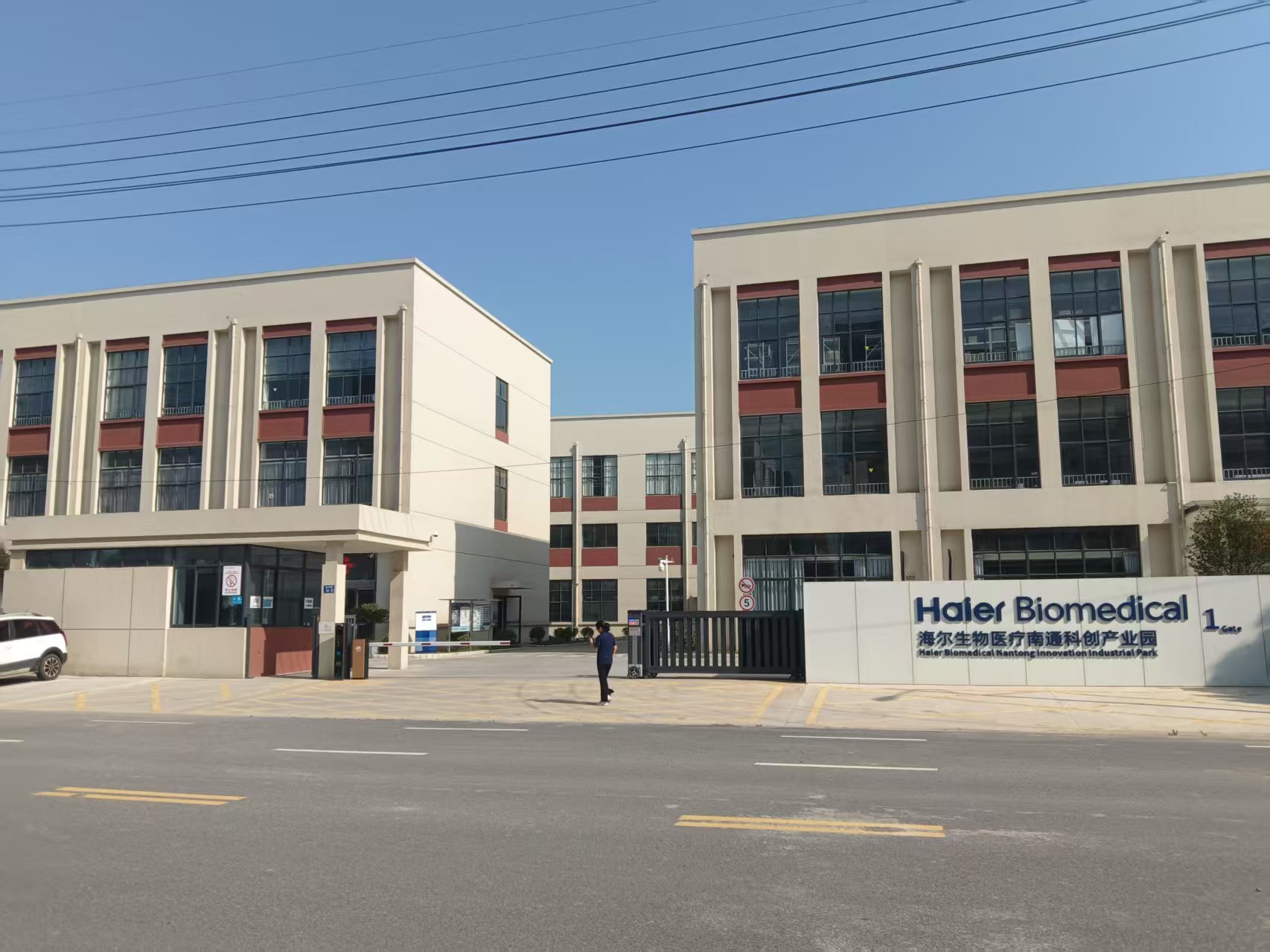
The manufacturing base behind those terms is a 13,000 m² facility with 500 employees, including a 100-engineer R&D team, and the company exports to Europe, the Middle East, Southeast Asia, Latin America, Africa and Oceania. Haier Biomedical was founded in 2015.

FAQ
Does the HOH-KF-Smart hold valid EU compliance documentation?
Two documents are published in its scope. ISET Voluntary Compliance Certificate ISETC.000220220323 is an MD Machinery Directive voluntary compliance certificate issued by ISET for the EU market on 2022-03-23, valid until 2027-03-22, against EN ISO 12100:2010 and EN 60204-1:2018, covering Automatic Dispensing System models including HOH-KF-Smart. ICR Verification of Conformity ICR/VC/HB250402 was issued by ICR for the EU market on 2025-04-17, valid until 2030-04-16, against the same two standards, and includes HOH-KF-Smart in its scope. Buyers should verify issue and expiry dates in the document pack, since the two certificates expire in different years.
Can a robotic arm dispenser integrate with our hospital information system?
Yes, subject to project definition. Haier pharmacy automation solutions can be integrated with hospital information systems to support automated prescription processing and dispensing workflows, and depending on project requirements the system can connect with HIS/EMR and other hospital systems, allowing prescription information to be transferred to the pharmacy automation system for medication dispensing. The hospital system sends prescription information through the defined interface, and the automation system processes it according to configured dispensing rules and equipment workflows. HIS interface and interface language are both within Haier's customisable scope, so the integration should be specified in the technical agreement rather than assumed.
How is a robotic arm dispenser different from a chute-type dispenser?
The difference is the handling mechanism. On a robotic arm dispenser the robotic arm performs automated picking and placement, moving medications between configured storage locations and dispensing points. On a chute-type dispenser, medication is released through a chute structure; the HOH-KF-1200 is specified with a modular dispensing, storage and loading unit structure, full-screen dispensing with safety buffers, parallel multi-prescription operation and a dispensing buffer port of at least 2 channels. In published specifications the HOH-KF-1200 states >350–500 prescriptions per hour, >2,400 boxes per hour replenishment and a space requirement under 12.85 m², while the HOH-KF-Smart states ≥300 prescriptions per hour, ≥700 boxes per hour replenishment, ≥1,500 medication types and ≥20,000 boxes of storage.
What are the MOQ, lead time and payment terms?
The minimum order quantity is 1 unit. Lead time is typically 60–90 days depending on project size and configuration, and production capacity is project-based. Delivery terms are FOB, Factory Acceptance Test (FAT) is supported as an acceptance step before shipment, and payment terms are 50% in advance by TT with the balance before shipping. After-sales scope covers remote technical support, on-site installation and commissioning, operator training, software upgrades, spare parts supply and global after-sales service.
Can a pharmacy automation OEM manufacturer customise a system for medication identification?
Yes. Haier Biomedical provides OEM, ODM and customisable production services, and the customisable scope includes equipment size, storage capacity, SKU quantity, robotic modules, software functions, HIS interface and language. For medication identification specifically, the relevant design items are the barcode recognition that supports full traceability, the FIFO/FEFO expiration management configuration and the HIS interface definition that carries medication information into the dispensing workflow. Projects that need local packaging formats handled can be scoped accordingly; the Thailand project, in which a customised universal dispenser system was developed for local medication packaging requirements, is an example of that approach. To discuss a configuration, send your medication profile, prescription volume and layout drawing to smartpharmacy@haierbiomedical.com, or download the brochure below.
Conclusion: Choosing the Right Automation Architecture, Not the Loudest Label
A robotic arm dispenser is defined by robotic pick-and-place handling, high medication-type coverage and storage capacity, and a specification set that a hospital can verify line by line. On the HOH-KF-Smart those lines read: at least 1,500 medication types, at least 20,000 boxes of storage, at least 300 prescriptions per hour, at least 700 boxes per hour replenishment, FIFO/FEFO expiration management support and barcode recognition with full traceability.
The evaluation discipline that matters is separating architecture from label. Confirm the handling principle first, then compare throughput and footprint against your own prescription mix and room drawing, then check the compliance documents and their expiry dates, and finally lock the customisation scope, the HIS interface and the delivery schedule into the agreement. Hospitals whose real constraint is peak-hour velocity or floor area should test the chute platform honestly; hospitals whose constraint is boxed-medication breadth and robotic handling should test the robotic platform on the same terms.
Next Step: Sample Configuration and Project Review
Share your medication profile, prescription volume, available floor space and HIS interface requirements, and Haier Biomedical can review the appropriate robotic or chute configuration for your pharmacy. OEM, ODM and customisable modes are available, with an MOQ of 1 unit and a typical lead time of 60–90 days depending on project size and configuration.
Download the brochure: Full-scenario Intelligent Pharmacy (PDF)
Email: smartpharmacy@haierbiomedical.com | Tel / WhatsApp: +86-187 7008 3375 | Website: www.haierautomation.com
Haier Biomedical Technology (Suzhou) Co., Ltd, No.6 Shizhong Road, Wuzhong District, Suzhou, China, 215100. Contact: Gina.
Have Questions or Need More Details?
Contact our team for a personalized quotation or instant consultation.
Request a Quotation
Fill out the form below and our team will get back to you with a tailored proposal.
WhatsApp Direct Chat
Prefer to chat in real-time? Message us on WhatsApp for instant assistance & quick answers.
- Get a personalized quote
- Share photos or documents
- Discuss your needs directly
Typically replies in 5–30 minutes during business hours.