
Pharmacy Automation: Arm, Chute or High-Speed Dispenser
The three main dispensing architectures used in hospital pharmacy automation are not interchangeable, and their published performance figures are not directly comparable. A robotic arm dispenser picks and places boxed medication with a robotic mechanism: the HOH-KF-Smart is specified for parallel multi-prescription operation, a footprint under 12.85 m², 1,100+ medication types and replenishment above 2,400 boxes per hour. A chute type dispenser releases medication down channels: the HOH-KF-1200 is specified with a dual-level stacked structure, high-precision photoelectric sensors, at least 2 boxes per second on a single channel and storage of 5,000 boxes or more. A high-speed dispenser works at pack level: the HOH-GF is specified with AI-powered visual verification, a 72-slot tray, 400 medication boxes and 40–60 packs per minute.
Because those figures measure four different things, the selection decision should follow a fixed order: normalize throughput to the pharmacy's busiest hour, confirm the real footprint, design the buffer and handover point, then lock the HIS integration mode. This guide works through that sequence using the published specifications, the conformity certificates that cover each model, and the customization and delivery terms that determine how quickly a chosen architecture can be installed.
Why dispenser specifications resist direct comparison
A dispenser datasheet normally reports the step the manufacturer can measure most precisely. Across the three models in this guide, the headline numbers describe three different process steps.
- Replenishment rate. More than 2,400 boxes per hour for the HOH-KF-Smart describes how fast medication boxes can be loaded back into the machine. It does not describe how fast prescriptions leave the machine.
- Release rate. At least 2 boxes per second on a single channel for the HOH-KF-1200 describes the drop rate of one channel under the stated condition. It is a per-channel figure, not a system figure.
- Pack output. 40–60 packs per minute for the HOH-GF describes packing throughput at the dispensing unit. A pack is not the same unit as a box or a prescription line.
Storage figures are just as easy to misread. The HOH-KF-Smart is specified for 1,100+ medication types, which is a measure of SKU breadth — how many different products the machine can hold. The HOH-KF-1200 is specified for 5,000 boxes or more of storage, which is a measure of stock depth. The HOH-GF is specified with 400 medication boxes and a 72-slot tray, which describes its storage positions in a different configuration. Setting 1,100+ against 400 without noting that one counts medication types and the other counts physical boxes produces a conclusion that means nothing.
The practical consequence is a sequencing rule. Before comparing architectures, convert every vendor figure into the unit your pharmacy is managed on: prescription lines completed per hour at the busiest dispensing window. That conversion needs four inputs — peak-hour prescription lines, average boxes per line, how many channels or trays serve a single prescription, and the time the pharmacist spends on verification and handover.
What the market context says about this decision
The global pharmacy automation devices market was estimated at around USD 6.7 billion in 2024 by Insightace Analytic. Published estimates for that year differ by scope: MarketsandMarkets reports approximately USD 6.65 billion and Dataintelo reports approximately USD 7.52 billion, largely depending on whether secondary services and specific software components are included. Grand View Research projects the wider pharmacy automation market reaching USD 11.6 billion by 2030 at a CAGR of 9.9%. The spread between 2024 estimates is itself a warning for buyers: figures only compare when the scope behind them is stated.
Demand is concentrated in the setting this guide addresses. Fortune Business Insights reports that the hospital pharmacy segment held the largest market share in 2024, driven by patient volumes and complex medication regimens, while Dataintelo places medication dispensing systems as the largest product segment at 32.5% in 2025. MarketsandMarkets expects pharmacy automation software to grow at the fastest rate among components from 2024 to 2030 — a signal that integration and data flow, not only mechanical handling, increasingly determine whether an installation delivers its intended result.
For a hospital pharmacy team, the implication is straightforward. The architecture decision is a capacity-planning exercise conducted against the busiest hour of the busiest day, not a choice between product categories. Hardware and integration should be evaluated together, because a dispenser that releases quickly but exchanges data slowly with the hospital information system simply relocates the queue.
The three dispenser architectures in technical terms
Haier Biomedical Technology (Suzhou) Co., Ltd is a healthcare technology company under Haier Group that develops intelligent pharmacy automation solutions for hospitals, clinics and healthcare organizations, covering medication storage, automated dispensing, medication verification, inventory management, IV compounding automation and digital pharmacy workflow optimization. Its pharmacy automation portfolio, described at haierautomation.com, includes the three architectures compared here.
Robotic arm dispenser: HOH-KF-Smart
A robotic arm dispenser stores boxed medication in configured positions and uses a robotic arm to pick and place items between storage locations and the dispensing point, following system instructions. Haier's selection guidance positions robotic dispensing for pharmacies that handle a relatively large number of boxed medications and require automated storage and dispensing, configurable across multiple modules according to medication volume, available space and dispensing requirements.
- Parallel multi-prescription operation — the machine can work on more than one prescription concurrently rather than processing prescriptions strictly one after another.
- Modular design — robotic modules are part of the customizable scope, so capacity and SKU coverage can be configured to the site.
- Footprint under 12.85 m² — the published floor area for the model, relevant to retrofit projects where the pharmacy shell cannot be rebuilt.
- 1,100+ medication types — a measure of SKU breadth rather than storage depth.
- Replenishment above 2,400 boxes per hour — a restocking rate that allows stock to be reloaded without stopping dispensing for an extended period.
Parallel operation matters most when a pharmacy receives many small prescriptions in a short window. A serial dispenser serves those prescriptions in sequence; a machine able to work on several at once reduces queueing caused by the machine itself, which shifts the practical constraint back to pharmacist verification and handover. Haier's selection guidance also states dispensing accuracy of up to 99% for the robotic arm dispenser where boxed medication volume and dispensing accuracy are the priorities; this is a manufacturer specification and should be verified against the agreed configuration and acceptance test.
Two boundaries are worth stating plainly. First, the 2,400 boxes per hour figure describes replenishment, so it must not be read as a dispensing rate. Second, the footprint figure should be confirmed against the installation drawing, since service access, power cabinets and the buffer port all consume floor area around the machine.
Chute type dispenser: HOH-KF-1200
A chute type dispenser holds medication in a stacked structure and releases items down channels to a collection point, with photoelectric sensors confirming that an item has passed the intended position. The HOH-KF-1200 is built on a dual-level stacked structure, which uses vertical space to reach its storage capacity.
- Dual-level stacked structure — two storage levels rather than a single tier, relevant where floor area is limited but clear height is available.
- High-precision photoelectric sensors — sensing at the release path, used to confirm passage and position of released items.
- At least 2 boxes per second on a single channel — the stated per-channel release rate.
- Storage of 5,000 boxes or more — a stock-depth figure, not a SKU count.
The per-channel rate converts, as simple arithmetic, to 120 boxes per minute and roughly 7,200 boxes per hour per channel. That is a calculated nominal figure, not a measured site result: it assumes continuous release on one channel, whereas a real prescription usually requires several boxes from different channels, plus verification and handover time. Haier's selection guidance describes the chute type dispenser as supporting simultaneous dispensing and replenishment and full-screen medication drop, aimed at hospitals with a high daily prescription volume.
Two verification points follow from the architecture. Because the rate is per channel, system throughput depends on how many channels are allocated to the prescriptions your site actually writes — a pharmacy dominated by multi-item prescriptions may not realise the headline rate. Because the model uses a stacked structure, confirm clear height, service access to both levels and the buffer arrangement at the collection point before signing the layout.
High-speed dispenser: HOH-GF
A high-speed dispenser is configured around tray-based handling and produces packs at a rate suited to high-volume pack-level output, with AI-powered visual verification applied as part of the dispensing process.
- AI-powered visual verification — an image-based check step inside the dispensing workflow, rather than a separate downstream station.
- 72-slot tray — the tray capacity stated for the model; tray count per system should be confirmed for the configuration quoted.
- 400 medication boxes — a storage-position figure for this unit, different in kind from the chute model's storage capacity.
- 40–60 packs per minute — pack output, equivalent to a nominal 2,400–3,600 packs per hour by simple arithmetic.
The unit of measurement is the decisive detail here. Packs per minute cannot be set against boxes per second or boxes per hour without knowing how many packs a prescription line generates and how many boxes feed each pack. For a site whose output is dominated by multi-dose packing, pack rate is the right metric; for a site dispensing whole boxes against outpatient prescriptions, it is not. The AI visual verification step is relevant to the verification stage of the chain described earlier, but it complements rather than replaces the pharmacist's professional check — automation standardises the picking workflow, and verification processes add a further layer of checking.
The four parameters that decide the architecture
Parameter 1 — Footprint and layout fit
Only one of the three models has a footprint figure published in the material used for this guide: the HOH-KF-Smart at under 12.85 m². For the HOH-KF-1200 and the HOH-GF, floor area must be confirmed per configuration, because storage capacity, channel count and tray count all change the machine's dimensions. A useful discipline is to draw three overlays on the actual pharmacy plan — machine footprint, service and maintenance clearance, and buffer/handover zone — and to check that the pharmacy can still operate during installation, since a retrofit that closes the outpatient window for several weeks carries a cost that never appears on the quotation.
Parameter 2 — Throughput normalized to the busiest hour
Throughput should be modelled as prescription lines per peak hour, not as the vendor's headline unit. As an illustration only, a pharmacy completing 600 prescription lines in its busiest hour with an average of two boxes per line faces a release requirement of roughly 1,200 boxes in that hour, or about 0.33 boxes per second. A single chute channel rated at 2 boxes per second carries margin on paper against that figure, but the realized rate depends on how many channels serve each prescription and on verification time. This is transparent arithmetic, not a measured site result, and it should be repeated using your own line count, item count and staffing model.
The same logic applies to replenishment. A restocking rate above 2,400 boxes per hour matters if the pharmacy refills during operating hours; if refilling happens overnight, the replenishment figure has little bearing on daytime performance and should not drive the decision.
Parameter 3 — Buffer port design
The buffer is where released items wait for the pharmacist, and it is frequently the real bottleneck. Four questions separate a workable design from a stressful one. How many prescriptions can wait in the buffer at once without physical mixing? Is each prescription segregated so that a fast-moving item cannot join the wrong order? What is the defined recovery path when an item is released incorrectly or a verification fails? And does the buffer smooth peak release or simply move the pile-up half a metre closer to the window?
Recovery design deserves particular attention because it differs by mechanism. In a pick-and-place architecture the arm can, in principle, return an item to storage, whereas in a gravity-fed chute design an item that has already dropped cannot normally travel back up the same path, so the recovery workflow has to be defined at the buffer. The exact procedure should be confirmed with the supplier for the quoted configuration rather than assumed from the architecture type.
Parameter 4 — HIS integration mode
Haier pharmacy automation solutions can be integrated with hospital information systems so that prescription information is transferred to the pharmacy automation system and processed according to configured dispensing rules, reducing repetitive manual data entry. The HIS interface and system language are both part of the customizable scope, which means integration is a specification item to be written down, not a switch that is flipped at commissioning.
Write the integration specification around five items: the interface type and message flow between HIS or EMR and the dispenser; ownership of the drug dictionary and how formulary changes propagate; behaviour when the interface is unavailable, including whether dispensing can continue on a defined fallback; the audit trail for who changed what and when; and any market-specific electronic-records requirement. For US sites, FDA 21 CFR Part 11 governs electronic records and electronic signatures, while IEC 60601-1 for medical electrical equipment safety and ISO 13485 for quality management are the reference standards commonly applied to these systems.
Step-by-step: running the selection
- Count the peak hour, not the average day. Extract prescription lines and items per line for the busiest 60 minutes in each of the last twelve months. Architecture decisions made on annual averages systematically under-size the pharmacy.
- Profile the medication mix. Separate boxed medications, loose or unit-dose items and multi-dose packing demand, and count active SKUs against fast movers. SKU breadth points toward the robotic arm architecture; stock depth and release rate point toward the chute architecture; pack-level volume points toward the high-speed architecture.
- Measure the space honestly. Record usable floor area, clear height, service access and the route by which a machine can physically enter the pharmacy. Confirm the footprint of each candidate configuration rather than the catalogue figure.
- Design the buffer and handover with the pharmacists. Walk through a failed verification, a cancelled prescription and a peak-hour surge. Specify buffer capacity per prescription and the segregation rule before comparing machine rates.
- Write the integration and data-integrity requirements. Interface type, drug dictionary ownership, fallback behaviour, audit trail and language localisation should appear in the technical annex, not in meeting notes.
- Verify certificate scope, acceptance test and lead time. Match the certificate's model list to the models actually quoted, agree the Factory Acceptance Test criteria, and confirm the delivery window against your opening date.
Comparison of the three architectures
| Selection dimension | HOH-KF-Smart (robotic arm) | HOH-KF-1200 (chute type) | HOH-GF (high-speed) |
|---|---|---|---|
| Dispensing mechanism | Robotic arm picks and places boxed medication between storage and dispensing point | Medication released down channels, with photoelectric sensing of the release path | Tray-based high-speed dispensing with AI-powered visual verification |
| Published capacity figures | 1,100+ medication types; replenishment above 2,400 boxes/hour | Storage of 5,000 boxes or more; at least 2 boxes/second per single channel | 400 medication boxes; 72-slot tray; 40–60 packs/minute |
| Footprint | Under 12.85 m² | Confirm per configuration | Confirm per configuration |
| Operating characteristic | Parallel multi-prescription operation; modular design | Dual-level stacked structure; simultaneous dispensing and replenishment; full-screen medication drop | AI-powered visual verification integrated into the dispensing workflow |
| EU conformity evidence | ICR/VC/HB250402; ISETC.000220220323 (voluntary) | ICR/VC/HB250402 | ICR/VC/HB250403 |
| Best-fit condition (analysis) | Broad SKU range, constrained floor area, accuracy-critical boxed dispensing | High daily prescription volume where release rate and storage depth dominate | High pack-level output where verification is part of the dispensing step |
The table deliberately separates figures that are often shown side by side without explanation. Replenishment rate, per-channel release rate, pack rate and storage capacity answer different questions, and the last row is analytical guidance based on those specifications rather than a performance guarantee for any specific site.
Matching architecture to pharmacy scenario
Space-constrained outpatient pharmacy with a broad formulary. Where the pharmacy shell cannot be rebuilt and the formulary runs to more than a thousand boxed items, the robotic arm architecture addresses both constraints at once: parallel multi-prescription operation reduces machine-side queueing, and the published footprint stays under 12.85 m². The trade-off to test is replenishment timing — if refilling must happen during opening hours, the replenishment rate becomes an operational metric rather than a footnote.
High-volume outpatient pharmacy with a narrower, fast-moving formulary. Where daily prescription volume is the binding constraint and storage depth matters more than SKU breadth, the chute architecture fits: storage of 5,000 boxes or more, at least 2 boxes per second per channel, and support for simultaneous dispensing and replenishment. The trade-off is layout: the dual-level stacked structure requires clear height and service access to both levels.
Pack-level output with in-line verification. Where output is measured in packs and each pack must be checked, the high-speed architecture with AI-powered visual verification and a 72-slot tray is the relevant comparison. The trade-off is scope: 400 medication boxes defines a different storage envelope, so the site must confirm that its stock depth fits the unit or that supplementary storage is planned.
Two documented projects show how configuration follows local conditions rather than a standard template. A private hospital in Thailand received a customized universal dispenser system for its outpatient pharmacy, adapted to local medication packaging characteristics and integrated with HIS; the project description records improved dispensing accuracy and reduced repetitive tasks for pharmacists, with modular design and scalability noted as the basis for future expansion. A general hospital in Vietnam received an intelligent pharmacy automation system configured around its own pharmacy layout and workflow, with HIS integration; the project description records reduced patient waiting time and improved medication management efficiency. Both are provider-recorded project descriptions rather than independently measured outcomes, and they should be read as evidence of customization capability rather than as performance benchmarks.
Compliance evidence to check before signing
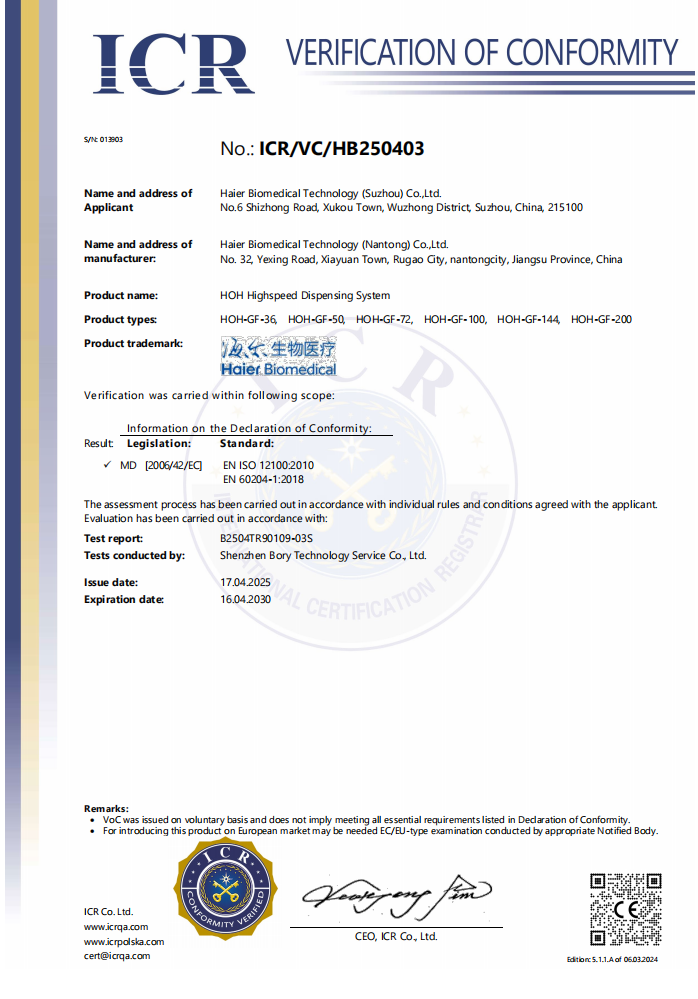
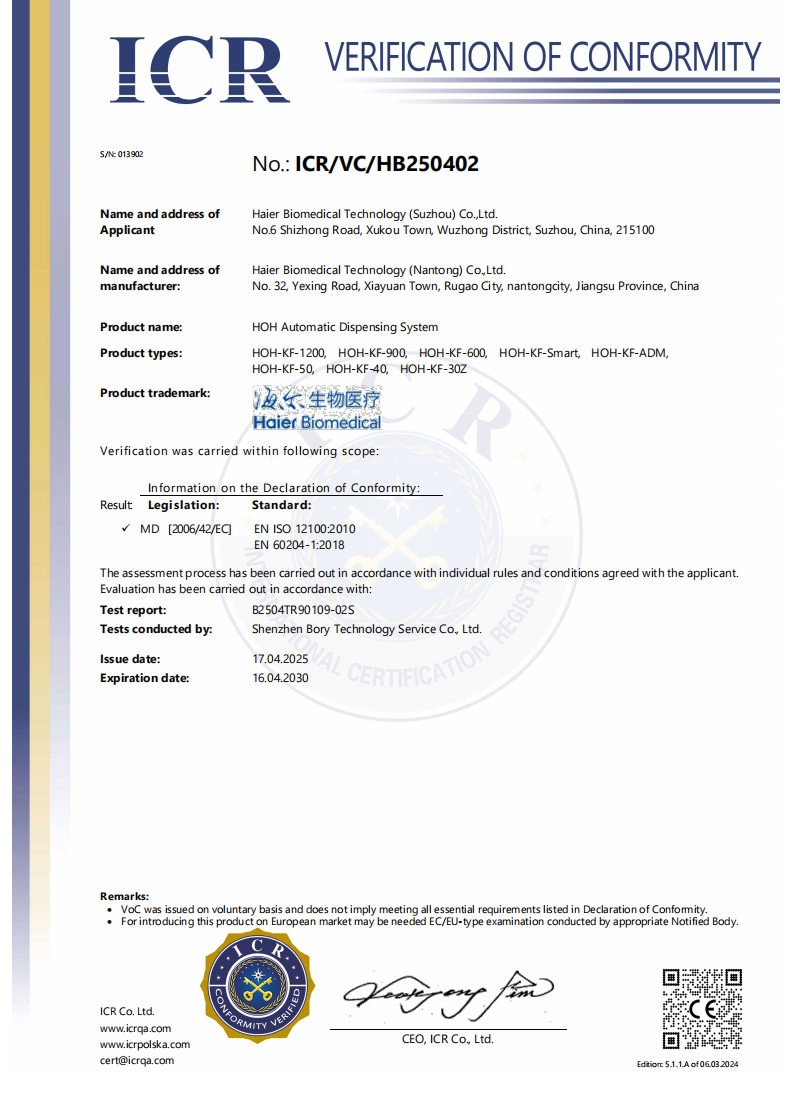
Certificate scope is a specification item. The HOH-KF-Smart and HOH-KF-1200 sit inside ICR Verification of Conformity ICR/VC/HB250402, issued 17 April 2025 and valid to 16 April 2030 against EN ISO 12100:2010 and EN 60204-1:2018, which also lists the HOH-KF-900, HOH-KF-600, HOH-KF-ADM, HOH-KF-50, HOH-KF-40 and HOH-KF-30Z. The HOH-GF series is covered by ICR/VC/HB250403, issued on the same date and valid for the same period, listing HOH-GF-36 through HOH-GF-200. The HOH-KF-Smart additionally appears on ISET voluntary compliance certificate ISETC.000220220323, valid from 23 March 2022 to 22 March 2027.
Three cautions apply to all of them. A certificate covers the listed models, not a bespoke configuration built outside that list. It evidences conformity assessment, not measured performance in your pharmacy. And market applicability differs — a European conformity document does not by itself satisfy a regulator elsewhere, so the applicable market requirement should be confirmed in the project specification. Haier Biomedical operates an ISO 13485 medical device quality management system, and Factory Acceptance Testing before shipment is available as an acceptance step.

Customization, lead time and commercial terms
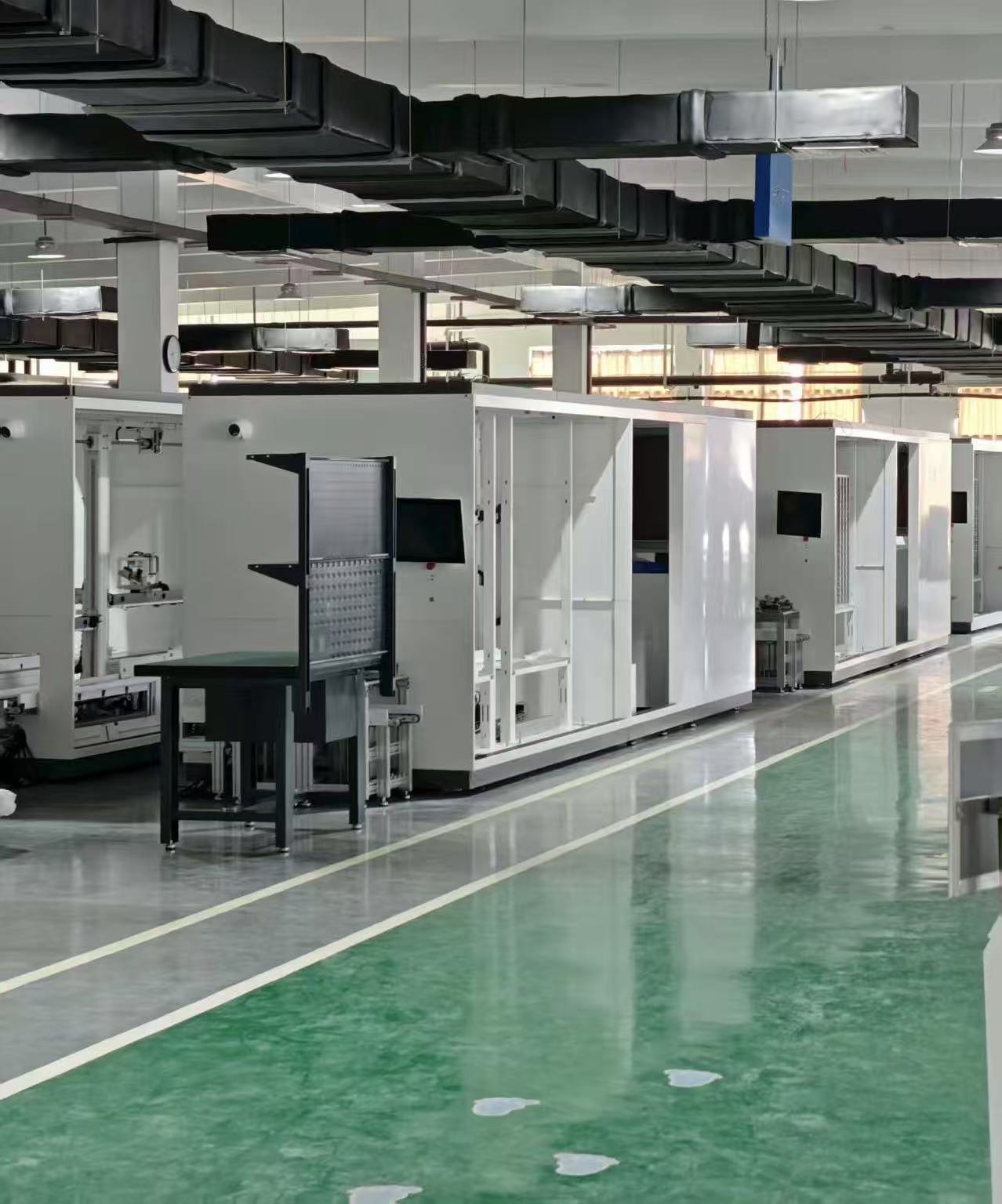
Once the architecture is fixed, execution risk moves to configuration and delivery. Haier Biomedical provides OEM, ODM and customizable production services. The customizable scope covers equipment size, storage capacity, SKU quantity, robotic modules, software functions, HIS interface and language — which is precisely the set of variables that determines whether a standard machine fits a specific pharmacy.
Production capacity is project-based, the minimum order quantity is 1 unit, and standard delivery time is typically 60–90 days depending on project size and configuration. Published purchasing terms state FOB delivery, Factory Acceptance Test supported as an acceptance criterion, and payment of 50% in advance by TT with the balance before shipping. After-sales scope includes remote technical support, on-site installation and commissioning, operator training, software upgrades, spare parts supply and global after-sales service. For a hospital working to a fixed opening date, the lead time should be read backwards from the go-live date together with the installation and training window, not forward from the purchase order.
Frequently asked questions
Which certificates should a hospital verify for the HOH-KF-Smart, HOH-KF-1200 and HOH-GF?
For the European market, verify the certificate against the exact model quoted. ICR/VC/HB250402 (issued 17 April 2025, valid to 16 April 2030) covers automatic dispensing system models including the HOH-KF-Smart and HOH-KF-1200, assessed against EN ISO 12100:2010 and EN 60204-1:2018. ICR/VC/HB250403, issued and valid for the same period, covers high-speed dispensing system models from HOH-GF-36 to HOH-GF-200. The HOH-KF-Smart also appears on ISET voluntary compliance certificate ISETC.000220220323, valid from 23 March 2022 to 22 March 2027. Haier Biomedical holds ISO 13485 certification for its medical device quality management system. Check that the certificate lists the configuration you are buying and that it is accepted in your market.
Can a hospital or distributor order these dispensers under an OEM or ODM model?
Yes. Haier Biomedical provides OEM, ODM and customizable production services, with a minimum order quantity of 1 unit. Customization covers equipment size, storage capacity, SKU quantity, robotic modules, software functions, HIS interface and language, which allows medication identification and dispensing behaviour to be adapted to local packaging and formulary conditions — as in the Thailand outpatient project, where the dispenser system was developed around local medication packaging requirements. Production capacity is project-based and standard delivery time is typically 60–90 days depending on project size and configuration.
Can the dispensers integrate with our hospital information system?
Yes. Haier pharmacy automation solutions can be integrated with HIS and EMR platforms so that prescription information is transferred to the automation system and processed according to configured dispensing rules, reducing repetitive manual data entry. The HIS interface and system language are part of the customizable scope. Specify the interface type, drug dictionary ownership, fallback behaviour when the interface is unavailable and the audit trail in the technical annex, and confirm any market-specific electronic-records requirement such as FDA 21 CFR Part 11 for US sites.
What are the purchasing terms and acceptance criteria?
Published terms are: minimum order quantity 1 unit; delivery terms FOB; Factory Acceptance Test supported as an acceptance criterion before shipment; payment of 50% in advance by TT with the balance before shipping. Configuration-specific commercial details are confirmed during project scoping, because storage capacity, channel or tray count, software functions and interface work all change the delivered scope. Agree the FAT checklist in writing so that acceptance is measured against definitions both parties signed.
Can we validate a dispenser configuration before it is installed?
Factory Acceptance Testing before shipment is available as the documented acceptance step, which allows the configured machine to be examined against agreed criteria before it leaves the factory. Customization to local medication packaging is also possible, as the Thailand outpatient project illustrates. After delivery, the after-sales scope includes on-site installation and commissioning, operator training, remote technical support, software upgrades and spare parts supply, so that site-level checks are carried out on the installed system rather than assumed from the factory test.
What is the typical lead time, and how does a project start?
Standard delivery time is typically 60–90 days depending on project size and configuration, with project-based production capacity and a minimum order quantity of 1 unit. A project normally starts from the site data the architecture decision depends on — peak-hour prescription lines, medication mix and SKU count, measured floor area and service clearance, buffer and handover requirements, and the HIS interface specification — after which the configuration, acceptance criteria and delivery window are fixed. The full-scenario brochure covering storage, dispensing, verification and IV compounding automation can be downloaded here: Full-scenario Intelligent Pharmacy brochure. For configuration questions, Haier Pharmacy Automation can be reached at smartpharmacy@haierbiomedical.com.
Conclusion
The choice between a robotic arm, a chute type and a high-speed dispenser is decided by four measurements, not by a headline rate. Normalize throughput to prescriptions per peak hour using your own line and item counts. Confirm the footprint of the configuration you are actually buying, not the catalogue figure. Design the buffer and its recovery path with the pharmacists who will use it. And write the HIS integration mode into the technical annex. Where those four answers point toward broad SKU coverage and constrained floor area, the HOH-KF-Smart architecture is the relevant comparison; where release rate and storage depth dominate, the HOH-KF-1200; where pack-level output with in-line visual verification is the requirement, the HOH-GF.
Two disciplines protect the decision after signing. Match every certificate to the exact model and market, remembering that conformity evidence is not a performance guarantee. And read the 60–90 day lead time backwards from the go-live date, including installation, commissioning and training, so that the pharmacy is not left running a half-finished workflow during its busiest season.
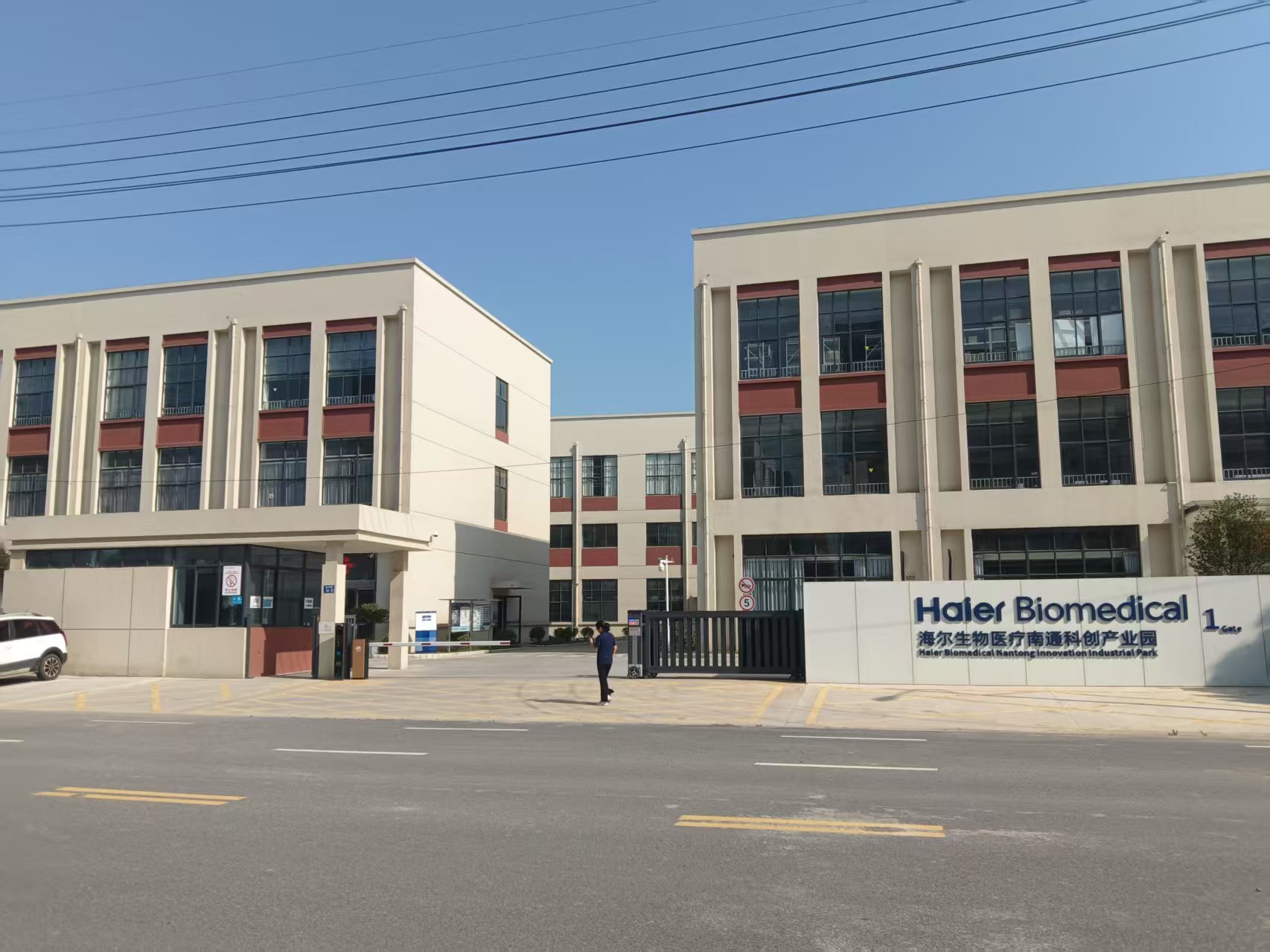
Next step. Prepare the site data first — peak-hour prescription lines, medication mix and SKU count, measured floor area, buffer requirements and the HIS interface specification — then request a configuration review against the architecture that matches it. Haier Biomedical Technology (Suzhou) Co., Ltd, No.6 Shizhong Road, Wuzhong District, Suzhou, China, 215100. Email smartpharmacy@haierbiomedical.com or visit www.haierautomation.com.
Have Questions or Need More Details?
Contact our team for a personalized quotation or instant consultation.
Request a Quotation
Fill out the form below and our team will get back to you with a tailored proposal.
WhatsApp Direct Chat
Prefer to chat in real-time? Message us on WhatsApp for instant assistance & quick answers.
- Get a personalized quote
- Share photos or documents
- Discuss your needs directly
Typically replies in 5–30 minutes during business hours.