
Pharmacy Automation Recommendation List: 7 Hospital Systems Ranked by Use Case
Answer first: seven Haier Biomedical pharmacy automation systems are ranked below by hospital use case rather than by model size or headline throughput. Placement reflects how much medication risk a configuration removes and how poorly general-purpose equipment substitutes for it, so a lower rank is not a lower capability tier. HOH-Robot-Plus leads because it addresses cytotoxic compounding inside PIVAS; HOH-KF-Smart sits at seventh because robotic-arm dispensing competes with several alternative configurations serving the same outpatient counter.
This list is written for pharmacy directors, procurement teams and biomedical engineering departments that have already decided to automate and now need to decide what goes where. Each entry states the department the system belongs in, the verified facts behind its placement, and the points that still have to be confirmed before a purchase order is raised.
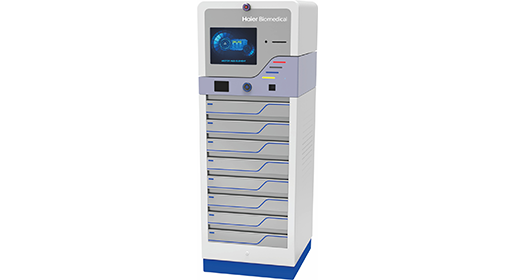
Cover: an anesthetic medication dispensing cabinet of the type used at the point of care in operating room workflows — one of seven configurations assessed in this ranking. Image: Haier Biomedical.
Problem Definition: Why the "Best System" Question Produces the Wrong Shortlist
Pharmacy automation is procured as a set of configurations, not as a single product category. A chute dispenser that releases boxes at an outpatient window and a robot that compounds cytotoxic preparations in a PIVAS unit are not alternatives to one another; they remove different risks in different rooms. Ranking them on one throughput figure produces a shortlist that cannot be specified, budgeted or commissioned.
Market structure supports the department-first view. The hospital pharmacy segment held the largest share of pharmacy automation demand in 2024, driven by high patient volumes and complex medication regimens (Fortune Business Insights). The largest segment is also the most internally varied, which is why a single ranking criterion fails.
Two operational facts explain the distinction. Automated dispensing reduces the number of repetitive manual picking steps a workflow depends on. When dispensing is combined with a medication verification step — for example an automatic sub-packaging and verification machine — the workflow adds a further check on medication information before the dose leaves the pharmacy. Those are two separate controls, and in most hospitals they belong to two separate departments.
A use-case ranking also protects the capital plan. Hospitals rarely buy one machine; they buy a sequence, and the sequence is set by which medication class creates the greatest risk today and which department absorbs the most manual handling.
Industry Background: What Is Changing in Hospital Pharmacy Automation
The global pharmacy automation devices market was estimated at USD 6.7 billion in 2024 (Insightace Analytic) and is projected to reach USD 11.6 billion by 2030, a CAGR of 9.9% (Grand View Research). Growth is uneven across product types, and the unevenness is what makes a use-case ranking useful.
- Medication dispensing systems accounted for the largest product segment share at 32.5% in 2025 (Dataintelo).
- Automated medication compounding is projected to be the fastest-growing product segment, with a CAGR above 10% (Grand View Research) — the segment that contains PIVAS cytotoxic compounding robots.
- Decentralized distribution models are expected to account for 79.8% of the market in 2026 as automated dispensing cabinets extend beyond the central pharmacy (Fortune Business Insights).
- Pharmacy automation software is expected to grow at the fastest rate among components from 2024 to 2030 (MarketsandMarkets), which is consistent with buyers treating integration as a first-order requirement rather than an add-on.
Labour is the second driver. Omnicell has reported that 75% of pharmacist time is traditionally spent on non-clinical tasks — the workload that automation is intended to absorb so that pharmacists can return to clinical review and patient-facing work.
Compliance expectations have tightened alongside the technology. Pharmacy automation systems must comply with IEC 60601-1 for medical electrical equipment safety and with ISO 13485 for quality management (CSA Group); in the United States, FDA 21 CFR Part 11 governs electronic records and electronic signatures. In the EU, the machinery safety evidence usually takes the form of a model-specific Verification of Conformity against EN ISO 12100:2010 and EN 60204-1:2018 — a document per model scope, not a category-wide certificate.
The supplier context matters for interpreting any ranking. Haier Biomedical Technology(Suzhou)Co., Ltd is a healthcare technology company under Haier Group and the business unit behind the HOH pharmacy automation range. Founded in 2015, the company operates a 13,000 m² factory with 500 employees and a 100-engineer R&D team, holds ISO 13485 medical device quality management system certification, and serves markets in Southeast Asia, Latin America and the Middle East. Its systems are designed to integrate with hospital information systems including HIS and EMR platforms. In its 2025 annual report, Haier Biomedical reported that AI-powered automated pharmacy solutions raised direct dispensing rates to 80%, and that AI-powered applications contributed 15% of total revenue.
How This Ranking Was Built
Four criteria set the order. None of them is dispensing speed in isolation, because speed without a matching workflow simply moves the bottleneck.
- Risk removed per dose handled. Cytotoxic preparations and controlled substances carry consequences that a mis-pick in a general outpatient queue does not. Higher consequence, higher placement.
- Specificity of fit. A configuration ranks higher when general-purpose equipment cannot substitute for it, and lower when several configurations can serve the same workflow.
- Evidence available per model. Placement reflects what can be documented — certificate scope, referenced standards, expiry dates and published capability statements.
- Workflow and integration reach. How much of the prescription path the system actually covers: HIS order intake, medication identification, dispensing, verification and traceability.
Rank therefore describes use-case fit, not build quality. Large hospitals routinely deploy three or more of these configurations in the same building, and the comparison table further down is designed to be read alongside the individual entries.
The Seven Systems, Ranked by Hospital Use Case
1. HOH-Robot-Plus — PIVAS Cytotoxic Compounding
Best fit: the PIVAS unit that prepares cytotoxic and other intravenous admixtures.
Why it ranks first: it is the only configuration on this list that acts on the preparation step itself rather than on the storage, picking or dispensing of a finished package. A PIVAS workflow runs from prescription intake through compounding, labelling, verification and release to the ward, and the compounding step is where hazardous exposure and preparation variance concentrate. The HOH-Robot-Plus is a fully automated cytotoxic drug compounding robot; automating that step removes manual transfer operations from the sequence and standardises how the preparation is produced.
What to confirm: this model is not inside the certificate scopes listed in this review, so request the current declaration package with the quotation, together with the room requirements for the cleanroom it will occupy and the exact point at which the system hands the preparation back to the verification and labelling workflow.
2. HOH-MJ-01 — Anesthetic Medication Dispensing
Best fit: operating room and anesthesia workflows that need controlled access to anesthetic and perioperative medication close to the point of use.
Why it ranks second: anesthetic medication is high-consequence, time-critical and consumed far from the central pharmacy window. The HOH-MJ-01 is an anesthetic medication dispensing cabinet, and its placement reflects where retrieval actually happens — while a case is running, not during a scheduled stock round. It is covered by ICR Verification of Conformity ICR/VC/HB240501 against EN 60204-1:2018 and EN ISO 12100:2010, issued 10 May 2025 and valid to 9 May 2029 for the EU market.
What to confirm: the same certificate scope covers eleven cabinet models across the HOH-M2300, HOH-BQ and HOH-M600 families, so the cabinet that suits an anesthesia bay is not necessarily the cabinet that suits a ward stockroom. Match the model to the room before matching it to the budget line.
3. HOH-BQ-A — Narcotic and Psychotropic Storage and Monitoring
Best fit: central or satellite pharmacy areas where narcotic and psychotropic medications are stored, issued and reconciled.
Why it ranks third: controlled-substance handling is a documentation problem as much as a storage problem — what was received, what was issued, to which department, by whom, and what balance remains. The HOH-BQ-A is an intelligent integrated management cabinet built for that storage and monitoring role, and it shares ICR Verification of Conformity ICR/VC/HB240501 (valid to 9 May 2029) with the anesthetic cabinet.
What to confirm: the reconciliation rules and record-retention policy the hospital's regulator applies. Where the facility falls under FDA 21 CFR Part 11, electronic-record and electronic-signature controls need to be written into the specification rather than assumed.
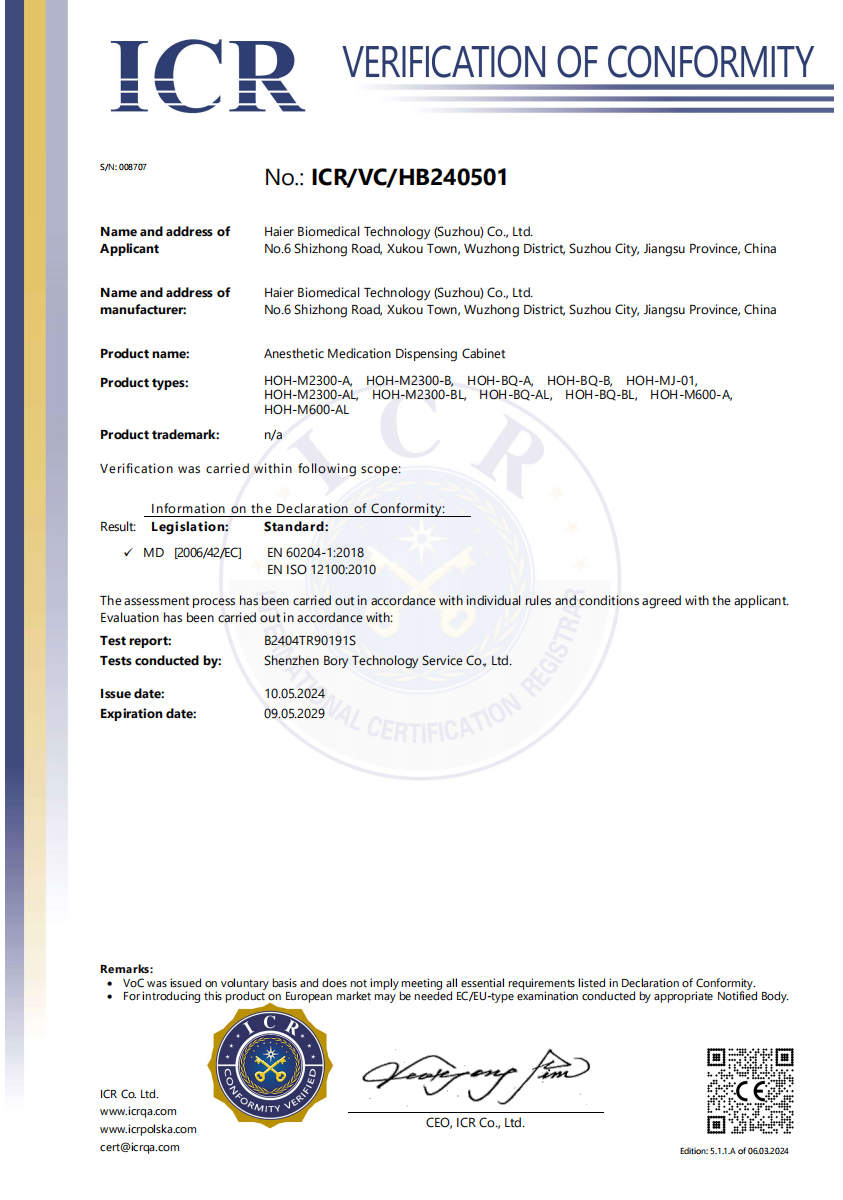
ICR Verification of Conformity ICR/VC/HB240501 covers the HOH-MJ-01 and HOH-BQ-A cabinet models against EN 60204-1:2018 and EN ISO 12100:2010, valid to 9 May 2029. Image: Haier Biomedical.
4. HOH-FB-D400-HD — Automatic Sub-packaging and Verification
Best fit: inpatient unit-dose dispensing, where bulk medication is sub-packaged into patient-specific doses and checked before it leaves the pharmacy.
Why it ranks fourth: it is the configuration on this list that carries an explicit verification stage. Automated dispensing removes repetitive manual picking; a verification step adds a further check on medication information before release. The HOH-FB-D400-HD is an automatic sub-packaging and verification machine, covered by ICR Verification of Conformity ICR/VC/HB250802 against EN ISO 12100:2010 and EN 60204-1:2018, issued 6 August 2025 and valid to 5 August 2030 — the longest validity window in this review. The certificate scope also covers HOH-FB-D320-HD and HOH-FB-D480-HD.
What to confirm: pouch format, the labelling content the ward expects, and how the verification result is written back into the HIS record so that the check is traceable rather than local to the machine.
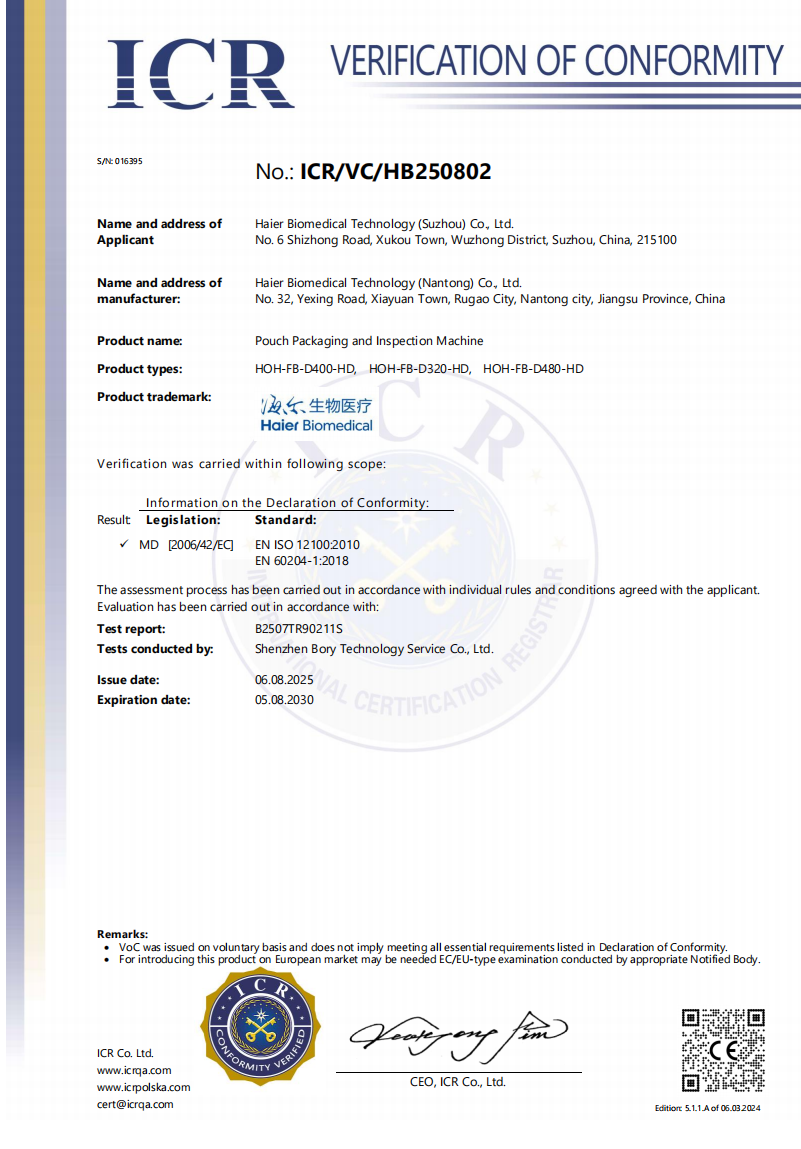
ICR Verification of Conformity ICR/VC/HB250802 covers HOH-FB-D400-HD, HOH-FB-D320-HD and HOH-FB-D480-HD, valid to 5 August 2030. Image: Haier Biomedical.
5. HOH-GF (2 Modules) — High-Speed Packaging
Best fit: inpatient and long-term care dispensing that needs high packaging throughput across a wide SKU set, supplied here as a two-module build.
Why it ranks fifth: capacity scaling is the point of this model. Certificate ICR/VC/HB250403, issued 17 April 2025 and valid to 16 April 2030, covers six high-speed dispensing models from HOH-GF-36 to HOH-GF-200 against EN ISO 12100:2010 and EN 60204-1:2018, which means the series can be matched to prescription volume instead of forcing the workflow to match the machine. Its position below the verification model reflects a simple fact: packaging alone does not add a checking step.
What to confirm: the module count against peak-day volume, and the physical footprint the two-module configuration requires. Equipment size, storage capacity and SKU quantity are customization parameters, so identical model names can describe materially different installations.
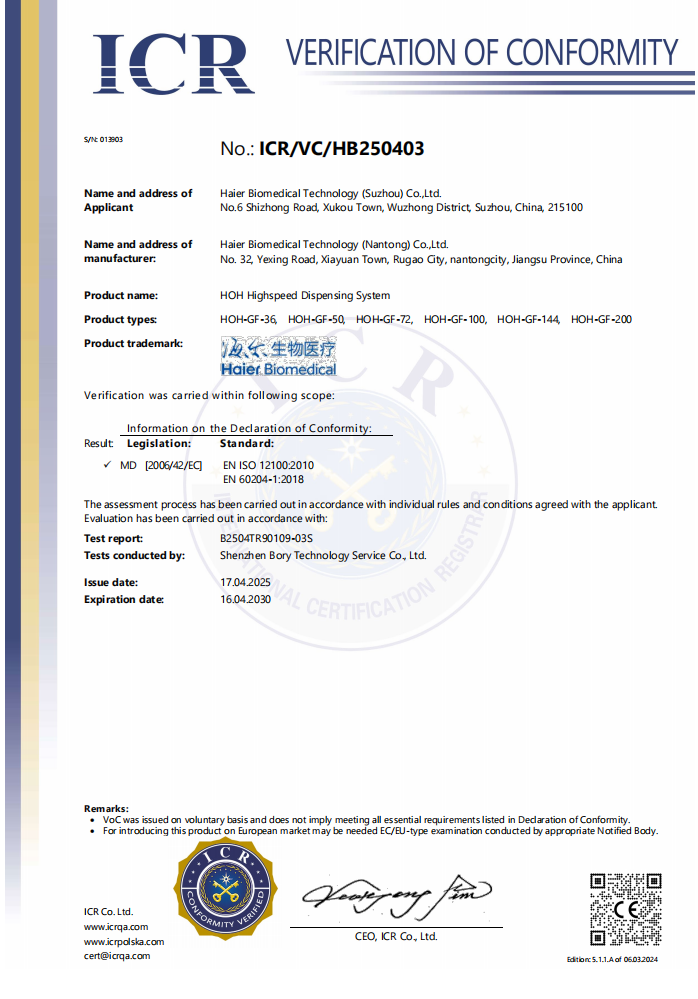
ICR Verification of Conformity ICR/VC/HB250403 covers the HOH-GF-36 to HOH-GF-200 high-speed dispensing series, valid to 16 April 2030. Image: Haier Biomedical.
6. HOH-KF-1200 — Chute-Type High-Speed Dispensing
Best fit: outpatient pharmacies with a high daily prescription count.
Why it ranks sixth: the chute architecture supports simultaneous dispensing and replenishment and a full-screen medication drop, which is what keeps a dispensing window moving when prescriptions arrive back to back. It sits below the packaging configurations because, for many hospitals, a robotic-arm dispenser can serve the same outpatient counter; the choice between them is a layout, SKU-mix and volume decision rather than a capability gap. Certificate ICR/VC/HB250402, issued 17 April 2025 and valid to 16 April 2030, covers HOH-KF-1200 together with HOH-KF-900, HOH-KF-600, HOH-KF-Smart, HOH-KF-ADM, HOH-KF-50, HOH-KF-40 and HOH-KF-30Z.
What to confirm: whether pharmacists will actually replenish during dispensing peaks. Simultaneous dispensing and replenishment is only an advantage if the staffing model uses the overlap.
7. HOH-KF-Smart — Robotic-Arm Parallel Multi-Prescription Dispensing
Best fit: outpatient and inpatient pharmacies that handle a large number of boxed medications and need several prescriptions dispensed in parallel.
Why it ranks seventh: not because capability is lower. Haier specifies dispensing accuracy of up to 99% for the robotic arm dispenser, and the platform can be configured with multiple modules and integrated into the wider pharmacy workflow according to medication volume, available space and dispensing requirements. It ranks seventh because this is the use case with the most substitutes — a chute dispenser, a carousel or a high-speed dispenser can each be argued into the same outpatient workflow, so use-case specificity alone cannot lift it. Compliance evidence is also the most layered on this model: ISET Voluntary Compliance Certificate ISETC.000220220323 against EN ISO 12100:2010 and EN 60204-1:2018, issued 23 March 2022 and valid to 22 March 2027, sits alongside ICR/VC/HB250402.
What to confirm: module count and robotic-arm throughput against the peak prescription mix, and the floor space the chosen module stack occupies. Because module count, storage capacity, SKU quantity, equipment size, software functions, HIS interface and language are all customization parameters, two installations of the same model can differ substantially in footprint and behaviour.
Comparison Table: Seven Systems Side by Side
The table below uses only documented facts. Where a certificate scope does not cover a model, that is stated rather than inferred.
| Rank | Model | Primary hospital use case | Verified capability facts | EU compliance evidence | Configuration note |
|---|---|---|---|---|---|
| 1 | HOH-Robot-Plus | PIVAS cytotoxic compounding | Fully automated cytotoxic drug compounding robot | Not within the certificate scopes listed in this review — request the current declaration package | Confirm cleanroom and hand-over point to verification and labelling |
| 2 | HOH-MJ-01 | Operating room and anesthesia medication dispensing | Anesthetic medication dispensing cabinet | ICR/VC/HB240501, EN 60204-1:2018 + EN ISO 12100:2010, 2025-05-10 to 2029-05-09 | Scope covers 11 cabinet models across three families |
| 3 | HOH-BQ-A | Narcotic and psychotropic storage and monitoring | Intelligent integrated management cabinet | ICR/VC/HB240501, 2025-05-10 to 2029-05-09 | Shared scope with HOH-MJ-01; match cabinet to room |
| 4 | HOH-FB-D400-HD | Inpatient unit-dose sub-packaging and verification | Automatic sub-packaging and verification machine with a checking step before release | ICR/VC/HB250802, EN ISO 12100:2010 + EN 60204-1:2018, 2025-08-06 to 2030-08-05 | Scope also covers HOH-FB-D320-HD and HOH-FB-D480-HD |
| 5 | HOH-GF (2 Modules) | High-speed packaging for inpatient dispensing | High-speed dispensing series with capacity steps | ICR/VC/HB250403, 2025-04-17 to 2030-04-16 | Certificate scope lists HOH-GF-36 to HOH-GF-200; supplied as a two-module build |
| 6 | HOH-KF-1200 | Chute-type high-speed outpatient dispensing | Simultaneous dispensing and replenishment; full-screen medication drop; suited to high daily prescription volume | ICR/VC/HB250402, 2025-04-17 to 2030-04-16 | Choose when replenishment can overlap dispensing peaks |
| 7 | HOH-KF-Smart | Robotic-arm parallel multi-prescription dispensing | Dispensing accuracy up to 99%; multiple modules configurable; built for high volumes of boxed medication | ISETC.000220220323, 2022-03-23 to 2027-03-22, plus ICR/VC/HB250402 | Module count and footprint vary by configuration |
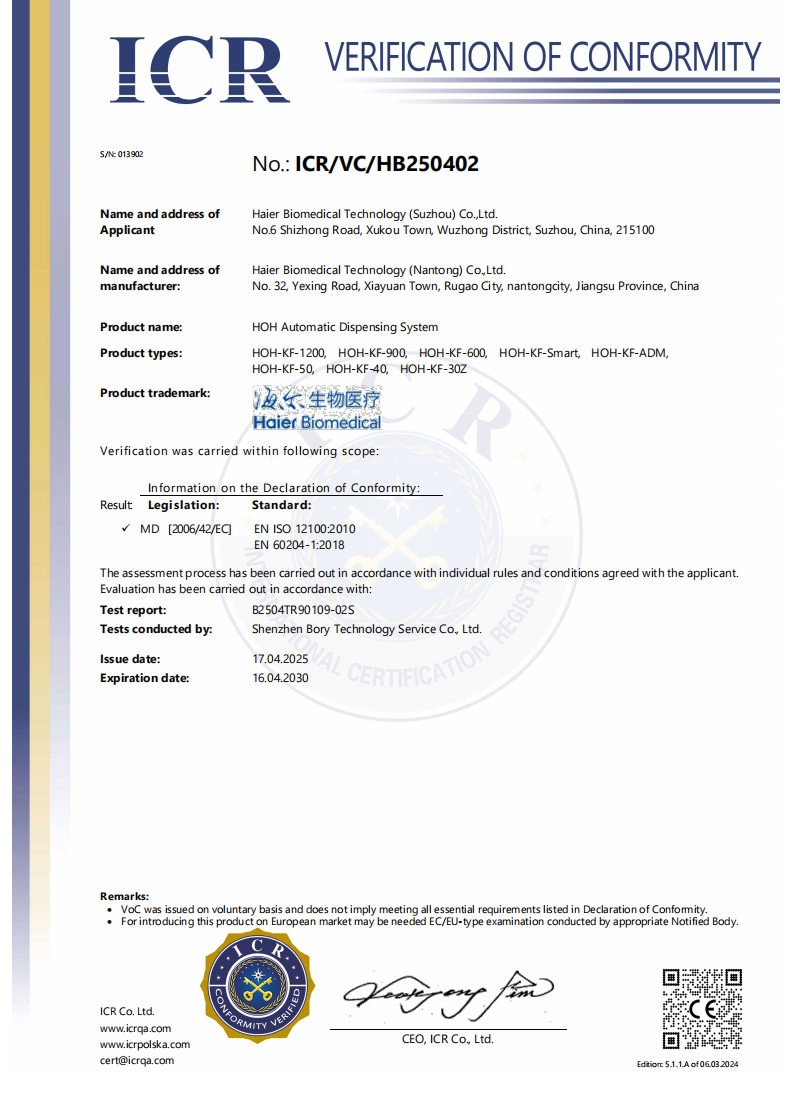
ICR Verification of Conformity ICR/VC/HB250402 covers HOH-KF-1200, HOH-KF-Smart and six further KF models, valid to 16 April 2030. Image: Haier Biomedical.
Step-by-Step Breakdown: Turning This Ranking Into a Specification
The ranking is a starting point, not a purchase order. The sequence below is the order in which the decisions actually constrain each other.
- Name the medication class and the department before the equipment. Cytotoxic admixtures point to PIVAS; anesthetic agents point to the operating room; narcotics and psychotropics point to controlled storage; inpatient unit doses point to sub-packaging and verification. The department choice eliminates more options than any datasheet comparison.
- Define the data backbone. Specify how prescriptions reach the machine. Haier pharmacy automation solutions can be integrated with HIS/EMR so that prescription information transfers to the automation system for dispensing. Confirm the interface, the software functions and the interface language as project parameters, and decide where barcode-based identification and verification sit in the flow.
- Check the compliance evidence against the exact model. Certificates are scoped. ICR/VC/HB240501 does not cover the dispensing models; ICR/VC/HB250402 does not cover the cabinets. Build a document matrix per model, note the expiry dates, and add IEC 60601-1 and ISO 13485 expectations to the technical file.
- Size the configuration against space, SKU count and staffing. Equipment size, storage capacity, SKU quantity and module count are customization parameters. A two-module high-speed dispenser and a multi-module robotic arm solve different problems at different footprints, and neither fits a room that was dimensioned for shelving.
- Validate before you scale. The minimum order quantity is 1 unit and Factory Acceptance Test is supported before shipment, which makes a single-department pilot practical. Use the pilot to test the HIS interface and the verification step, not only the hardware.
- Plan delivery and lifecycle together. Standard delivery time is typically 60–90 days depending on project size and configuration. After-sales scope covers remote technical support, on-site installation and commissioning, operator training, software upgrades and spare parts supply — agree these before the equipment arrives, not after.
Use Cases: Which Department Each Configuration Belongs To
Use-case fit is easier to check against a department list than against a specification sheet.
- PIVAS and oncology preparation rooms: HOH-Robot-Plus, where the objective is to standardise cytotoxic compounding and reduce manual handling of hazardous preparations.
- Operating theatres and anesthesia bays: HOH-MJ-01, where anesthetic medication must be retrievable during a case under controlled access.
- Controlled-substance storage rooms: HOH-BQ-A, where narcotic and psychotropic stock has to be stored, issued and reconciled with a defensible record.
- Inpatient dispensaries: HOH-FB-D400-HD for unit-dose sub-packaging with verification, and HOH-GF (2 Modules) where packaging throughput across a wide SKU set is the binding constraint.
- High-volume outpatient pharmacies: HOH-KF-1200 where dispensing peaks overlap replenishment, and HOH-KF-Smart where a large boxed-medication catalogue and parallel prescriptions dominate the workload.
- Unattended and extended-hours operation: configurations can be specified for continuous operation and unattended running where the hospital's workflow supports it — confirm this explicitly, since it changes the escalation and monitoring requirements.
FAQ: Compliance, Capability, Commercial Terms and Lead Time
Which compliance documents should a hospital verify before accepting a pharmacy automation system?
Verification is model-specific rather than category-wide. For the systems in this list, Haier Biomedical supplies EU Verifications of Conformity issued by ICR: ICR/VC/HB240501 for the HOH-MJ-01 and HOH-BQ-A cabinet models against EN 60204-1:2018 and EN ISO 12100:2010, valid to 9 May 2029; ICR/VC/HB250402 for HOH-KF-1200 and HOH-KF-Smart, valid to 16 April 2030; ICR/VC/HB250403 for the HOH-GF series, valid to 16 April 2030; and ICR/VC/HB250802 for HOH-FB-D400-HD, valid to 5 August 2030. An ISET Voluntary Compliance Certificate, ISETC.000220220323, also covers HOH-KF-Smart and runs to 22 March 2027. Beyond EU machinery evidence, buyers commonly request IEC 60601-1 for medical electrical equipment safety and ISO 13485 for quality management, and US deployments require controls consistent with FDA 21 CFR Part 11 for electronic records and signatures.
Can these pharmacy automation systems integrate with the hospital HIS and support medication identification?
Haier pharmacy automation solutions can be integrated with hospital information systems to support automated prescription processing and dispensing. Depending on project requirements, the system connects with HIS/EMR and other hospital systems so that prescription information is transferred to the pharmacy automation system for dispensing, which removes repetitive manual data entry and keeps process continuity. Identification and checking are handled inside the dispensing and verification workflow, and the HIS interface, software functions and interface language are agreed as customization parameters at project stage.
What are the commercial terms for a pharmacy automation project?
The minimum order quantity is 1 unit and delivery terms are FOB. Payment terms are 50% in advance by TT with the balance before shipping, and Factory Acceptance Test (FAT) is supported as the acceptance criterion before shipment. Because configuration drives scope, the quotation normally follows a confirmed department-level requirement rather than a model number alone.
Can a hospital validate a single unit before committing to a multi-department rollout?
Yes. The 1-unit MOQ makes a single-department pilot practical, and FAT is supported before shipment. A private hospital in Thailand took this route with a customized universal dispenser system developed around local medication packaging characteristics; the configuration supports HIS integration and was built to be scalable, and the installation has been in service for 10 years. A staged approach — prove the workflow and the interface in one department, then extend the same integration and reporting model — is the lower-risk path for hospitals replacing existing shelving or cabinets.
What is the lead time, and what can be customized?
Standard delivery time is typically 60–90 days depending on project size and configuration. Customization covers equipment size, storage capacity, SKU quantity, robotic modules, software functions, HIS interface and language. After-sales scope includes remote technical support, on-site installation and commissioning, operator training, software upgrades and spare parts supply. To scope a configuration against a specific department, the full-scenario intelligent pharmacy brochure can be downloaded from the link below, and the team can be reached at smartpharmacy@haierbiomedical.com or on +86-18770083375 to arrange a requirement review.
Conclusion: Rank the Use Case, Then the Machine
The seven systems above do not compete for one budget line; they compete for different risks. HOH-Robot-Plus takes the top position because cytotoxic compounding concentrates both exposure and preparation variance in a single step. HOH-MJ-01 and HOH-BQ-A follow because anesthetic and controlled medications demand point-of-use access and defensible records. HOH-FB-D400-HD is the only configuration here that adds a verification stage to the dispensing path. HOH-GF (2 Modules), HOH-KF-1200 and HOH-KF-Smart then sit in the volume-driven tier, where the choice is decided by footprint, SKU mix and staffing model rather than by capability.
A hospital that starts from the department and the medication class will usually find that two or three configurations survive the first filter, and that the remaining differences are integration, certificate scope and floor space — all of which can be verified before signature. That is a faster route to a defensible decision than comparing headline throughput across machines that never meet in the same room.
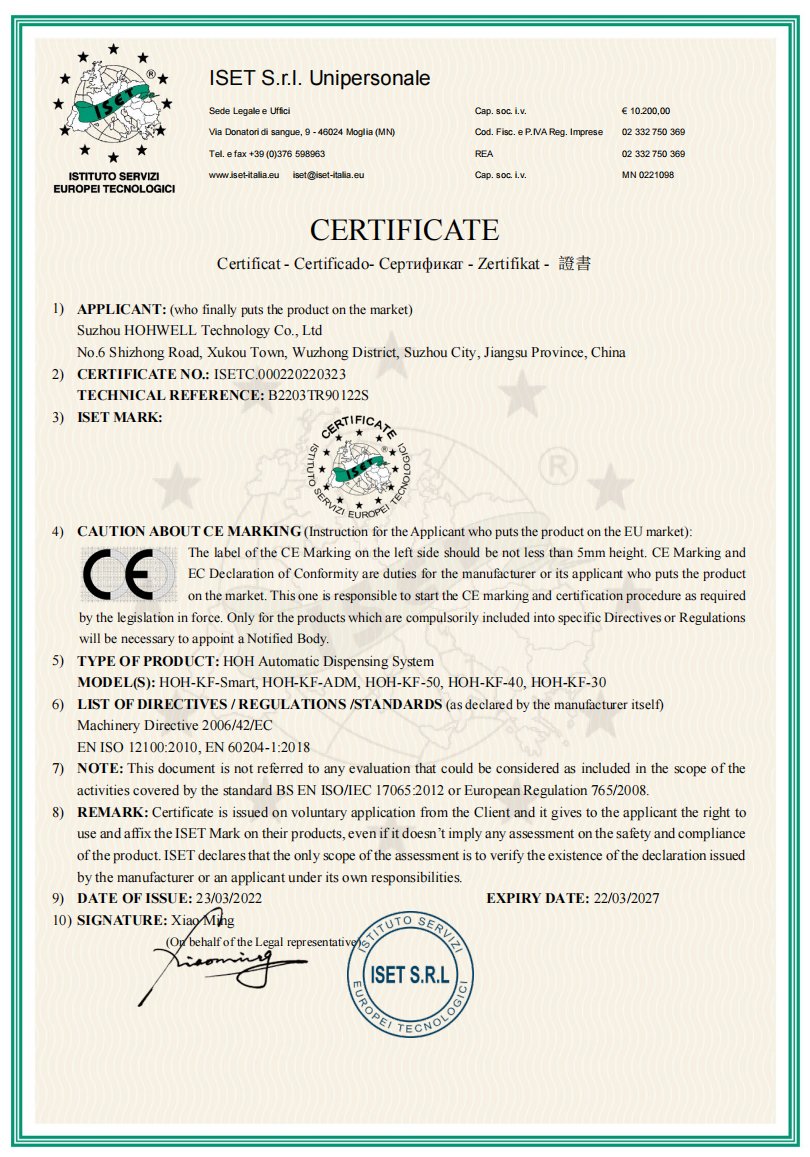
ISET Voluntary Compliance Certificate ISETC.000220220323 covers HOH-KF-Smart against EN ISO 12100:2010 and EN 60204-1:2018, valid to 22 March 2027. Image: Haier Biomedical.
Next step: download the Full-scenario Intelligent Pharmacy brochure for the complete configuration set, or contact Haier Biomedical Technology(Suzhou)Co., Ltd at smartpharmacy@haierbiomedical.com / +86-18770083375 to request a use-case review, a model-specific certificate pack or a quotation for a single-department pilot. Website: www.haierautomation.com.
Have Questions or Need More Details?
Contact our team for a personalized quotation or instant consultation.
Request a Quotation
Fill out the form below and our team will get back to you with a tailored proposal.
WhatsApp Direct Chat
Prefer to chat in real-time? Message us on WhatsApp for instant assistance & quick answers.
- Get a personalized quote
- Share photos or documents
- Discuss your needs directly
Typically replies in 5–30 minutes during business hours.