
Pharmacy Automation Hardware Categories: Dispensers, Cabinets, and Compounding Robots Explained
Hospital pharmacy automation is easier to evaluate when the hardware is grouped into three functional families instead of treated as one long list of machines. Dispensing systems — robotic arm, chute type, and high-speed — move boxed medication from storage to a picking point. Cabinet systems — intelligent integrated medication management cabinets and anesthetic medication dispensing cabinets — hold medication close to the point of use and control who opens what. Preparation equipment — automatic sub-packaging and verification machines and fully automated cytotoxic drug compounding robots — either changes the physical form of a medication or prepares it before it reaches the patient. This article defines all seven categories, states the verified specifications of one representative model in each, and shows how the categories are combined in hospital projects.
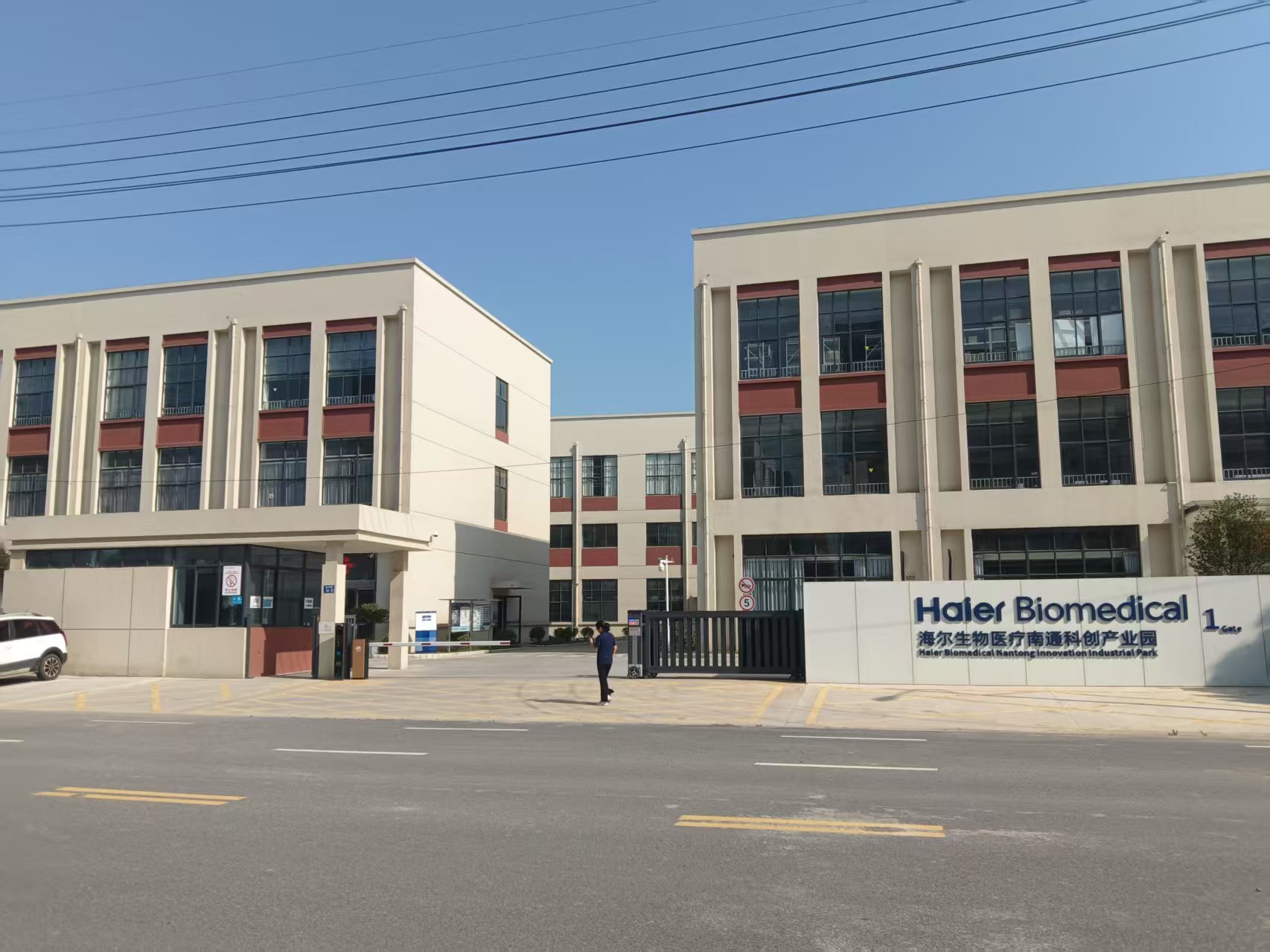
The explainer is written for buyers at the evaluation stage: pharmacy directors, biomedical engineering teams, and procurement managers who already know they want automation but need to decide which hardware belongs in which part of the workflow. It uses only published specifications from Haier Biomedical Technology (Suzhou) Co., Ltd — a healthcare technology company under Haier Group that develops intelligent pharmacy automation for hospitals, clinics, and healthcare organisations — together with third-party market data where a source is named.
The Category Problem: Why Hardware Labels Do Not Compare Cleanly
Most evaluation problems in pharmacy automation start with vocabulary, not with equipment. A robotic arm dispenser, a chute type dispenser, and a high-speed dispenser are all described in tenders as an “automated dispensing system”, yet they solve different throughput problems. Cabinets are frequently filed under the same heading even though they do not dispense prescriptions at all — they store and control access. A sub-packaging machine and a verification machine are often quoted as one item, although only one of them changes the medication into unit-dose pouches and the other adds a checking step.
Five comparison errors follow from that ambiguity, and they appear repeatedly in evaluation documents:
- Comparing throughput figures that measure different things. A single-channel figure (boxes per second) and a whole-machine figure (prescriptions per hour) are not interchangeable, and neither is a batch-dispensing rate.
- Sizing storage for today’s formulary only. Each category has a defined medication-type and box-capacity ceiling that constrains future formulary growth.
- Treating cabinets as accessories. When a hospital wants medication held at ward or theatre level rather than in the central pharmacy, cabinets are the primary hardware decision, not an add-on.
- Skipping the verification layer. Automation removes manual picking steps; a verification process adds a separate check on what was dispensed.
- Checking a vendor’s certification instead of the model’s scope. Compliance documents are issued for defined model lists, and a certificate that does not name the model being purchased proves nothing about that model.
Industry Background: Why the Category Set Is Widening
Pharmacy automation hardware is expanding from dispensing-only equipment into dispensing, decentralised storage, and robotic preparation. Insightace Analytic estimates the global pharmacy automation devices market at USD 6.7 billion in 2024, and Grand View Research projects it to reach USD 11.6 billion by 2030 at a CAGR of 9.9%. The category mix matters more than the headline figure for anyone writing a specification.
Dataintelo reports that medication dispensing systems held the largest product segment share in 2025 at 32.5%, which is consistent with dispensers remaining the first automation purchase in most hospitals. Grand View Research identifies automated medication compounding systems as the fastest-growing product segment, with a CAGR exceeding 10%. Fortune Business Insights reports that the hospital pharmacy segment held the largest market share in 2024, driven by patient volumes and complex medication regimens, and that decentralised distribution models are expected to account for 79.8% of the market in 2026 as automated dispensing cabinets are adopted. MarketsandMarkets expects software to grow fastest among components from 2024 to 2030.
Two operational drivers sit underneath those numbers. Omnicell reports that 75% of pharmacist time is traditionally spent on non-clinical tasks, which is the workload automation is meant to absorb. Haier Biomedical reports that its AI-powered automated pharmacy solutions increased direct dispensing rates to 80% in 2025. Both point in the same direction: the hardware decision is increasingly about which step in the workflow is automated, not about whether to automate.
The Seven Hardware Categories, Explained
1. Robotic Arm Dispenser — HOH-KF-Smart
A robotic arm dispenser stores boxed medication in a defined storage structure and uses a robotic arm to pick and place items between storage locations and the dispensing point. It is the category to examine when a pharmacy carries a wide formulary of boxed medicines and needs automated storage and retrieval rather than manual shelf walking.
Verified specifications (HOH-KF-Smart):
Medication types ≥1,500 · Storage capacity ≥20,000 boxes · Dispensing speed ≥300 prescriptions/hour · Replenishment speed ≥700 boxes/hour · Main unit dimensions 8650 × 1747 × 2850 mm (replenishment module excluded) · FIFO/FEFO expiration management · barcode recognition with full-chain traceability
Two specification points deserve attention during evaluation. First, expiration management is stated as FIFO/FEFO support, which is the mechanism behind drug expiration monitoring: stock is issued in date order rather than by physical position. Second, barcode recognition is described as full-chain monitoring, which is what makes a drug traceability system possible at item level rather than at batch level.
The constraint is physical. At 8,650 mm of main-unit length excluding the replenishment module, this category is a room-planning decision as much as a purchasing decision. Hospitals with tight outpatient footprints should confirm available length before shortlisting it.
2. Chute Type Dispenser — HOH-KF-1200
A chute type dispenser releases medication down dedicated chutes after the system locates the correct storage position. It is built for prescription throughput in outpatient pharmacies where the bottleneck is the number of prescriptions completed per hour rather than the number of SKUs carried.
Verified specifications (HOH-KF-1200):
Medication types >1,100 · Storage capacity >15,000 boxes · Dispensing speed >350–500 prescriptions/hour · Replenishment speed >2,400 boxes/hour · Dimensions <4690 × 2850 × 2735 mm · Space requirement <12.85 m² · Modular dispensing, storage, and loading units · Full-screen dispensing with safety buffers · Parallel multi-prescription operation · ≥2 dispensing buffer ports supporting side buffering and front-end output
The defining design feature is parallel multi-prescription operation combined with a modular structure: dispensing, storage, and loading units are separate modules, so the machine can be sized to the room and the workload instead of being accepted as one fixed block. The safety buffers are what make parallel operation practical, because prescriptions wait in at least two channels rather than colliding at a single output point.
The limitation to check is scope: with more than 1,100 medication types and more than 15,000 boxes, this category covers a broad but bounded formulary. Pharmacies carrying unusually wide boxed ranges should compare it against the robotic arm category.
3. High-Speed Dispenser — HOH-GF (2 Modules)
A high-speed dispenser handles fast-moving SKUs in bulk. Rather than serving as the only dispensing unit in a pharmacy, it is typically paired with a larger dispenser to absorb the medicines that dominate daily volume.
Verified specifications (HOH-GF, 2 modules):
Storage slots ≥100 · Storage capacity ≥5,000 boxes · Single-channel dispensing ≥2 boxes/second · Medication bin modules ≤2 · Main unit dimensions 2180 × 1230 × 2800 mm · Dual-level stacked structure with adjustable bin width · Batch dispensing for multiple boxes · High-precision photoelectric sensors for dispensing detection · Automatic positioning guidance with indicator lights
The dual-level stacked structure with adjustable bin width is the part that matters operationally, because bin width determines which pack sizes the machine can hold without jamming. Dispensing detection is handled by photoelectric sensors, and errors are flagged through indicator lights that guide the operator to the position that needs attention — a small detail that decides how quickly a queue is cleared after a fault.
Its boundary is capacity, not speed. At 5,000 boxes across at least 100 slots, this category is a high-velocity buffer, not a replacement for a wide-formulary dispenser.
4. Automatic Sub-packaging and Verification Machine — HOH-FB-D400-HD
This category does something different from a dispenser: it repackages medication into unit-dose pouches and provides a verification step in the same workflow. It is the standard hardware answer for inpatient and long-term care dispensing, where nurses need single doses rather than boxes.
Verified specifications (HOH-FB-D400-HD):
Number of medication boxes 400 · Packaging speed 40–60 packs/minute · Packaging bag size 75 × 70 mm · External output tray 72 slots · Overall dimensions 1200 × 880 × 2025 mm · Rated power 2,000 W · Net weight 700 kg · Operating environment 0–40 °C, humidity 10–80% · Power supply AC220 V +10%, 50/60 Hz
The verification function is the reason this category appears in tender lists alongside dispensers. Automated dispensing follows predefined medication and prescription information; the verification process checks the dispensed medication against that information according to the configured workflow. Automation reduces the number of manual picking steps, while verification adds a separate layer of checking — the two are complementary, not substitutes.
Environment is the practical constraint. The stated operating range of 0–40 °C and 10–80% humidity should be checked against the room the machine will actually occupy, and the 72-slot output tray needs to match the handover pattern of the ward it serves.
5. Intelligent Integrated Medication Management Cabinet — HOH-BQ-A
An intelligent integrated medication management cabinet stores medication at the point of use with controlled access and digital records. It is the category that supports decentralised distribution: instead of every dose travelling from a central pharmacy, stock is held closer to the ward and released under defined permissions.
Verified specifications (HOH-BQ-A):
External dimensions 620 × 700 × 1240 mm · Small pillboxes (standard) 32 pcs · Capacity per small pillbox 150 pcs (counted by 1 mL ampoule) · Large pillboxes (standard) 8 pcs · Capacity per large pillbox 20 pcs (calculated on a regular pillbox) · 23-inch touch screen · Power supply AC 220 V, 50/60 Hz
The footprint is the evaluation point. At 620 mm wide, the cabinet fits into ward corridors and treatment rooms where a dispenser cannot go, and the 23-inch touch screen is large enough for medication identification at the point of access. Capacity is deliberately modest: 32 small and 8 large pillboxes is a point-of-use complement to central dispensing, not a store-room replacement.
6. Anesthetic Medication Dispensing Cabinet — HOH-MJ-01
An anesthetic medication dispensing cabinet is configured for the operating room and anaesthesia workflow, where access is frequent, the item count per transaction is small, and documentation has to keep pace with the case list.
Verified specifications (HOH-MJ-01):
9 drawers — the first 7 drawers use a 6-grid layout, the bottom 2 drawers use a single-grid layout, all with lids · 44 compartments in total · Maximum single-layer volume 28.3 L · External dimensions 745 × 700 × 1800 mm · Small drawer 243 × 128 × 85 mm (42 pcs) · Large drawer 477 × 491 × 108 mm (2 pcs) · Power supply 220 V, 50/60 Hz · Power 400 W · Net weight 400 kg · 15-inch touch screen
The drawer geometry is what separates this category from a general cabinet. A 6-grid layout across seven drawers gives compartment-level separation for small anaesthetic items, while two large drawers at 28.3 L maximum single-layer volume accept bulk items. Lids on every drawer mean the cabinet can be closed and locked as a unit between cases.
7. Fully Automated Cytotoxic Drug Compounding Robot — HOH-Robot-Plus
A cytotoxic compounding robot prepares hazardous intravenous medication inside a controlled environment. It is the category that belongs to the PIVAS (pharmacy intravenous admixture service) rather than to the outpatient counter, and it is the most technically constrained of the seven.
Verified specifications (HOH-Robot-Plus):
Dimensions 2200 × 1520 × 2370 mm · Device weight 1,300 kg · Vial compatibility >95% of vials · Compounding efficiency 25 preparations/hour · Solvent compatibility 50–1,000 mL soft bags, plastic bottles, and stand-up pouches · Consumables: Luer-lock general-purpose syringes and dedicated needles · Compounding accuracy 100% · Compounding environment Class 100 (ISO 5) cleanroom conditions
Compounding takes place inside a Class 100 (ISO 5) cleanroom environment built into the unit, so the hazardous preparation step is performed by the robot inside that enclosure rather than at an open bench. That changes the operator’s role from manual transfer to consumable loading and process oversight, and it is the reason this category is evaluated against cleanroom classification evidence rather than against dispensing speed alone.
Quantity expectations should be set realistically. At 25 preparations per hour, the robot is usually paired with manual capacity for peaks rather than assumed to absorb the entire PIVAS workload. Solvent compatibility is also bounded: 50–1,000 mL soft bags, plastic bottles, and stand-up pouches, with Luer-lock general-purpose syringes and dedicated needles as consumables.
Step-by-Step: Matching a Category to Your Pharmacy
- Define the bottleneck in prescriptions, not in machines. Record peak-hour prescription volume and the step where queues form. A dispensing bottleneck points to the chute or robotic arm category; a unit-dose bottleneck points to sub-packaging and verification; a hazardous-preparation bottleneck points to the compounding robot.
- Classify the medication forms you actually hold. Boxed medication, unit-dose pouches, ampoules and vials, and hazardous preparations each map to different hardware. Mixing them in one requirement document is the most common source of mismatched quotations.
- Check storage ceilings against formulary growth. The robotic arm category is specified at ≥1,500 medication types and ≥20,000 boxes; the chute category at >1,100 types and >15,000 boxes; the high-speed category at ≥5,000 boxes. Compare these to a three-year formulary forecast, not to today’s list.
- Confirm the physical fit before the commercial discussion. Dimensions and space requirements differ by an order of magnitude between categories: 8,650 mm of main-unit length for the robotic arm dispenser, under 12.85 m² of space for the chute dispenser, and 620 mm of width for the integrated cabinet. Measure the room first.
- Map the data interfaces. Pharmacy automation is integrated with hospital information systems so that prescription information is transferred to the automation system for processing under configured dispensing rules, which reduces repetitive manual data entry. The HIS interface and system language are both listed as customisable items, so they should be settled in the requirement, not after delivery.
- Verify compliance evidence at model level. Ask for the certificate that names the model being purchased and confirm the standards and validity dates. The EU documents for these categories cite EN ISO 12100:2010 and EN 60204-1:2018; quality management is covered separately by ISO 13485 certification.
- Plan validation and delivery. Factory Acceptance Test (FAT) before shipment is part of the manufacturer’s quality control process. Lead time is typically 60–90 days depending on project size and configuration, with a minimum order quantity of one unit, followed by on-site installation and commissioning, operator training, software upgrades, and spare parts supply.
Use Cases: Which Category Fits Which Hospital Setting
High-volume outpatient pharmacy
The chute type dispenser is the natural anchor, with >350–500 prescriptions per hour, parallel multi-prescription operation, and at least two buffer channels. Where a large share of volume sits in a small number of fast movers, a high-speed dispenser is added to absorb batch dispensing at ≥2 boxes per second per channel.
Wide-formulary outpatient or central pharmacy
The robotic arm dispenser covers ≥1,500 medication types and ≥20,000 boxes, with FIFO/FEFO expiration management and barcode-based traceability. It suits pharmacies where formulary breadth, rather than prescription count, is the defining constraint.
Inpatient wards and unit-dose distribution
The automatic sub-packaging and verification machine produces 40–60 pouches per minute into 75 × 70 mm bags with a 72-slot output tray. Combined with a verification step in the workflow, it gives the ward a checked unit-dose supply rather than bulk boxes.
Ward-level and theatre-level storage
The intelligent integrated medication management cabinet covers point-of-use storage in 620 mm of width, and the anesthetic medication dispensing cabinet provides 44 compartments across nine drawers with lids for operating room access patterns. Both are decentralised-distribution hardware, which is the segment Fortune Business Insights expects to account for 79.8% of the market in 2026 as automated dispensing cabinets are adopted.
PIVAS and hazardous drug preparation
The cytotoxic compounding robot operates at 25 preparations per hour inside Class 100 (ISO 5) cleanroom conditions, with vials covering more than 95% of types and solvents from 50 to 1,000 mL. It belongs in a PIVAS workflow with defined consumable logistics, not in a general dispensary.
Reference installations
Two hospital projects illustrate how these categories are combined in practice. A private hospital in Thailand deployed one set of a customized universal dispenser system in its outpatient pharmacy, developed around local medication packaging characteristics and compatible with various medication formats; customer feedback reports stable and efficient automated dispensing with improved accuracy and reduced repetitive tasks, and the system supports HIS integration with a modular, scalable design. A general hospital in Vietnam deployed one set of an intelligent pharmacy automation system, customized to the hospital’s pharmacy layout and workflow with seamless HIS integration, achieving a pharmacy automation upgrade, optimised dispensing workflows, improved medication management efficiency, reduced patient waiting time, and an improved patient service experience.
Comparison Table: Verified Specifications by Category
| Hardware category | Representative model | Verified characteristics | Primary fit |
|---|---|---|---|
| Robotic arm dispenser | HOH-KF-Smart | ≥1,500 medication types; ≥20,000 boxes; ≥300 prescriptions/hour; replenishment ≥700 boxes/hour; FIFO/FEFO; barcode traceability; 8650 × 1747 × 2850 mm | Wide formularies in high-volume boxed medication settings |
| Chute type dispenser | HOH-KF-1200 | >1,100 medication types; >15,000 boxes; >350–500 prescriptions/hour; replenishment >2,400 boxes/hour; modular units; parallel multi-prescription; ≥2 buffer ports; space <12.85 m² | High-throughput outpatient dispensing |
| High-speed dispenser | HOH-GF (2 modules) | ≥100 slots; ≥5,000 boxes; ≥2 boxes/second per channel; dual-level stacked structure; adjustable bin width; photoelectric dispensing detection; 2180 × 1230 × 2800 mm | Fast-moving SKUs and batch dispensing |
| Sub-packaging and verification machine | HOH-FB-D400-HD | 400 medication boxes; 40–60 packs/minute; 75 × 70 mm bags; 72-slot output tray; 1200 × 880 × 2025 mm; 2,000 W | Unit-dose inpatient supply with a verification step |
| Intelligent integrated medication management cabinet | HOH-BQ-A | 32 small pillboxes (150 pcs each); 8 large pillboxes (20 pcs each); 23-inch touch screen; 620 × 700 × 1240 mm | Point-of-use storage and access control |
| Anesthetic medication dispensing cabinet | HOH-MJ-01 | 9 drawers; 44 compartments; max single-layer volume 28.3 L; 15-inch touch screen; 745 × 700 × 1800 mm; 400 W | Operating room and anaesthesia storage |
| Fully automated cytotoxic drug compounding robot | HOH-Robot-Plus | >95% vial compatibility; 25 preparations/hour; solvents 50–1,000 mL; 100% compounding accuracy; Class 100 (ISO 5) cleanroom conditions; 2200 × 1520 × 2370 mm | PIVAS and hazardous drug preparation |
All specifications above are as published for the named models; other configurations within the same category differ.
| Hospital profile | Category combination to evaluate | Reason |
|---|---|---|
| Very high outpatient prescription count | Chute type dispenser + high-speed dispenser | Prescription throughput plus batch handling of fast movers |
| Broad formulary, moderate count | Robotic arm dispenser | Medication-type and box-capacity headroom |
| Inpatient wards on unit-dose supply | Sub-packaging and verification machine | Pouch output at 40–60 packs/minute with a checking step |
| Decentralised ward or theatre stock | Integrated management cabinet + anesthetic cabinet | Small-footprint point-of-use access with controlled release |
| Hazardous IV preparation | Cytotoxic compounding robot | Class 100 (ISO 5) environment and 100% compounding accuracy specification |
This mapping is an editorial guideline built from the verified specifications above; final configuration depends on measured prescription volume, formulary, and room dimensions.
FAQ
- Which compliance documents should be checked for each hardware category?
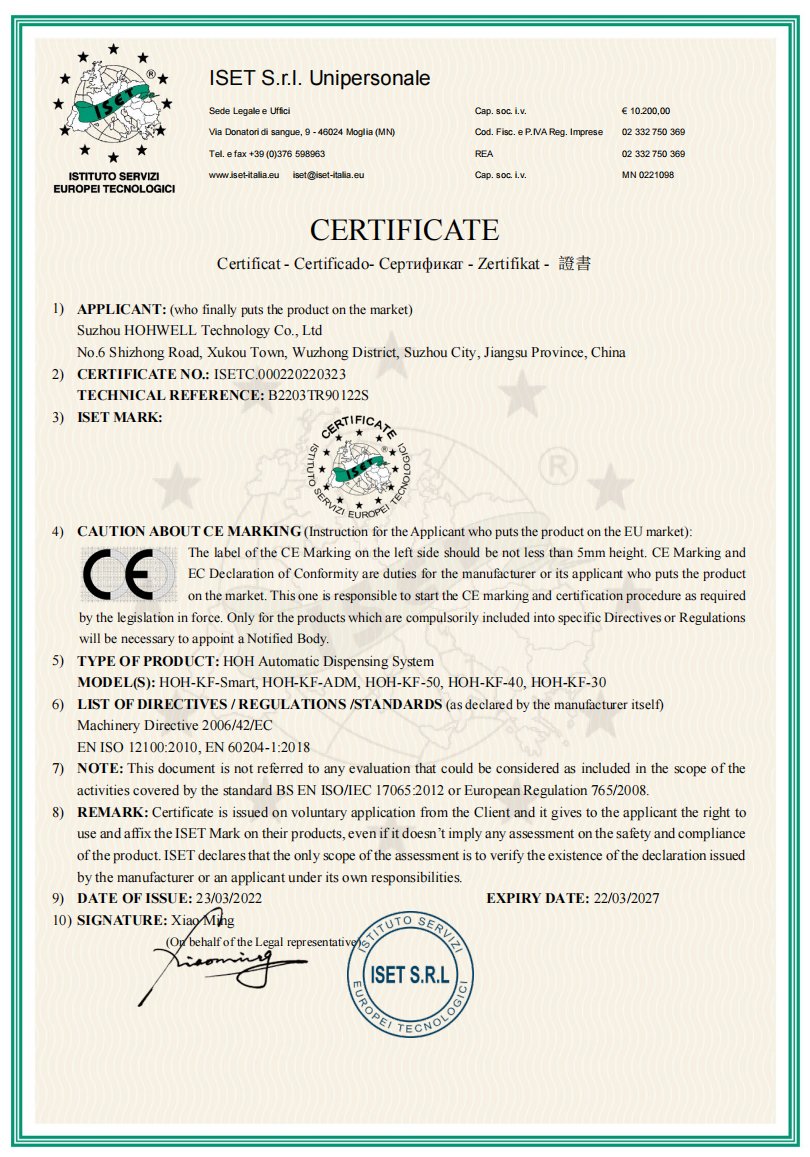
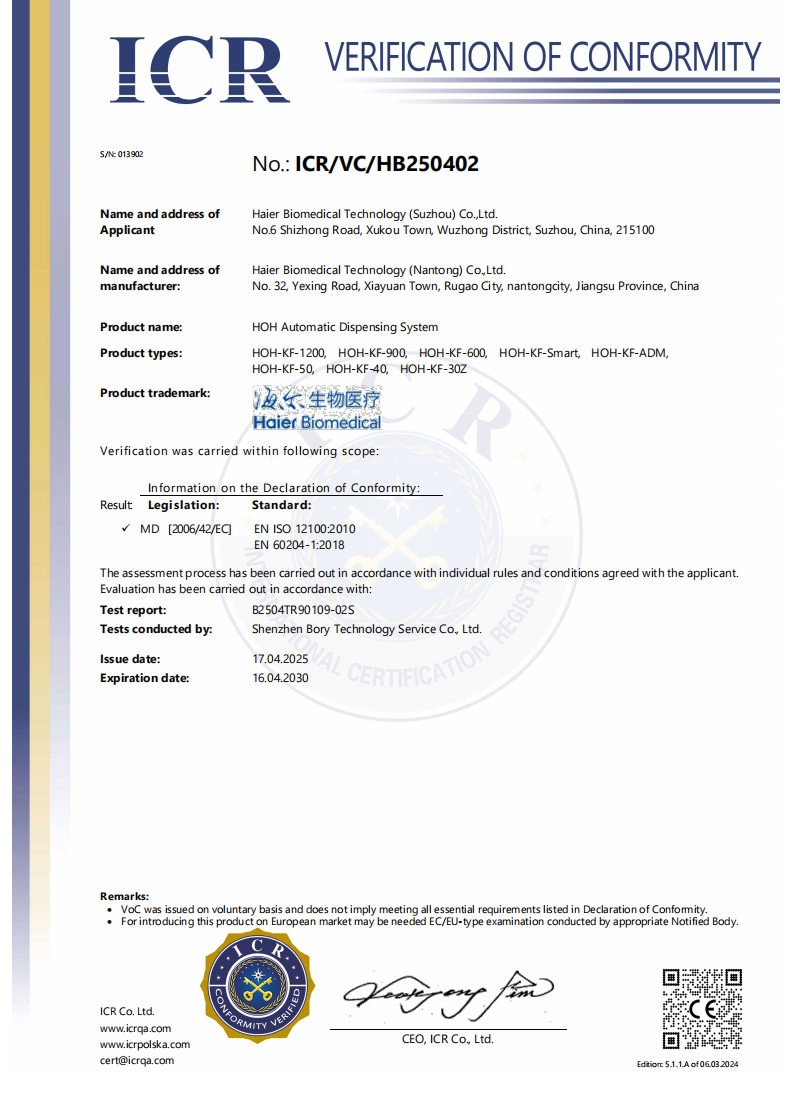
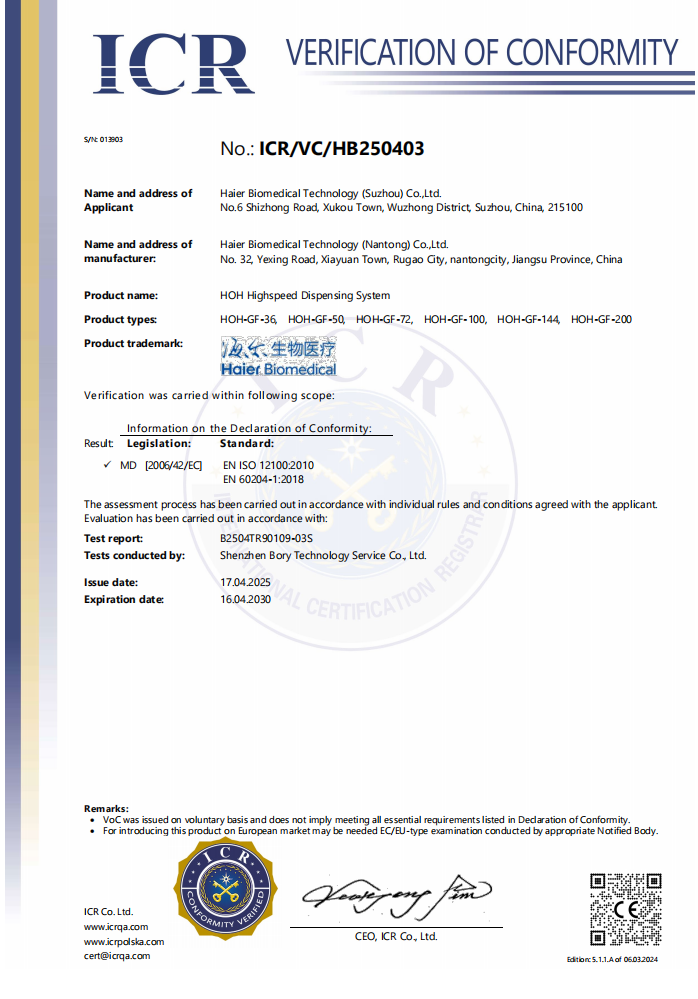
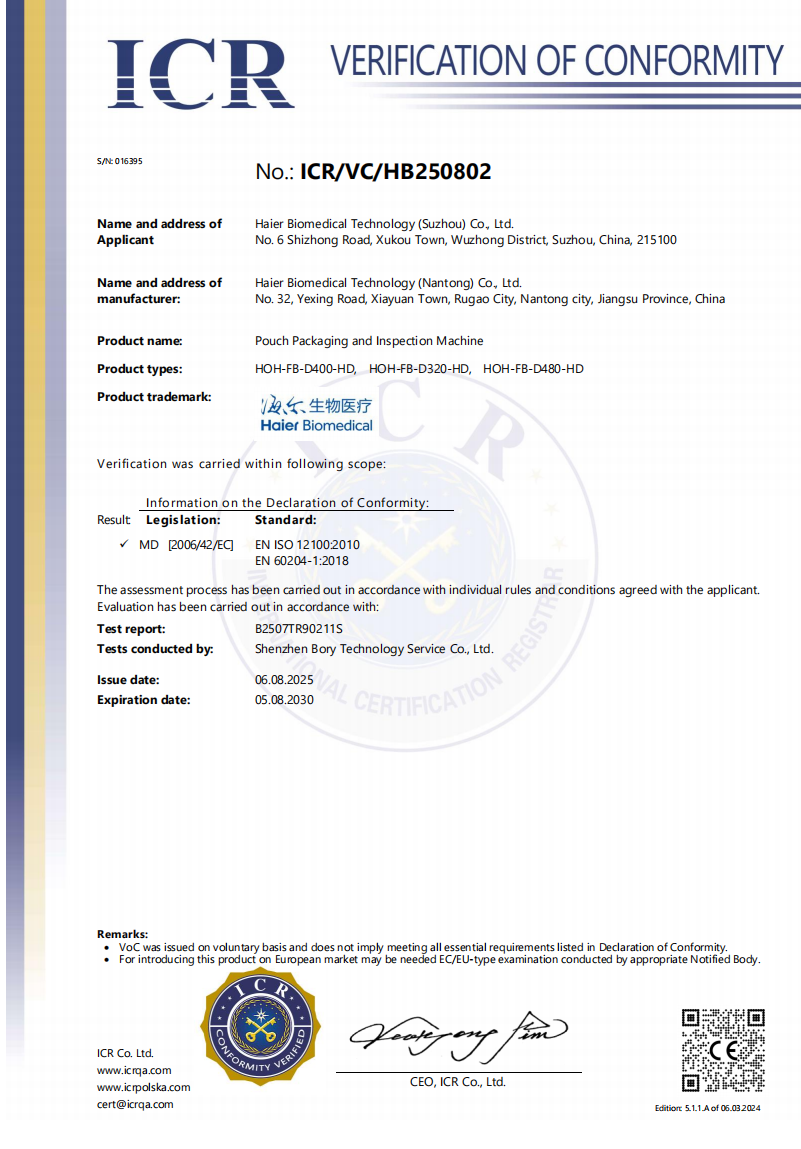
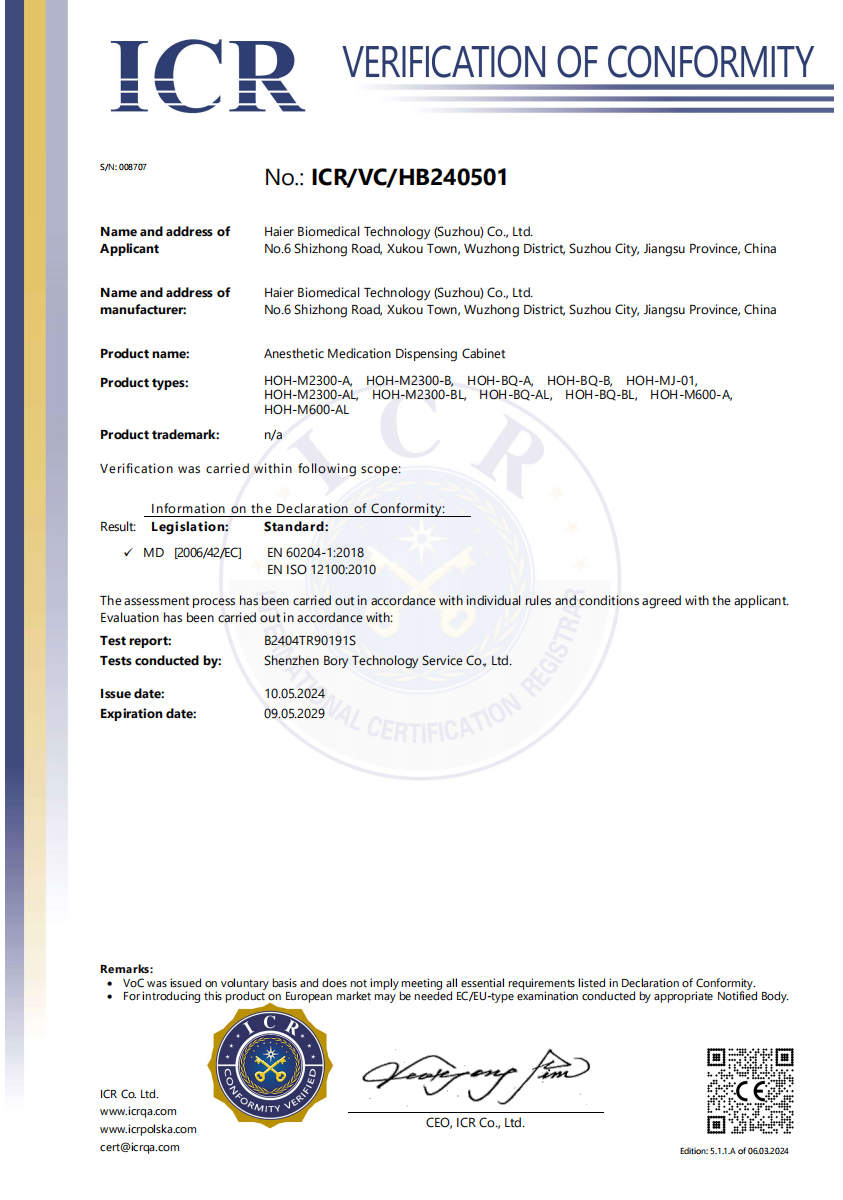
- Ask for the certificate that names the model being purchased. For the EU market, the Haier Biomedical model families referenced in this article carry Verification of Conformity documents issued against EN ISO 12100:2010 and EN 60204-1:2018: ICR/VC/HB250402 for Automatic Dispensing System models including HOH-KF-1200 and HOH-KF-Smart (valid to 16 April 2030); ICR/VC/HB250403 for Highspeed Dispensing System models HOH-GF-36 to HOH-GF-200 (valid to 16 April 2030); ICR/VC/HB250802 for Pouch Packaging and Inspection Machine models HOH-FB-D400-HD, HOH-FB-D320-HD, and HOH-FB-D480-HD (valid to 5 August 2030); and ICR/VC/HB240501 for cabinet models including HOH-BQ-A and HOH-MJ-01 (valid to 9 May 2029). HOH-KF-Smart is additionally named in ISET voluntary compliance certificate ISETC.000220220323 (valid to 22 March 2027). At manufacturer level, Haier Biomedical holds ISO 13485 medical device quality management system certification, while general requirements for medical electrical equipment safety are covered by IEC 60601-1 and electronic records and signatures in US settings by FDA 21 CFR Part 11.
- Can these hardware categories integrate with a hospital HIS?
- Yes. Haier pharmacy automation solutions can be integrated with hospital information systems to support automated prescription processing and dispensing workflows, and depending on project requirements the system can connect with HIS/EMR and other hospital systems so prescription information is transferred to the pharmacy automation system for dispensing. The hospital system sends prescription information through the defined interface, and the automation system processes it according to configured dispensing rules and equipment workflows, which reduces repetitive manual data entry and keeps process continuity. HIS interface and system language are both listed as customisable items in the manufacturer’s OEM/ODM scope, alongside equipment size, storage capacity, SKU quantity, robotic modules, and software functions.
- What determines the commercial scope of a pharmacy automation hardware project?
- Scope is driven by configuration rather than by category alone. The customisable variables published for these systems are equipment size, storage capacity, SKU quantity, robotic modules, software functions, HIS interface, and language — and each of them changes the specification, the footprint, and the delivery plan. Site conditions matter as much: an 8,650 mm robotic arm main unit, a chute dispenser requiring under 12.85 m² of space, and a 620 mm-wide cabinet are three different room requirements. The minimum order quantity is one unit, and production is project-based, so the practical way to obtain a costed scope is to submit the formulary, prescription volume, room dimensions, and interface requirements together, then request a configuration-specific quotation.
- How can a hospital validate a configuration before it is shipped?
- Validation is built into the delivery process: the manufacturer performs Factory Acceptance Test (FAT) before shipment as part of its quality control, so the configured system is tested at the factory rather than first switched on at the hospital. Verification also belongs inside the workflow after go-live — automated dispensing reduces the volume of repetitive manual picking and standardises the dispensing workflow, while a verification process such as an automated verification machine adds further checks on medication information before dispensing. Reference installations can be reviewed in parallel: a private hospital in Thailand uses a customized universal dispenser system developed around local medication packaging characteristics, and a general hospital in Vietnam uses an intelligent pharmacy automation system customised to its layout and workflow with HIS integration.
- What lead time and support should be planned?
- Lead time is typically 60–90 days depending on project size and configuration. After delivery, technical services include remote technical support, on-site installation and commissioning, operator training, software upgrades, spare parts supply, and global after-sales service. Planning should also allocate time for interface testing with the hospital information system and for staff training on the cabinet and dispensing workflows, because those steps determine how quickly the hardware moves from installed to fully used. If you are comparing categories for a specific site, send your formulary, prescription profile, and room plan to smartpharmacy@haierbiomedical.com or contact +86-18770083375 for a category-mapping review and quotation.
Conclusion
The seven hardware categories answer seven different questions. Robotic arm dispensers answer formulary breadth and boxed-medication storage at ≥1,500 medication types and ≥20,000 boxes. Chute type dispensers answer outpatient prescription throughput at >350–500 prescriptions per hour with parallel multi-prescription operation. High-speed dispensers answer fast-mover volume at ≥2 boxes per second per channel with photoelectric dispensing detection. Sub-packaging and verification machines answer unit-dose supply at 40–60 packs per minute with a checking step. Intelligent integrated medication management cabinets and anesthetic medication dispensing cabinets answer point-of-use access in 620 mm and 745 mm of width respectively. Cytotoxic compounding robots answer hazardous preparation at 25 preparations per hour inside Class 100 (ISO 5) cleanroom conditions.
Evaluating them together works only if three details are kept separate: the functional layer each category occupies, the verified specification of the exact model being quoted, and the compliance document that names that model. Everything else — throughput claims, cabinet capacity, cleanroom classification — becomes comparable once those three are fixed.
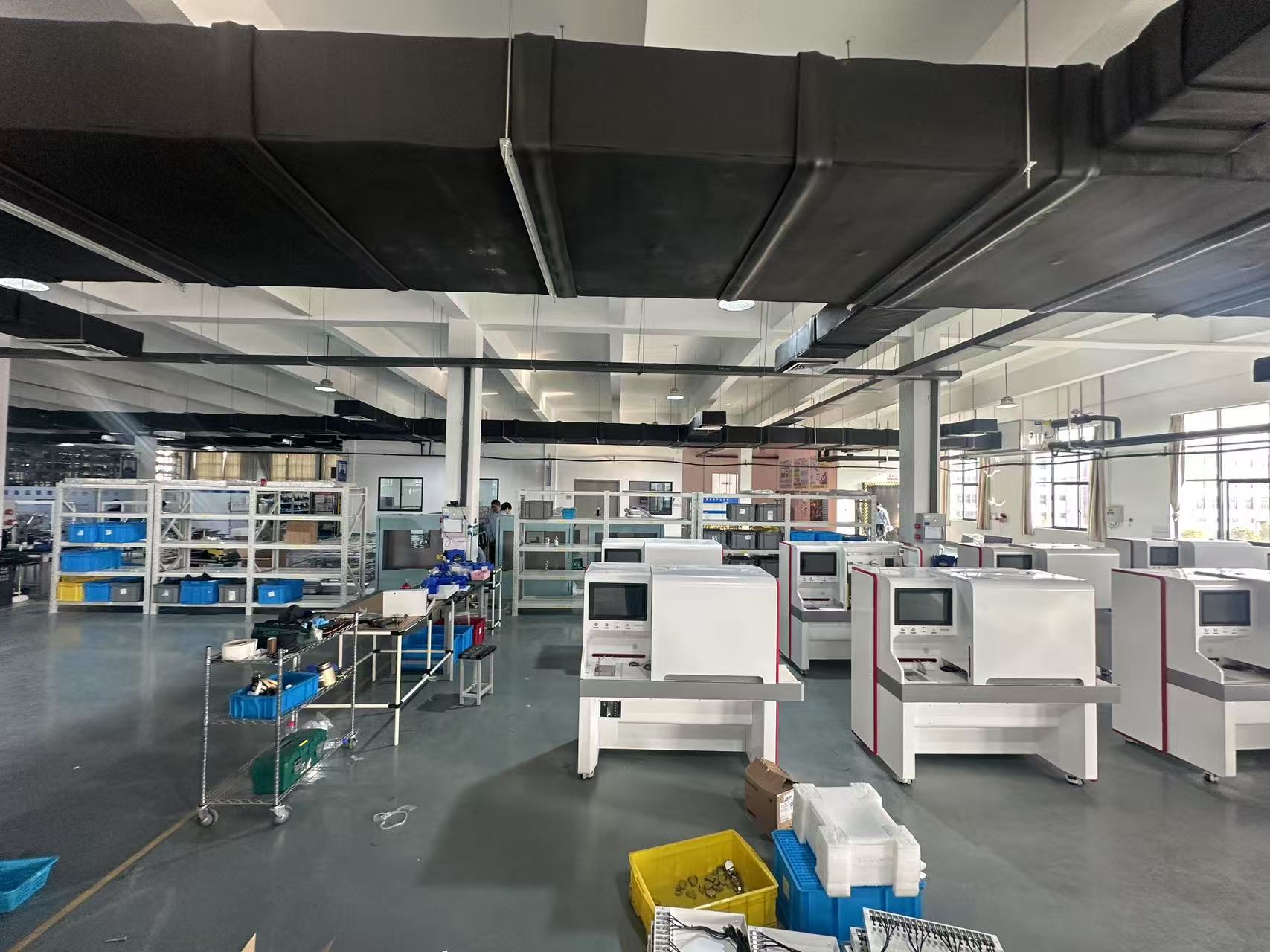
About the manufacturer: Haier Biomedical Technology (Suzhou) Co., Ltd was founded in 2015 and operates a 13,000 m² facility with 500 employees, including a 100-engineer R&D team, serving markets in Southeast Asia, Latin America, and the Middle East. Its pharmacy automation business unit develops intelligent pharmacy automation covering medication storage, automated dispensing, medication verification, inventory management, IV compounding automation, and digital pharmacy workflow optimisation, with integration support for HIS and EMR platforms.
Next Step
Category mappingConfiguration quoteCompliance pack
Download the full-scenario intelligent pharmacy catalogue for the complete model and specification list: Full-scenario Intelligent Pharmacy (PDF).
Contact: Gina · Tel +86-18770083375 · WhatsApp +86-187 7008 3375 · Email smartpharmacy@haierbiomedical.com · Website www.haierautomation.com · Address No.6 Shizhong Road, Wuzhong District, Suzhou, China, 215100.
Have Questions or Need More Details?
Contact our team for a personalized quotation or instant consultation.
Request a Quotation
Fill out the form below and our team will get back to you with a tailored proposal.
WhatsApp Direct Chat
Prefer to chat in real-time? Message us on WhatsApp for instant assistance & quick answers.
- Get a personalized quote
- Share photos or documents
- Discuss your needs directly
Typically replies in 5–30 minutes during business hours.