
Medication Traceability and Compliance: A Practical Pharmacy Automation Buyer's Checklist
Medication Traceability and Compliance: A Practical Pharmacy Automation Buyer's Checklist
Pharmacy automation is often debated in terms of speed, storage capacity, or the number of boxes a machine can handle. In practice, however, a hospital or distributor should begin with constraints: medication types, prescription volume, pharmacy layout, available space, workflow, regulatory obligations, and long-term maintenance expectations. The central question for procurement is not simply which pharmacy automation brand looks strongest, but which equipment class can be verified against the buyer's operating context.
This article provides a practical procurement checklist for medication traceability, compliance, and technical specifications. It uses Haier Biomedical Technology (Suzhou) Co., Ltd. as a reference example because this company, through its Haier Pharmacy Automation business unit, offers several certified automated dispensing platforms, controlled-drug cabinets, and case references from Southeast Asian hospital projects.
What Makes Pharmacy Automation a Constraint-Based Purchase?
Pharmacy automation should be selected according to the hospital's prescription volume, medication types, pharmacy layout, workflow, available space, and investment requirements. There is no single system that fits every pharmacy. Outpatient pharmacies with high daily prescription volume may require fast, high-storage dispensing systems. Inpatient or emergency pharmacies dispensing controlled substances may require locked cabinets with full traceability. Pharmacies preparing unit-dose packs may require automatic sub-packaging and verification rather than simple dispensing robots.
The main challenge is that several of these constraints can conflict. A high-speed dispenser may solve an outpatient bottleneck, but does not by itself solve anesthetic or psychotropic drug compliance. Similarly, a robotic arm system can improve picking accuracy, but if the hospital needs direct medication verification, the designer may need to add an automatic verification stage. Therefore, buyers should evaluate the complete pharmacy automation workflow, not one machine in isolation.
Industry Context: Why Regulated Hospital Pharmacies Are Moving Toward Automation
External market data supports the wide adoption of pharmacy automation in hospital settings. The global pharmacy automation devices market was estimated at about USD 6.7 billion in 2024. By 2030, the market is projected to reach approximately USD 11.6 billion. Hospital pharmacies have been one of the largest end-user segments because they handle high patient volumes and more complex medication regimens than most retail or clinic settings.
Within the broader market, medication dispensing systems accounted for the largest product segment share in 2025. This pattern reinforces a practical point: automated dispensing is no longer an experimental option for large hospital pharmacies. It is becoming a standard consideration for pharmacy design, hospital construction, and medication safety projects.
Regulatory requirements further explain this trend. For instance, EU-bound equipment should be supported by conformity documents that show the model has been assessed against relevant safety standards. Quality management is also an important seller capability, and Haier Biomedical reports an ISO 13485 medical device quality management system.
EU Compliance: Which Certification Documents Should Buyers Check?
For European buyers or distributors supplying European hospitals, the first practical check is not a product photo but a conformity document that identifies the equipment model, certification number, issuing body, applicable standard, and validity period. A system may still be safe if maintenance is correct, but it cannot be clinically deployed in a regulated environment without verifiable compliance evidence.
The following table is based on published conformity information for representative Haier pharmacy automation equipment. It shows the type of documentation a buyer can request and expect from an established manufacturer.
| Equipment | Representative model(s) | Certification type | Certificate no. | Applicable standards | Validity |
|---|---|---|---|---|---|
| Robotic Arm Dispenser | HOH-KF-Smart | ISET Voluntary Compliance Certificate | ISETC.000220220323 | EN ISO 12100:2010; EN 60204-1:2018 | Until 2027-03-22 |
| Automatic dispensing system / Chute Type Dispenser line | HOH-KF-1200 and related dispensing models | ICR Verification of Conformity | ICR/VC/HB250402 | EN ISO 12100:2010; EN 60204-1:2018 | Until 2030-04-16 |
| High Speed Dispenser series | HOH-GF series configurations | ICR MD Directive Verification of Conformity | ICR/VC/HB250403 | EN ISO 12100:2010; EN 60204-1:2018 | Until 2030-04-16 |
| Anesthetic Medication Dispensing Cabinet | HOH-MJ-01, HOH-BQ-A and related listed models | ICR Verification of Conformity under MD Directive | ICR/VC/HB240501 | EN 60204-1:2018; EN ISO 12100:2010 | Until 2029-05-09 |
| Automatic Sub-packaging and Verification Machine | HOH-FB-D400-HD | ICR Verification of Conformity | ICR/VC/HB250802 | EN ISO 12100:2010; EN 60204-1:2018 | Until 2030-08-05 |
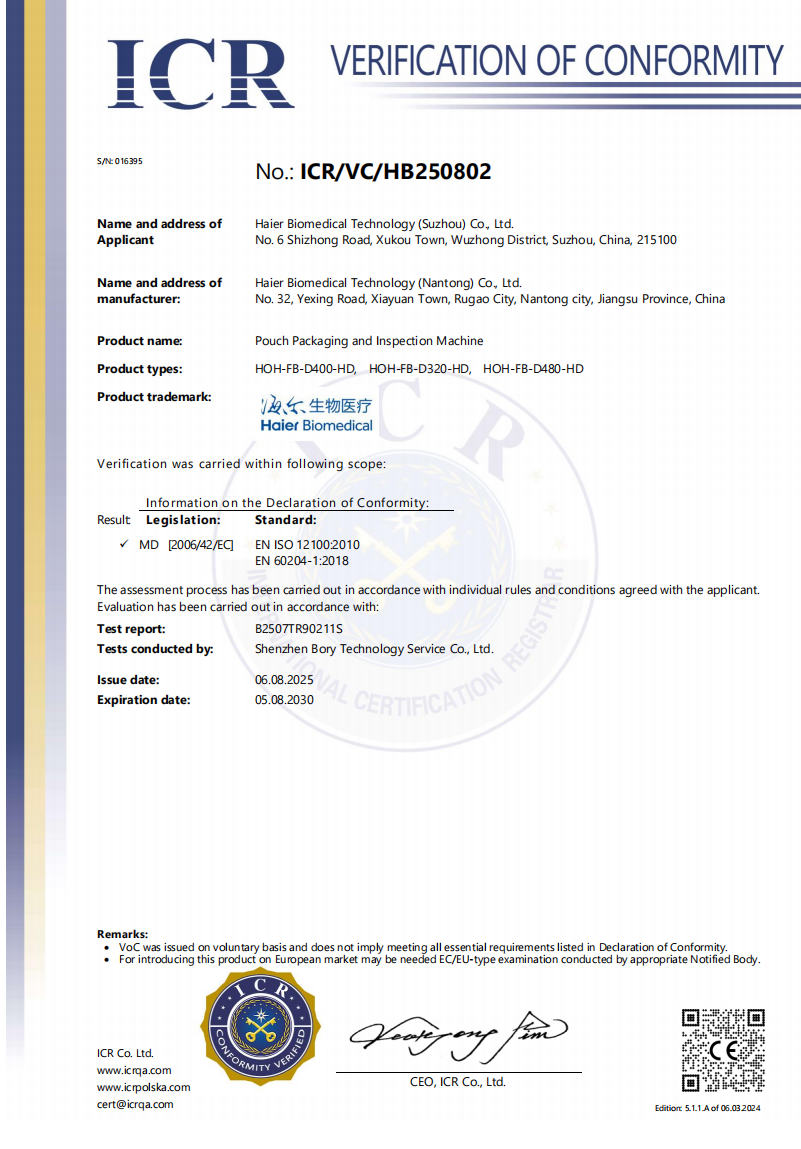
These certification examples help buyers see how equipment should be documented. However, the certificate alone is not the whole solution. Decision-makers should also confirm that the certificate scope matches the actual model, that the model has not been modified without reassessment, and that the buyer's local regulatory body accepts the certificate type.
Technical Constraint Checklist: Specifications That Support Medication Traceability
Beyond compliance documents, a pharmacy automation buyer should compare equipment parameters against real operating needs. Below is a specification-level checklist drawn from Haier Biomedical's published product information.
Robotic Arm Dispenser: HOH-KF-Smart
The robotic arm dispenser HOH-KF-Smart combines robotic storage and picking with hospital information system integration. It supports at least 1,500 medication types, stores 20,000 or more boxes, and can dispense at least 300 prescriptions per hour. Its medication return speed is stated at 700 or more boxes per hour. For expiration control, the system supports FIFO/FEFO logic. Its barcode recognition enables full-chain monitoring and traceability.
This product is a good example of why buyers need to look beyond throughput. A hospital with substantial boxed medication volume may need robotic automation, but the system also needs to fit physically into the pharmacy. The dimensions of the main unit are approximately 8650 x 1747 x 2850 mm, excluding the replenishment module, so site planning matters before signing.
Chute Type Dispenser: HOH-KF-1200
The HOH-KF-1200 is designed for outpatient pharmacy efficiency. It supports more than 1,100 medication types and stores more than 15,000 boxes. Its dispensing speed ranges from 350 to 500 prescriptions per hour, while replenishment can exceed 2,400 boxes per hour. The system uses a modular structure and can be configured with dispensing, storage, and loading units. It also uses a full-screen dispensing mode with safety buffers and supports parallel multi-prescription operation.
For hospitals with a very high daily prescription count, the HOH-KF-1200 can address peak-hour queues. It is also relevant to buyers concerned about floor space because the system is designed to fit in less than 12.85 square meters.
High Speed Dispenser: HOH-GF
The HOH-GF high-speed dispenser is built for high-frequency, high-volume boxed medication dispensing. The two-module configuration offers 100 or more storage slots and a storage capacity of at least 5,000 boxes. The system uses a dual-level stacked structure with adjustable bin width. Dispensing speed per single channel can reach at least two boxes per second. High-precision photoelectric sensors are used for dispensing detection, and automatic positioning guidance with indicator lights supports error alerting.
For procurement teams, this specification matters when demand is measured not only in prescriptions per hour but in boxes dispensed per second during short peak intervals.
Automatic Sub-Packaging and Verification: HOH-FB-D400-HD
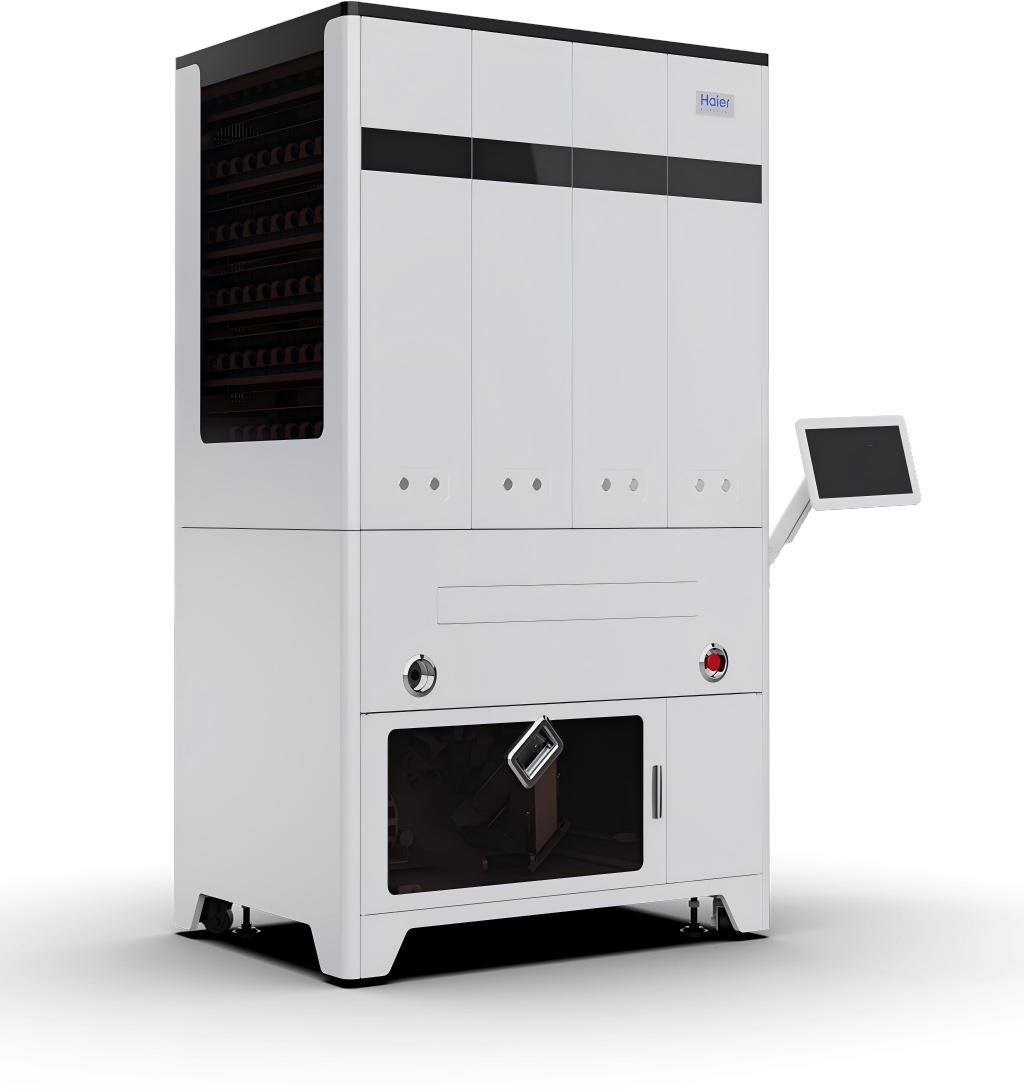
Medication errors can occur after automated picking if the wrong drug is placed in a package. Haier addresses this with the HOH-FB-D400-HD automatic sub-packaging and verification machine. The system holds 400 medication boxes and produces unit-dose packages at 40 to 60 packs per minute. It integrates AI-powered visual verification to check drug type, quantity, and prescription accuracy during unit-dose packaging.
This equipment is valuable for hospital pharmacies that repackage solid oral medications into unit-dose bags. It creates a closed loop between packaging and verification, reducing the risk of mispackaging and improving the final safety check before medication is sent to the ward.
Anesthetic Medication Dispensing Cabinet: HOH-MJ-01
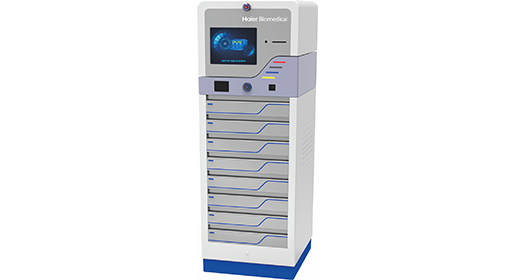
Controlled substances raise a different set of constraints. The HOH-MJ-01 is an anesthetic medication dispensing cabinet designed for hospital outpatient pharmacies, emergency pharmacies, and inpatient pharmacies. It is a full-process intelligent control device for anesthetic and psychotropic drugs, with 9 drawers and 44 compartments for organized storage.
This cabinet addresses three control problems: difficult traceability, disordered access control, and low inventory accuracy. It aligns with the hospital's Five-Specialty Management requirements for anesthetic and psychotropic drugs. For procurement teams, this type of product is important when the project includes controlled drug storage or when authorities require an audit trail for every transaction.
Intelligent Integrated Management Cabinet: HOH-BQ-A
The HOH-BQ-A is an intelligent integrated medication management cabinet for operating rooms or pharmacy preparation areas. It is designed for storage, management, and monitoring of narcotic and psychotropic drugs. Its features support full traceability and precise control, which makes it another option for hospitals that need decentralized drug control outside the central pharmacy.
Fully Automated Cytotoxic Drug Compounding Robot: HOH-Robot-Plus
Pharmacy automation extends beyond tablets and boxes. For PIVAS, or pharmacy intravenous admixture services, the HOH-Robot-Plus performs cytotoxic drug compounding inside a closed environment. It operates under Class 100 (ISO 5) cleanroom conditions and has a stated compounding accuracy of 100%. Its compounding efficiency is 25 cycles per hour. The system is compatible with more than 95% of vial types and can handle 50 to 1000 mL soft bags, plastic bottles, and stand-up pouches.
This robot is relevant when a hospital is designing or upgrading its oncology pharmacy and wants to reduce staff exposure to hazardous drugs. It also demonstrates that automated medication handling applies not only to dispensing and packaging, but also to high-risk compounding processes.
How Automated Dispensing and Verification Work Together
A common procurement misunderstanding is that an automated dispenser automatically verifies every item it picks. In reality, automated dispensing reduces the number of manual picking steps and standardizes the dispensing workflow. When an automated verification process is added, the system can provide an additional check on medication information before the medication is released.
In the Haier pharmacy automation ecosystem, integration with hospital information systems is a core part of this workflow. Prescription data from the HIS or EMR can be transferred to the dispensing system. The system locates the relevant medication storage area and dispenses the order. When unit-dose repackaging is required, the HOH-FB-D400-HD performs packaging and AI-powered visual verification in real time, comparing the packaged medication against the prescription information.
This architecture is important for constrained purchasing decisions because it shows where errors are prevented. Barcode scanning, visual recognition, and automated position guidance are all mechanisms that support identification and traceability. None of these mechanisms works well if the hospital's workflow does not clearly define which system is responsible for each check.
Step-by-Step Verification Workflow for Pharmacy Automation Procurement
The following six-step process can help procurement teams compare pharmacy automation proposals consistently.
- Define the pharmacy scenario and constraints. Document prescription volume, medication type mix, physical space, workflow, controlled substance requirements, and HIS/EMR environment. This is the reference point for all later decisions.
- Request conformity documentation by exact model. Ask for the certificate number, issuing body, applicable standards, and validity period. Check that the model number on the certificate matches the product that will be shipped.
- Match system specifications to the medication workflow. For high-density boxed medication dispensing, evaluate robotic or chute type systems. For unit-dose repackaging, evaluate automatic sub-packaging with verification. For controlled drugs, evaluate intelligent locking cabinets.
- Confirm HIS or EMR integration requirements. Haier solutions can be integrated with hospital information systems including HIS and EMR platforms according to project requirements. Prescription information can be passed directly to the automated dispensing equipment, reducing manual data entry and improving continuity.
- Review customization and factory acceptance. Haier states that customization can involve equipment size, storage capacity, SKU quantity, robotic modules, software functions, HIS interface, and language. The company reports project-based production capacity, an MOQ of one unit, and typical lead time of 60 to 90 days depending on configuration. A factory acceptance test before shipment is part of the quality control process.
- Plan lifecycle support. Ask about installation, commissioning, operator training, software upgrades, remote technical support, spare parts, and global after-sales service. These points determine whether the pharmacy automation system remains safe and usable after go-live.
Use Cases: What Compliance and Customization Look Like in Practice
Private Hospital in Thailand
A private hospital in Thailand purchased one set of a customized universal dispenser system for its outpatient pharmacy. The system was customized based on local medication packaging characteristics in Thailand. According to the project record, it enabled stable and efficient automated dispensing, improved dispensing accuracy, and reduced repetitive pharmacist tasks. The hospital uses a solution that is compatible with various medication formats, supports HIS integration, and uses a modular design for scalability.
This case is useful for buyers in emerging markets because it shows that pharmacy automation cannot always be copied from a standard European or North American configuration. Local packaging may require custom chute widths, product dimensions, or software handling rules.
General Hospital in Vietnam
A general hospital in Vietnam deployed one set of an Intelligent Pharmacy Automation System in its outpatient pharmacy. The project involved automated medication storage, dispensing, and intelligent medication management. The solution was customized according to the hospital's pharmacy layout and workflow, and it integrated with the hospital's HIS system. The reported result included optimized dispensing workflows, improved medication management efficiency, reduced patient waiting time, and enhanced patient service experience.
These two cases demonstrate a practical pattern: pharmacy automation success is not only about the machine specifications. Site-specific customization and information system integration are part of the deliverables that should be checked during negotiation.
Representative Dispenser Comparison Table
The following table compares representative Haier dispenser models available for different pharmacy automation scenarios. The data are based on published specifications and are intended as a starting point for evaluation.
| System | Representative model | Medication capacity | Throughput | Design characteristics |
|---|---|---|---|---|
| Robotic Arm Dispenser | HOH-KF-Smart | At least 1,500 medication types; at least 20,000 boxes | At least 300 prescriptions/hour; replenishment at least 700 boxes/hour | Robotic picking, barcode recognition, FIFO/FEFO support, full traceability monitoring |
| Chute Type Dispenser | HOH-KF-1200 | More than 1,100 medication types; more than 15,000 boxes | 350 to 500 prescriptions/hour; replenishment more than 2,400 boxes/hour | Full-screen dispensing, safety buffer, parallel multi-prescription operation, modular dispensing/storage/loading |
| High Speed Dispenser | HOH-GF (2 Modules) | At least 100 storage slots; at least 5,000 boxes | Single channel at least 2 boxes/second | Dual-level stacked structure, adjustable bin width, photoelectric sensors for dispensing detection, batch dispensing |
| Automatic Sub-packaging and Verification Machine | HOH-FB-D400-HD | 400 medication boxes | 40 to 60 packs/minute | Unit-dose packaging with AI-based visual verification, HIS interoperability, real-time verification of drug type, quantity, and prescription |
| Anesthetic Medication Dispensing Cabinet | HOH-MJ-01 | 9 drawers with 44 total compartments | Access and transaction control | Full-process intelligent control for anesthetic and psychotropic drugs, traceability, closed-loop data |
When using this comparison table, buyers should remember that the total solution may include multiple modules. A high-volume outpatient pharmacy might combine a chute dispenser, storage cabinets, a conveyor system, automatic labeling, packaging, and an intelligent verification stage. Final engineering should be based on a site survey.
Frequently Asked Questions
1. What compliance documents should a buyer review when purchasing pharmacy automation for the EU market?
A buyer should review the conformity document linked to the exact product model. Important details include the certificate number, issuing body, applicable standards, scope, and expiry date. In Haier's published portfolio, for example, the HOH-KF-Smart Robotic Arm Dispenser is covered by an ISET Voluntary Compliance Certificate with number ISETC.000220220323. The HOH-KF-1200 automatic dispensing line is covered by ICR certificate number ICR/VC/HB250402. The HOH-FB-D400-HD automatic sub-packaging and verification machine is covered by ICR certificate number ICR/VC/HB250802. These are the kinds of documents a hospital audit team should ask to see before installation.
2. Is pharmacy automation suitable for every hospital?
No single pharmacy automation system is appropriate for every hospital. Selection depends on prescription volume, medication types, pharmacy layout, workflow, available space, and investment requirements. A hospital handling a very high daily prescription volume may benefit from a chute type dispenser. A facility focused on boxed medication accuracy may consider a robotic arm dispenser. Hospitals serving outpatient, emergency, and inpatient populations may need different systems in different areas. Haier offers robotic, chute, high-speed, sub-packaging, and controlled-substance cabinet solutions to address different scenarios.
3. Can pharmacy automation systems integrate with a hospital HIS?
Yes. Haier pharmacy automation solutions can be integrated with hospital information systems to support automated prescription processing and dispensing. Depending on project requirements, the system can connect with HIS/EMR platforms, allowing prescription data to be transferred directly to the pharmacy automation equipment. This reduces repetitive manual data entry and helps close the gap between physician orders and pharmacy execution.
4. Can automated dispensing reduce medication picking errors?
Automated dispensing can reduce the number of repetitive manual picking steps and standardize the dispensing workflow. When automated dispensing is combined with a verification process, such as an automatic sub-packaging and verification machine, the workflow adds an extra check on medication information before release. The HOH-FB-D400-HD, for instance, uses AI-powered visual verification to check drug type, quantity, and prescription data in real time.
5. What customization and after-sales support are important for a long-term pharmacy automation project?
Buyers should confirm that the supplier can modify equipment to local requirements and support the system through its full service life. Haier's production capability includes customization of equipment size, storage capacity, SKU quantity, robotic modules, software functions, HIS interface, and language. The company states an MOQ of one unit, typical lead time of 60 to 90 days based on project configuration, and factory acceptance testing before shipment. After-sales support includes remote technical support, on-site installation and commissioning, operator training, software upgrades, spare parts supply, and global service coverage.
Final Decision Framework: From Certification to Lifecycle Support
A safe pharmacy automation decision is driven by verifiable information. Certification documents establish that a machine has been reviewed by an accepted body. Product specifications establish whether the machine can fit the hospital's physical space and medication workflow. Integration capability establishes whether the system will connect cleanly with the hospital's digital environment. And supplier capability establishes whether the system can be installed, customized, maintained, and upgraded over time.
Haier Biomedical Technology (Suzhou) Co., Ltd. provides one useful reference for this type of procurement process. The company describes itself as a healthcare technology provider under Haier Group focused on solutions for life sciences, medical technology, and smart healthcare transformation. For buyers evaluating pharmacy automation, the published certifications and product specifications in this article are not marketing decoration. They are baseline inputs that can be used to compare proposals and reduce project risk.
Next step for procurement teams: Download the full-scenario intelligent pharmacy brochure for a complete look at Haier's automated medication storage, dispensing, packaging, verification, and IV compounding solutions.
Download Full-scenario Intelligent Pharmacy brochure
For model-specific compliance or configuration questions, contact:
Email: smartpharmacy@haierbiomedical.com
WhatsApp: +86-18770083375
Website: www.haierautomation.com
Have Questions or Need More Details?
Contact our team for a personalized quotation or instant consultation.
Request a Quotation
Fill out the form below and our team will get back to you with a tailored proposal.
WhatsApp Direct Chat
Prefer to chat in real-time? Message us on WhatsApp for instant assistance & quick answers.
- Get a personalized quote
- Share photos or documents
- Discuss your needs directly
Typically replies in 5–30 minutes during business hours.