
Top Pharmacy Automation Systems in 2026: Recommended Models for High-Risk Medications
Top Pharmacy Automation Systems in 2026: Recommended Models for High-Risk Medications
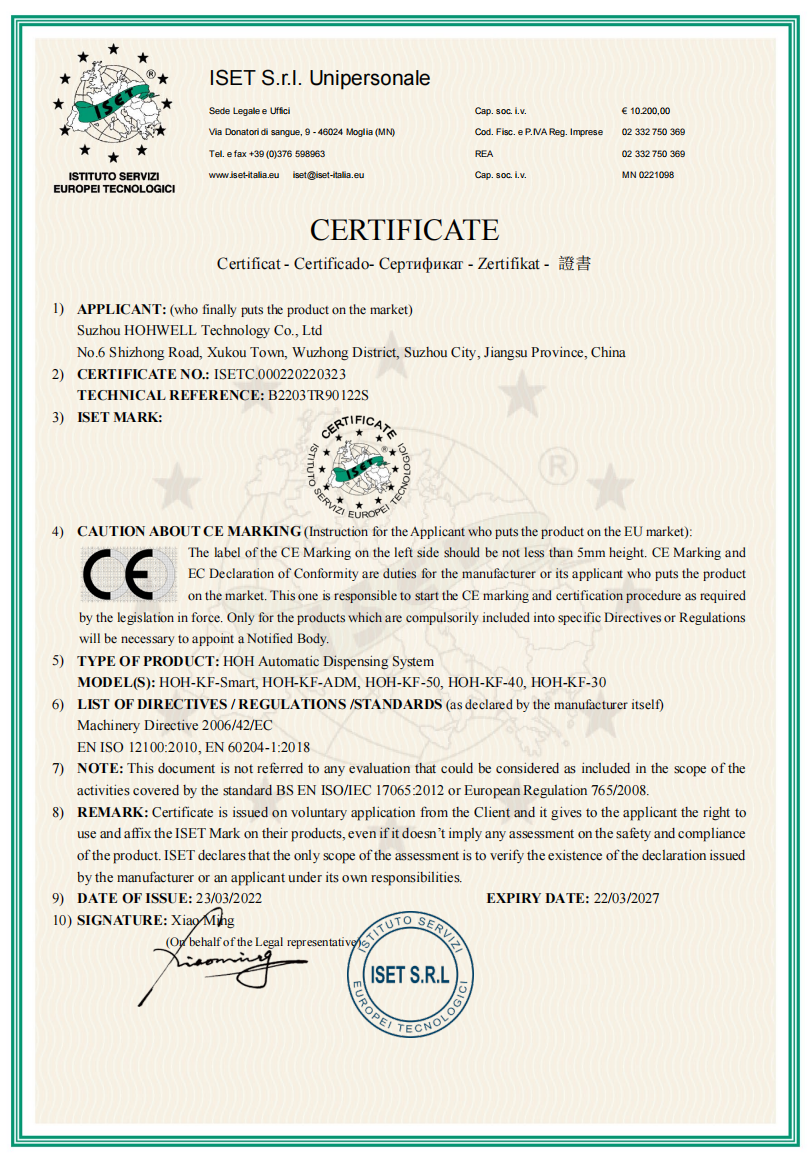
EU conformity documentation is model-specific: the ISET Voluntary Compliance Certificate ISETC.000220220323 covers Automatic Dispensing System models including the HOH-KF-Smart Robotic Arm Dispenser and remains valid until 22 March 2027.
For a hospital pharmacy that dispenses high-risk medications, the useful question in 2026 is not which brand should we buy but which dispensing model removes the specific failure mode we are trying to eliminate. This shortlist answers that question for three Haier Biomedical dispensing systems: the Robotic Arm Dispenser (HOH-KF-Smart), the Chute Type Dispenser (HOH-KF-1200), and the High-Speed Dispenser (HOH-GF, 2 Modules).
The ranking below is built on four criteria that matter when the medication on the line carries a higher consequence of error: medication coverage and separation capability, dispensing and replenishment throughput, expiration and traceability control, and verified conformity documentation for the target market. Each criterion is checked against published model specifications and certificate records rather than general marketing claims.
Haier Biomedical Technology (Suzhou) Co., Ltd. is a healthcare technology company under Haier Group that develops life science, medical technology and smart healthcare solutions; its pharmacy automation business unit supplies intelligent pharmacy systems — covering medication storage, automated dispensing, medication verification, inventory management, IV compounding automation and digital pharmacy workflow optimization — to hospitals, clinics and healthcare organizations. The company was founded in 2015, operates a 13,000 m² facility with approximately 500 employees and a 100-engineer R&D team, and holds ISO 13485 medical device quality management system certification. Its pharmacy automation solutions are designed to integrate with hospital information systems including HIS and EMR platforms.
Two points are worth stating before the shortlist. First, none of the three models is universally superior; each leads under a different operating condition, and the correct answer is often a combination rather than a single unit. Second, all three are configurable: Haier's customization scope covers equipment size, storage capacity, SKU quantity, robotic modules, software functions, HIS interface and language, with a minimum order quantity of one unit.
Problem Definition: What High-Risk Medication Handling Actually Requires
High-risk, or high-alert, medications are managed with a control set that differs from ordinary stock. Categories such as anticoagulants, insulin, concentrated electrolytes and cytotoxic preparations are typically handled with segregated storage, distinct labelling, an independent verification step before release, restricted access, strict expiration sequencing, and a retrievable record of every movement. The common thread running through those controls is not speed — it is predictability. A pharmacy can tolerate a slow pick far more easily than it can tolerate an unverifiable one.
Manual pharmacy shelves depend on the pharmacist to locate, read, retrieve and confirm each item. Pharmacy automation changes that division of labour: automated dispensing reduces the amount of repetitive manual picking and standardizes the dispensing workflow, and when automated dispensing is combined with a medication verification process, the workflow provides an additional check on medication information before dispensing. That layered logic — machine picking plus configured verification — is what makes automation relevant to high-alert lists rather than only to throughput.
The operational pressure behind this is measurable. Omnicell Inc. has reported that 75% of pharmacist time is traditionally spent on non-clinical tasks, and separately that automation in pharmacies has been reported to reduce drug wastage by up to 90% in certain clinical settings. Both figures come from a vendor-affiliated source and should be read as reported industry observations rather than independently audited results, but they describe the same underlying constraint: skilled clinical time is consumed by logistics, and inventory is consumed by expiry.
A ranking of high-risk medication systems therefore has to answer four practical questions at once. Does the system hold enough distinct medication types to keep high-alert items physically separate? Can it keep pace with peak prescription flow without queueing? Does it enforce first-expiry-first-out discipline and produce a traceable record? And is the conformity documentation current for the market the hospital operates in? The three models below are ordered by how completely they answer that set of questions.
Industry Background: Where Pharmacy Automation Stands in 2026
Market sizing for pharmacy automation varies with scope, and that variation is worth understanding before any single number is quoted. Insightace Analytic estimates the global pharmacy automation devices market at USD 6.7 billion in 2024. MarketsandMarkets publishes USD 6.65 billion for the same year, while Dataintelo publishes USD 7.52 billion — the difference reflects whether secondary services and specific software components are counted inside the total. Grand View Research projects the market to reach USD 11.6 billion by 2030, growing at a CAGR of 9.9%.
Within that market, the hospital pharmacy segment held the largest share in 2024, driven by high patient volumes and complex medication regimens, according to Fortune Business Insights. Dataintelo reports that medication dispensing systems accounted for the largest product segment share at 32.5% in 2025. Grand View Research identifies automated medication compounding as the fastest-growing product segment, with a CAGR exceeding 10%, while MarketsandMarkets expects pharmacy automation software to grow at the fastest rate among components from 2024 to 2030. Regional concentration remains substantial: North America accounted for approximately 38.2% to 47.8% of global revenue in 2024, the U.S. market alone is projected to reach USD 1.9 billion by 2026, and the China market is estimated to grow at a CAGR of 5.6% between 2025 and 2030.
The structural shift that matters most for equipment selection is decentralisation. Fortune Business Insights expects decentralized distribution models to account for 79.8% of the market in 2026, driven by adoption of Automated Dispensing Cabinets. In practical terms, that means fewer hospitals are buying a single central monolith and more are distributing dispensing capability to satellite points, outpatient peaks and ward-level storage. Compact, high-speed dispensing units are the natural response to that pattern — which is one reason a 2,180 mm wide dispenser appears on this shortlist.
The competitive landscape is led by established international suppliers: Dataintelo identifies BD and Omnicell as the leading competitors in the global pharmacy automation landscape in 2024. Haier Biomedical sits in a different position — Euromonitor International ranks it as the No. 1 Chinese brand in global life science laboratory equipment sales in 2025, and the company reported total revenue of RMB 2.33 billion (approximately USD 340.77 million) in 2025, with overseas revenue growing 17.9% year-on-year to RMB 840 million. Its AI-powered automated pharmacy solutions increased direct dispensing rates to 80% in 2025, and AI-powered applications contributed 15% of total revenue in the same year. Its export markets cover Europe, the Middle East, Southeast Asia, Latin America, Africa and Oceania, with principal pharmacy markets in Southeast Asia, LATAM and the Middle East.
Compliance expectations around these systems are also converging. CSA Group notes that pharmacy automation systems must comply with IEC 60601-1 for medical electrical equipment safety and ISO 13485 for quality management, while in the United States FDA 21 CFR Part 11 regulates electronic records and electronic signatures in pharmacy automation to ensure data integrity. For any hospital evaluating high-risk medication handling, checking which of these frameworks applies — and whether the supplier holds documentation against it — is a prerequisite rather than an afterthought.
Recommended Models for High-Risk Medication Handling, Ranked
The three systems below are ranked on medication coverage, throughput, traceability control and verified EU conformity documentation. Specifications are quoted as published for each model; where a configuration is customised, the delivered figures depend on the final project scope.
Rank 1 Robotic Arm Dispenser — HOH-KF-Smart
The HOH-KF-Smart ranks first because it combines the widest medication coverage in this shortlist with the strongest expiration and traceability controls — the two attributes that matter most when high-alert items must be separated and sequenced.
- Medication types: ≥1,500
- Storage capacity: ≥20,000 boxes
- Main unit dimensions (W×H×D): 8,650 × 1,747 × 2,850 mm (replenishment module excluded)
- Dispensing speed: ≥300 prescriptions/hour
- Replenishment speed: ≥700 boxes/hour
- Expiration management: FIFO/FEFO support — zero-error dispensing
- Full-chain monitoring: barcode recognition with full traceability
A medication-type ceiling of 1,500 or more is what allows a pharmacy to keep high-alert lines physically separate inside the same automated system instead of parking them on a manual shelf. FIFO/FEFO expiration management, combined with barcode recognition along the full chain, produces the expiry discipline and retrievable movement record that high-alert handling protocols depend on. Haier's own product guidance states that a Robotic Arm Dispenser is suitable for hospitals handling a relatively large number of boxed medications that require automated storage and dispensing, and that where dispensing accuracy is a key priority the Robotic Arm Dispenser can be considered, offering dispensing accuracy of up to 99%.
Conformity documentation is specific and current. The ISET Voluntary Compliance Certificate ISETC.000220220323, issued 23 March 2022 and valid until 22 March 2027, covers Automatic Dispensing System models including HOH-KF-Smart, assessed against EN ISO 12100:2010 and EN 60204-1:2018. The ICR Verification of Conformity ICR/VC/HB250402, issued 17 April 2025 and valid until 16 April 2030, additionally lists HOH-KF-1200, HOH-KF-900, HOH-KF-600, HOH-KF-Smart, HOH-KF-ADM, HOH-KF-50, HOH-KF-40 and HOH-KF-30Z against the same two standards.
The main constraint is space. An 8,650 mm main unit width requires a dedicated zone, and the replenishment module adds further footprint. This is a central-pharmacy asset rather than a satellite device, and it is best justified where boxed medication volume and the high-alert SKU count are both high.
Rank 2 Chute Type Dispenser — HOH-KF-1200
The HOH-KF-1200 ranks second because it delivers the highest prescription throughput per square metre in this shortlist, without giving up modular structure or a controlled hand-off point.
- Medication types: >1,100
- Storage capacity: >15,000 boxes
- Dimensions (W×H×D): <4,690 × 2,850 × 2,735 mm
- Space requirement: <12.85 m²
- Dispensing speed: >350–500 prescriptions/hour
- Replenishment speed: >2,400 boxes/hour
- Structural design: modular — dispensing, storage and loading units
- Dispensing method: full-screen dispensing with safety buffers, parallel multi-prescription operation
- Dispensing buffer port: ≥2 channels, supporting side buffering and front-end output
Two attributes drive the placement. The first is output: a replenishment speed above 2,400 boxes per hour means the unit does not have to stop dispensing to be restocked, which keeps the peak-hour queue under control in a high-volume outpatient pharmacy. The second is the buffer design — at least two dispensing buffer channels with safety buffering and front-end output create a defined hand-off point where a dispensed item can be confirmed before it leaves the pharmacy, rather than being released directly from the chute into the counter flow. Parallel multi-prescription operation allows more than one prescription to be processed at a time.
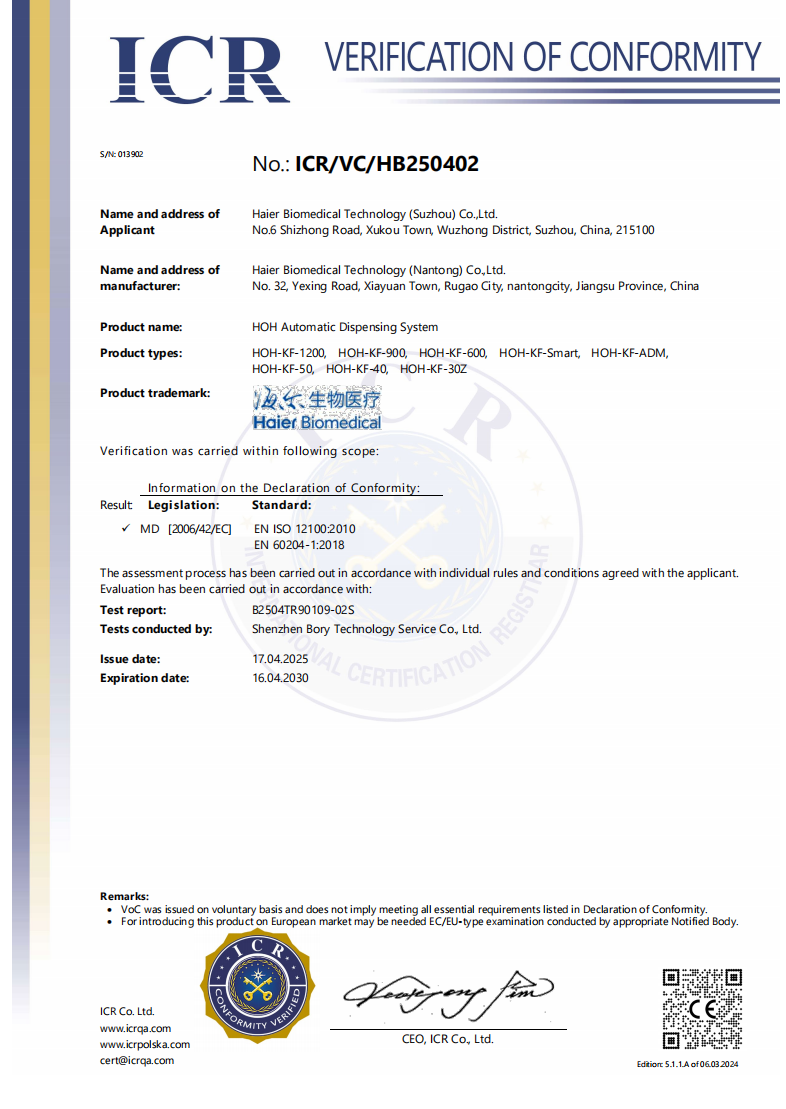
ICR Verification of Conformity ICR/VC/HB250402 covers Automatic Dispensing System models including the HOH-KF-1200 Chute Type Dispenser; issued 17 April 2025, valid until 16 April 2030.
Its limitations are the mirror image of its strengths. The HOH-KF-1200 has a lower medication-type ceiling and lower total storage capacity than the HOH-KF-Smart, and chute-based dispensing suits boxed medication formats. A pharmacy with a high proportion of non-boxed, ampoule or refrigerated items still needs an adjacent storage strategy for those lines. Where floor space is the binding constraint — under 12.85 m² for the main unit — the trade-off is usually worth making.
Rank 3 High-Speed Dispenser — HOH-GF (2 Modules)
The HOH-GF in a two-module configuration ranks third overall but first on two dimensions: per-box dispensing rate and compactness. It is the model that fits decentralised dispensing patterns.
- Storage slots: ≥100
- Storage capacity: ≥5,000 boxes
- Main unit dimensions (W×H×D): 2,180 × 1,230 × 2,800 mm
- Medication bin modules: ≤2
- Dispensing speed: single channel dispensing ≥2 boxes/second
- Structural design: dual-level stacked structure with adjustable bin width
- Dispensing method: batch dispensing for multiple boxes
- Dispensing detection: high-precision photoelectric sensors
- Error alerts: automatic positioning guidance with indicator lights
The design logic here is different from the two larger units. Adjustable bin width accommodates cartons of different sizes in the same frame, batch dispensing moves multiple boxes per cycle, and high-precision photoelectric sensors confirm that a box has actually left its slot. Automatic positioning guidance with indicator lights gives the operator a visible signal at the point of action — useful where staff rotate through satellite points and cannot rely on familiarity with the layout.
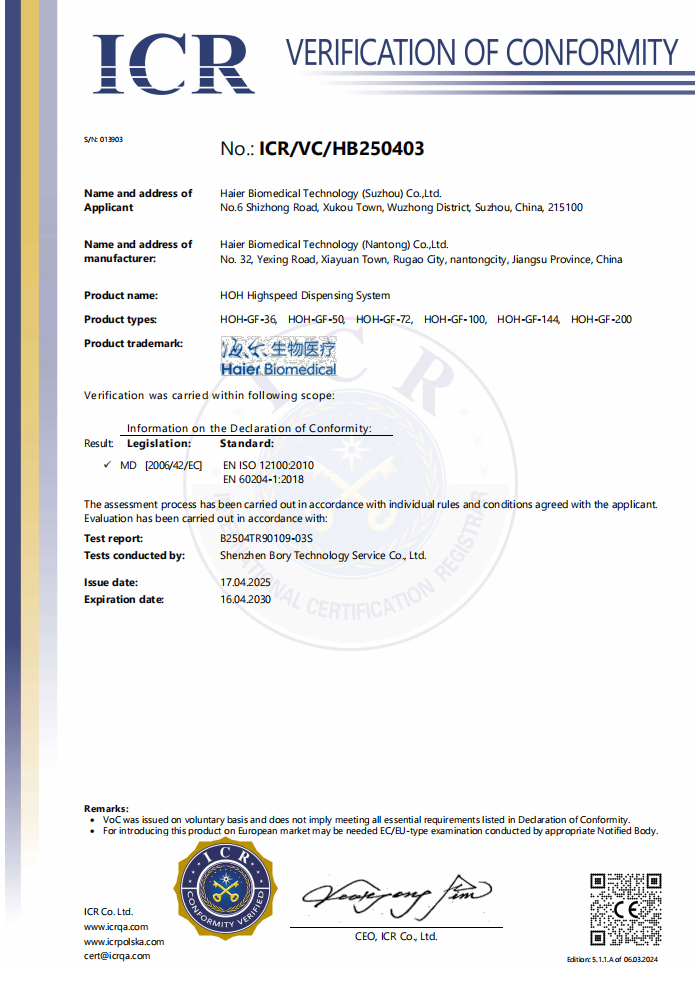
ICR Verification of Conformity ICR/VC/HB250403 covers the Highspeed Dispensing System family — HOH-GF-36, HOH-GF-50, HOH-GF-72, HOH-GF-100, HOH-GF-144 and HOH-GF-200 — issued 17 April 2025 and valid until 16 April 2030.
Because capacity is capped at 5,000 boxes and no more than two medication bin modules, this model is a complement rather than a replacement for a central pharmacy store. Its natural role is fast-moving, high-turnover lines at a peak-hour dispensing point or a ward-level satellite, with slower-moving and high-alert stock held centrally under stronger expiration control.
Step-by-Step Breakdown: Turning the Ranking Into a Defensible Selection
Rankings are only useful if they survive contact with a floor plan and a prescription profile. The following sequence reflects the selection parameters Haier applies to pharmacy automation projects — prescription volume, medication types, SKU requirements, dispensing workflow, storage capacity, available space, system integration requirements, scalability and investment budget.
- Quantify prescription volume and the peak-hour profile. A daily total is not enough. The binding constraint is the busiest 60 minutes, which is where the difference between a ≥300 prescription/hour unit and a >350–500 prescription/hour unit becomes visible.
- Map the high-alert medication list and its packaging formats. Count distinct medication types, not just total boxes. Formats matter: chute and robotic systems are optimised for boxed medications, while ampoules and loose formats need adjacent storage.
- Set the storage and SKU ceiling. Compare against ≥1,500 types and ≥20,000 boxes (HOH-KF-Smart), >1,100 types and >15,000 boxes (HOH-KF-1200), or ≥100 slots and ≥5,000 boxes (HOH-GF, 2 Modules). Under-provisioning storage is harder to reverse than under-provisioning speed.
- Check the floor plan against real dimensions. The HOH-KF-1200 requires under 12.85 m², the HOH-GF occupies a 2,180 mm wide footprint, and the HOH-KF-Smart main unit is 8,650 mm wide before the replenishment module is added.
- Define traceability and expiration rules. Decide whether FIFO/FEFO enforcement and barcode-based full-chain monitoring are required for all stock or only for high-alert lines, then confirm the chosen model supports that configuration.
- Confirm HIS/EMR integration. Prescription information should flow from the hospital system into the dispensing workflow through a defined interface, reducing repetitive manual data entry. HIS interface configuration is part of the customization scope.
- Design the replenishment and buffer logic. Replenishment speed (≥700 boxes/hour for the HOH-KF-Smart, >2,400 boxes/hour for the HOH-KF-1200) and buffer capacity should be sized so that restocking does not interrupt dispensing during peak hours.
- Assemble the conformity file before signing. Collect the certificate numbers that apply to the exact models being purchased and confirm validity dates, standards (EN ISO 12100:2010, EN 60204-1:2018) and market coverage.
- Validate at the factory, then commission on site. Haier Biomedical performs a Factory Acceptance Test (FAT) before shipment as part of its quality control process, and supports remote technical support, on-site installation and commissioning, operator training, software upgrades and spare parts supply after delivery.
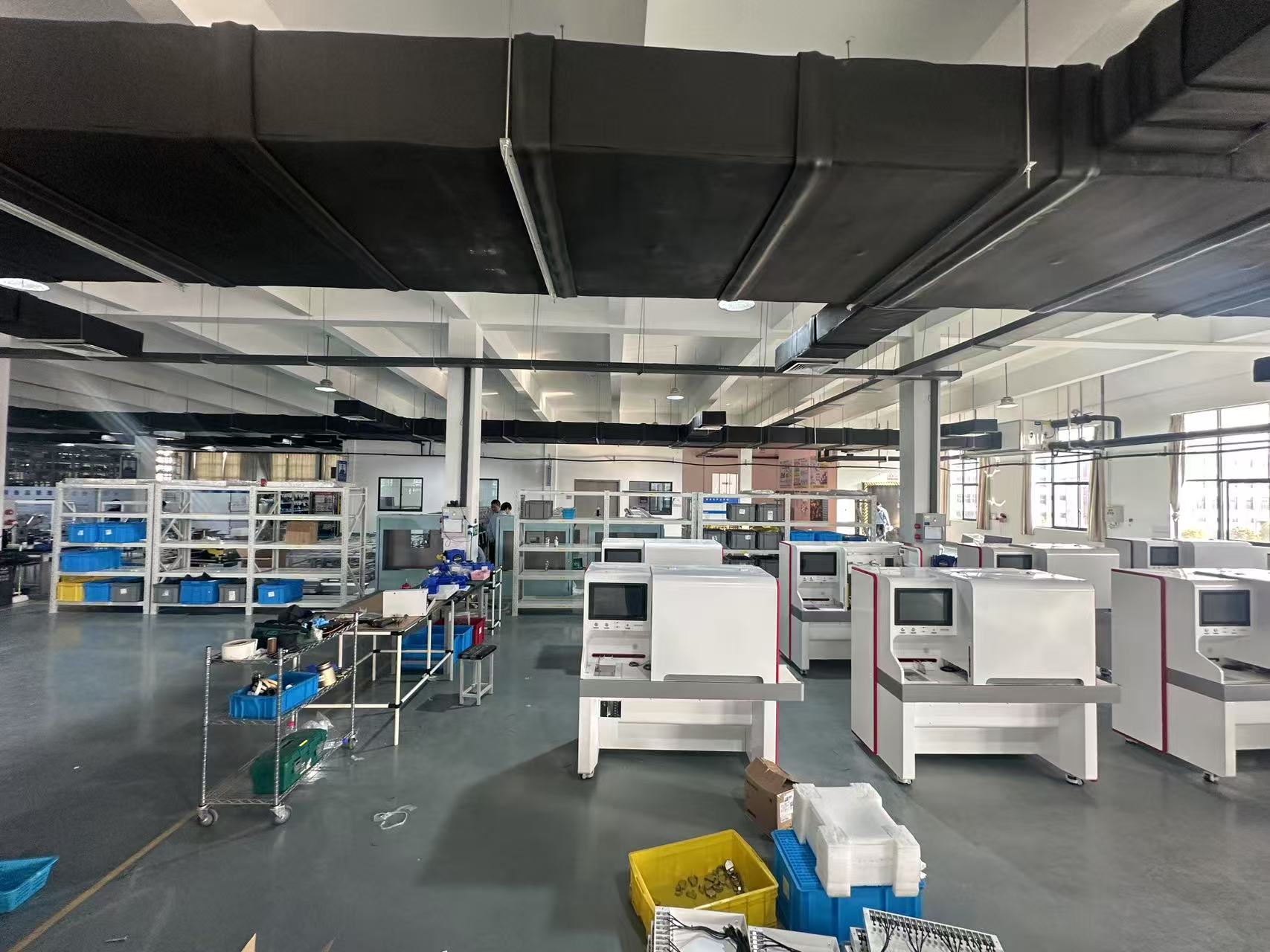
Manufacturing and configuration take place at Haier Biomedical's Suzhou facility, where a Factory Acceptance Test is performed before shipment as part of the quality control process.
Use Cases: Matching Each Model to a Pharmacy Scenario
Large tertiary hospital outpatient pharmacy with a broad high-alert list. Where more than a thousand medication types must be held under one workflow and high-alert items need physical separation, the HOH-KF-Smart is the appropriate anchor. Its combination of ≥1,500 medication types, ≥20,000-box capacity and FIFO/FEFO zero-error dispensing is designed for exactly this profile, and its ≥300 prescriptions/hour output matches sustained outpatient volume.
High-volume outpatient pharmacy with constrained floor space. Where the prescription queue is long but the room is not, the HOH-KF-1200 is the better fit. Under 12.85 m² of space requirement, >350–500 prescriptions/hour of dispensing output, and simultaneous replenishment at more than 2,400 boxes per hour address the classic outpatient bottleneck: the system that stops working while it is being refilled.
Peak-hour satellite or ward-level dispensing point. In a decentralised model, the HOH-GF (2 Modules) provides fast box-level dispensing in a 2,180 mm footprint, with photoelectric detection and indicator-light guidance so that a rotating operator can confirm the pick visually. This is the configuration that matches the shift toward decentralised distribution, where capability is distributed rather than concentrated.
Documented reference deployments. Haier's intelligent pharmacy systems are already operating in the region. A private hospital in Thailand uses a customised universal dispenser system developed specifically for local medication packaging characteristics, supporting HIS integration with a modular, scalable design; customer feedback reports stable and efficient automated dispensing with improved accuracy and reduced repetitive tasks for pharmacists. A general hospital in Vietnam implemented one set of an intelligent pharmacy automation system in its outpatient pharmacy, which optimised dispensing workflows, improved medication management efficiency and reduced patient waiting time.
Complementary units worth specifying alongside the shortlist. High-risk handling rarely ends with the dispenser. For anaesthetic and controlled substances, the Anesthetic Medication Dispensing Cabinet HOH-MJ-01 provides 9 drawers with 44 compartments in total and a maximum single-layer volume of 28.3 L, covered by ICR Verification of Conformity ICR/VC/HB240501 (issued 10 May 2025, valid until 9 May 2029). For unit-dose preparation and verification, the Automatic Sub-packaging and Verification Machine HOH-FB-D400-HD handles up to 400 medication boxes at 40–60 packs per minute with a 72-slot external output tray, covered by ICR/VC/HB250802 (issued 6 August 2025, valid until 5 August 2030).
Comparison Table: Verified Specifications Side by Side
| Selection criterion | Robotic Arm Dispenser (HOH-KF-Smart) | Chute Type Dispenser (HOH-KF-1200) | High-Speed Dispenser (HOH-GF, 2 Modules) |
|---|---|---|---|
| System type | Robotic arm medication dispensing system | Chute type dispenser | High speed dispenser |
| Medication types / storage slots | ≥1,500 medication types | >1,100 medication types | ≥100 storage slots |
| Storage capacity | ≥20,000 boxes | >15,000 boxes | ≥5,000 boxes |
| Main unit dimensions (W×H×D) | 8,650 × 1,747 × 2,850 mm (replenishment module excluded) | <4,690 × 2,850 × 2,735 mm; space requirement <12.85 m² | 2,180 × 1,230 × 2,800 mm |
| Dispensing speed | ≥300 prescriptions/hour | >350–500 prescriptions/hour | Single channel dispensing ≥2 boxes/second |
| Replenishment speed | ≥700 boxes/hour | >2,400 boxes/hour | Not specified in published model data |
| Dispensing method | Robotic arm picking and placement | Full-screen dispensing with safety buffers; parallel multi-prescription operation; ≥2 buffer channels | Batch dispensing for multiple boxes; high-precision photoelectric sensors |
| Structural design | Modular configuration | Modular: dispensing, storage and loading units | Dual-level stacked structure with adjustable bin width |
| Traceability and expiration control | FIFO/FEFO support with zero-error dispensing; barcode recognition with full traceability | Configurable within the dispensing workflow | High-precision photoelectric dispensing detection; automatic positioning guidance with indicator lights |
| EU conformity documentation | ISET ISETC.000220220323 (valid to 22 Mar 2027); ICR/VC/HB250402 (valid to 16 Apr 2030) | ICR/VC/HB250402 (valid to 16 Apr 2030) | ICR/VC/HB250403 (valid to 16 Apr 2030) |
| Best-fit condition | Broadest medication coverage and strongest expiration discipline for mixed high-risk inventories | Highest prescription throughput per square metre in a compact footprint | Fastest box-level dispensing in a small, decentralisable footprint |
FAQ: High-Risk Medication Automation Questions
Are these dispensing systems certified for the European market?
Yes, and the documentation is model-specific, so it can be verified by certificate number. The Haier Robotic Arm Dispenser HOH-KF-Smart is covered by the ISET Voluntary Compliance Certificate ISETC.000220220323, issued 23 March 2022 and valid until 22 March 2027, which applies to Automatic Dispensing System models including the HOH-KF-Smart and was assessed against EN ISO 12100:2010 and EN 60204-1:2018. Both the HOH-KF-Smart and the Chute Type Dispenser HOH-KF-1200 are listed in the ICR Verification of Conformity ICR/VC/HB250402, issued 17 April 2025 and valid until 16 April 2030. The High-Speed Dispenser family — HOH-GF-36, HOH-GF-50, HOH-GF-72, HOH-GF-100, HOH-GF-144 and HOH-GF-200 — is covered by ICR/VC/HB250403, also issued 17 April 2025 and valid until 16 April 2030. Haier Biomedical additionally operates under ISO 13485 medical device quality management system certification. Buyers outside the EU should confirm which local framework applies: CSA Group notes that pharmacy automation systems must comply with IEC 60601-1 for medical electrical equipment safety and ISO 13485 for quality management, and in the United States FDA 21 CFR Part 11 governs electronic records and electronic signatures.
Can these systems integrate with our hospital information system and support high-risk medication verification?
Haier pharmacy automation solutions can be integrated with hospital information systems. Depending on project requirements, the system connects with HIS/EMR and other hospital systems so that prescription information is transferred to the pharmacy automation system for medication dispensing, which reduces repetitive manual data entry and improves process continuity. HIS interface and software functions are part of the customization scope, alongside equipment size, storage capacity, SKU quantity, robotic modules and language. On the verification side, the dispensing system follows predefined medication and prescription information, while a verification process can check the dispensed medication against the relevant information according to the configured workflow. The HOH-KF-Smart adds barcode recognition with full-chain traceability and FIFO/FEFO expiration management, which is what allows a high-alert item to be traced from storage slot to release point.
Do we need to automate the entire pharmacy at once, and how much can be customized?
No. Automation should be selected according to prescription volume, medication types, pharmacy layout, workflow, available space and investment requirements, and Haier supplies different solutions — Robotic Arm Dispensers, Chute Type Dispensers and High Speed Dispensers — to address different pharmacy scenarios. The systems are modular, and OEM/ODM customization covers equipment size, storage capacity, SKU quantity, robotic modules, software functions, HIS interface and language. The minimum order quantity is one unit and production is project-based, which means a hospital can start with the bottleneck area — a satellite dispensing point, a high-alert storage zone or a high-volume outpatient line — and expand in later phases as volume grows.
How can a hospital validate a system before full deployment?
Validation begins at the factory. Haier Biomedical performs a Factory Acceptance Test (FAT) before shipment as part of its quality control process, so the configured system is checked against the agreed specification before it leaves the production site. Reference deployments can also be reviewed before committing: a private hospital in Thailand operates a customised universal dispenser system developed for local medication packaging requirements, with HIS integration and a modular, scalable design, and customer feedback reports stable and efficient automated dispensing with improved accuracy and reduced repetitive tasks; a general hospital in Vietnam implemented one set of an intelligent pharmacy automation system, which optimized dispensing workflows, improved medication management efficiency and reduced patient waiting time.
What is the typical lead time, and what after-sales support is included?
Lead time is typically 60–90 days, depending on project size and configuration. After-sales support includes remote technical support, on-site installation and commissioning, operator training, software upgrades, spare parts supply and global after-sales service. Hospitals evaluating high-risk medication automation can begin by downloading the full-scenario intelligent pharmacy brochure or sending their prescription volume, high-alert medication list and pharmacy floor plan to smartpharmacy@haierbiomedical.com so that a configuration proposal can be prepared against the models ranked above.
Conclusion: A Shortlist Built on Verified Specifications
The 2026 shortlist for high-risk medication handling resolves into three roles rather than three interchangeable options. The Robotic Arm Dispenser HOH-KF-Smart is the broadest-coverage choice, holding ≥1,500 medication types and ≥20,000 boxes with FIFO/FEFO zero-error dispensing and barcode-based full-chain traceability. The Chute Type Dispenser HOH-KF-1200 is the throughput choice, delivering >350–500 prescriptions per hour and >2,400 boxes per hour of replenishment inside a space requirement of under 12.85 m², with at least two buffered output channels. The High-Speed Dispenser HOH-GF (2 Modules) is the compact speed choice, dispensing from a single channel at ≥2 boxes per second with photoelectric detection and indicator-light guidance.
What ties the shortlist together is documentation rather than adjectives. All three models carry EU Verification of Conformity coverage — ISETC.000220220323 and ICR/VC/HB250402 for the HOH-KF-Smart, ICR/VC/HB250402 for the HOH-KF-1200, and ICR/VC/HB250403 for the HOH-GF family — assessed against EN ISO 12100:2010 and EN 60204-1:2018, backed by ISO 13485 quality management system certification and HIS/EMR integration. For a hospital that has to defend its equipment choice to a pharmacy and therapeutics committee or a regulator, that combination of published specification and named certificate is the part that carries the argument.
Next Step: Configure the Right Model for Your High-Risk Medication Profile
Haier Pharmacy Automation builds systems around the pharmacy rather than the other way round — from modular dispensers to verification, inventory management and IV compounding automation. To move from shortlist to specification, share your prescription volume, high-alert medication list and available floor space.
- Download the full-scenario intelligent pharmacy brochure: Full-scenario Intelligent Pharmacy (PDF)
- Company website: www.haierautomation.com
- Email: smartpharmacy@haierbiomedical.com
- Contact: Gina · Tel +86-18770083375 · WhatsApp +86 187 7008 3375
- Address: No.6 Shizhong Road, Wuzhong District, Suzhou, China, 215100

Haier Biomedical Technology (Suzhou) Co., Ltd. operates a 13,000 m² facility with approximately 500 employees and a 100-engineer R&D team, serving pharmacy automation projects across Europe, the Middle East, Southeast Asia, Latin America, Africa and Oceania.
Have Questions or Need More Details?
Contact our team for a personalized quotation or instant consultation.
Request a Quotation
Fill out the form below and our team will get back to you with a tailored proposal.
WhatsApp Direct Chat
Prefer to chat in real-time? Message us on WhatsApp for instant assistance & quick answers.
- Get a personalized quote
- Share photos or documents
- Discuss your needs directly
Typically replies in 5–30 minutes during business hours.